


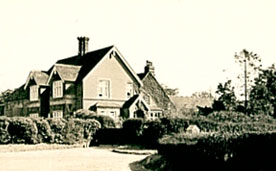
| Pre-1935 | Owned by the Evelyn family and known as Home Farm |
| 1935 | Re-named Manor Farm. EDG Matthews is tenant farmer |
| 1945 | Producing food for the nation during Second World War |
| 1946 | The short horn dairy herd was sold |
| 1960 | Acreage had increased to 550 acres and Edward and Fred Matthews took over the farm from their father |
| 1964 | Fred took control of the business after the retirement of his father and death of his brother and mother |
| 1977 | Friesian dairy herd sold |
| 1978 | Fred’s son Laurence started to work on the farm |
| 1981 | Pigs farming ceased |
| 1989 | Major restructuring of the farm, land increased to 750 acres |
| 1994 | Laurence became a partner |
| 1999 | Poultry farming ceased |
| Present day - | Laurence runs the business on 3,000 acres with nine landlords and 4-8 employees. Arable and beef enterprises, supported by diversification. Paula organises Educational school visits to the farm, created the farm website and other interpretive material, expands the Belted Galloway suckler herd and sells 'Beltie' beef direct from the farm. |
Farm History
Manor Farm, Wotton, was originally called Home Farm when it was supplying milk and other produce for the Evelyn family at Wotton House. When this supply was no longer needed, the farm was re-named and tenanted out with 381
acres in 1935
E.D.G.Matthews and Sons.
Edward Douglas Gerald Matthews and his wife May moved to Manor Farm from Cowden, Kent in 1935 with their two sons Edward and Fred and two members of staff.
Edward and May had a short-horn dairy herd, beef, pigs, poultry and arable business. There were 6-8 staff, with two or three men milking the 30 cows and three employed for carting.
Horses were used to pull the plough and carts and there were two tractors, a Case and a Ford.
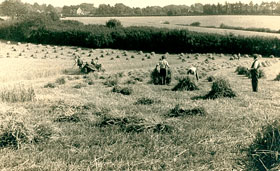
The corn was cut by hand and with a binder and placed in small stooks (stacks of corn) in the field for two or three weeks to dry, after which it was carted to West Lane for threshing. After threshing, the straw was stacked in a rick and was used as required for bedding or feed.
Two and a quarter cwt (hundred weight) sacks were filled with corn (252 lbs), these were lifted by hand onto carts and taken to grain merchants such as Attlees in Dorking.
Crops included oats, wheat, barley and mangolds. The mangolds were fed to the cows and a corn or barley mix was kept on farm also for animal feed.
During the Second World War, Edward Matthews was in the home guard and continued farming. He was soon asked to work for the War Agricultural Committee which was responsible for ensuring that British farms were producing as much food as possible for the people of Britain. At this time 7-8 people worked on the farm including prisoners of war; two Italians, followed by Germans. The prisoners were given a bunk at Manor Farm and meals were prepared for them by May Matthews.
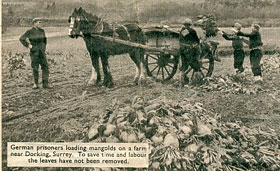 This picture shows German prisoners
Loading mangolds onto a cart at Manor Farm, with the North Downs in the distance.
This picture shows German prisoners
Loading mangolds onto a cart at Manor Farm, with the North Downs in the distance.
In 1946 the shorthorn dairy herd was sold and for a while just a few cows were kept and milked by Edward himself. Gradually over the years Friesian dairy cows were bought and a herd was established at West Lane with the milk sold to the Milk Marketing Board.
The first combine harvester was bought in 1950.
Acreage increased over the years and by 1960 when Edward and Fred took over the farm from their father, it was 550 acres.
In 1964 Fred took control of the business after the retirement of his father and death of his mother and brother Edward.
Fred's son Laurence started working on the farm in 1978, taking time out to attend agricultural college for three years. The family ceased dairy farming in 1977, pigs in 1981 and poultry in 1999.
In 1989 Laurence began a major restructuring of the business, rationalising the farm and updating equipment. The farm increased to 750 acres and the work was undertaken by Fred, Laurence and one employee. Laurence became a partner in 1994.
Since that time the acreage has increased to around 3,000 acres with nine landlords. Laurence now runs the farm with Paula and four full time employees, and an extra three working full time during harvest.
Crops grown in the past include barley, beans, peas. Linseed, triticale and rye.