


 EDUCATIONAL VISITS Manor Farm is fully accredited by the Countryside Educational Visits Accreditation Scheme (CEVAS)
 THE FARM
Contact us for availability.

Latest News
27th June 2021
They say ‘a change is as good as a rest’ and I certainly agree with that sentiment after my refreshing break away from our farm in the south, to attend a training course held at Racy Ghyll in the north east of the Lake District.
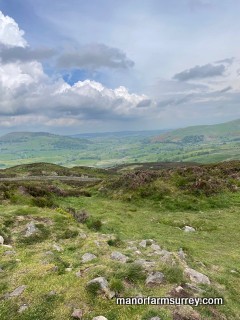
I was fortunate to have a day to myself exploring Gowbarrow Fell with its views over Ullswater and towards Racy Ghyll, which I would see more of in the following days.
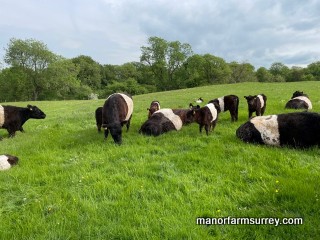
With the home of Barwise Mister M not far away, I also found time to visit his breeder Carolyn Fletcher and it was a pleasure to take a look around the farm and visit the Barwise Belted Galloway herd.
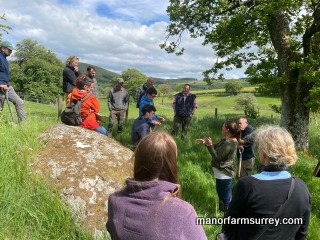
James and his family have farmed in the Lake District for generations and now James and his wife Helen and their children are working together with nature and have made some bold changes to their farming practices at Racy Ghyll over the past four years.
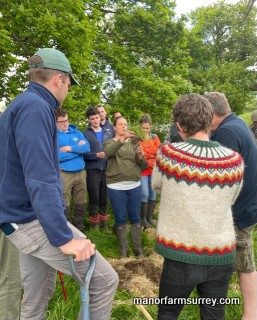
It felt like a very natural and down to earth couple of days looking at nature friendly farming and habitat restoration already underway at Racy Ghyll, the fundamentals of soil health, improved water cycles and grassland management techniques whilst balancing the whole farm context.
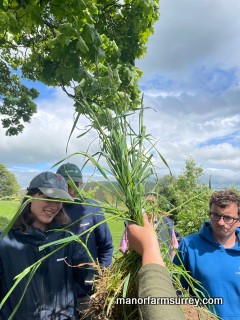
We were a cross section of farmers and land managers from family farms, small holdings and large estates. And from the buzz amongst the group, there was a sense that whilst each farm is different and comes with its own challenges, we’re all trying to improve and learn more about how we can do things better on the land we care for; and what better way than sharing ideas amongst an inspirational group of farmers who are at different stages of regenerative farming.
A common thread during Grazing School was the reminder that we should continue to ask ourselves whether the management changes we make can be balanced socially and economically, so that individual farms are in a resilient position to undertake environmental and regenerative farming techniques as part of the whole farm context. The two day event surpassed my expectations and we could easily have continued talking for another day!
Regular cost analysis has been an important tool for our business in the last forty years, but since Laurence began re-structuring the business in 1989 we’ve also had valuable input from a farming consultant who brings knowledge and experience to the table and provides a sounding board to new ideas or changes in equipment and farming practices.
Our regenerative journey began at least 25 years ago (although it wasn’t called that then!) when we ceased ploughing the land, but this only became possible due to new technology and alternative farming techniques becoming available.
Ploughing used to be the first preparation of the soil for creating a seedbed, a method of turning the soil over to bury weed growth and debris from the previous crop, breaking and loosening the soil, before further cultivation and sowing the next seeds.
New technology enabled us to move over to a minimum tillage system without ploughing and we purchased our first ‘direct drill’ which creates a slot in the soil with minimal disturbance, into which the seeds are placed.
By not ploughing, the theory is that soil biology, structure, organic matter and soil health is gradually improved year on year. Soil disturbance, loss of moisture and potential erosion is significantly reduced and carbon from the soil is not released into the atmosphere.
We’ve now progressed to a ‘zero-till’ system for our combinable crops and have a new Horsch Avatar direct-drill (more on that below, dated 8th November 2020).
These changes to our farming techniques over three decades, bring further benefits to soil health by reducing tractor passes across the fields by three times; thereby reducing soil compaction and the use of fossil fuels.
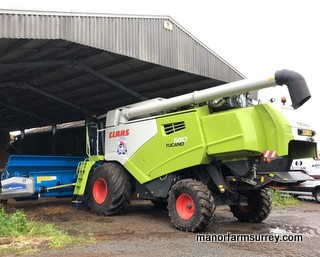
A conventional header or cutter bar on a combine harvester, cuts the stem of the crop quite low to the ground and takes it all into the combine, where mechanisms sort and thresh the grain from the straw. The chopped straw is pushed back out of the harvester into the field where it’s then baled and stacked.
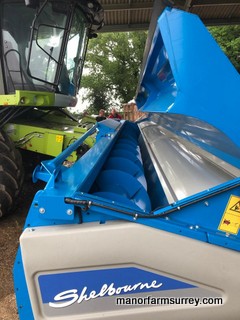
In contrast, a stripper header uses rotating fingers to remove the grain from the top of the plant and leave the stem or straw standing in the field. Because the combine harvester has far less material to process, it will move more quickly through the field and use half the diesel. For these combinable crops we’ll no longer be driving across the fields to bale, stack and cart the straw away, again reducing soil compaction and use of fossil fuel.
The next seeds will be sown by the direct drill into the field with the standing straw and any soil disturbance between these combinable crops will be minimal and should reduce the germination of weeds that might compete with the emerging crop.
With regular evaluation of the business and consideration of new systems or technology, we aim to continue improving soil health whilst growing food and further reducing emissions.
In my opinion ‘one size doesn’t fit all’ in British farming, even though some policies or the latest trends would have you think otherwise. What matters is that British farmers are trying to grow food and care for the environment as best they can within their whole farm context and that they continue to listen, learn, and try to improve what they do.
21st May 2021
Our crop rotations this year include wheat, spring barley, oilseed rape (OSR), fodder beat, maize, and grass.
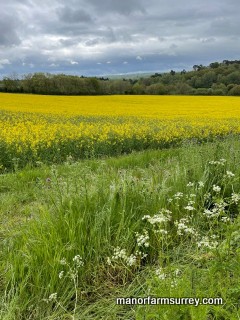
In heavier soils the temperature required for maize to germinate is 10 degrees, over the course of four consecutive days prior to drilling. However, we usually drill maize when the soil temperature reaches 12 degrees and preferably into damp conditions.
However, with April being particularly dry and cold, conditions weren’t ideal and within days of drilling we experienced some persistent, high winds which may yet affect seed establishment.
Okay, so farmers do talk about the weather a fair amount, but with good cause! You can have all the right seed and equipment, but the weather is one variable we cannot alter; it can affect the sowing and establishment of the plant, its growth, quality, yield, and success or otherwise of the harvest.
And now, here we are halfway through May and the average rainfall for this month has already fallen from the sky!
When the rain decides to ease, the tractor can return to the fields and wheat can be direct -drilled into some headlands.
These field margins of wheat need to establish over the coming months and will be left unharvested, so that the standing crop may provide bird food during winter.
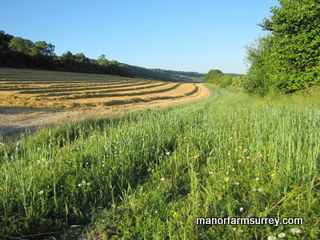
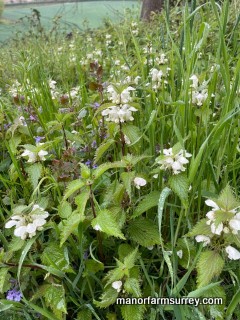
However, we provide field margins especially for wildlife and a lot of time and effort goes into establishing them; to offer a place of safety and peace, shelter and food for small mammals, birds, insects and reptiles. These areas around fields are chosen because they are not public paths and therefore the wildlife should not be disturbed.
This environmental work aims to increase biodiversity in the farmed landscape and we are pleased to have seen an increase in species being recorded and thriving.
We’d be delighted if visitors to the countryside would join our vision so that we might succeed in our endeavours of providing and protecting these quiet areas, hedgerows and fields for wild plants and animals, by remaining on public paths and keeping dogs off these margins and out of the hedgerows; therefore with everyone caring for the environment in this way, bird species like the Yellowhammer will continue to breed here which would be fantastic, but with disturbance in the hedges they will sadly decline. So let's make this a joint effort to support nature and see an increase in biodiversity.
21st April 2021
Something new for me during lockdown has been to attend a ‘filming on your phone workshop’ with Anna Jones and Alex Price of Just Farmers. We had to choose a story and learn how to develop it, recording the master sync, covering shots, sound and editing the film. The workshop was sponsored by the Pasture Fed Livestock Association.
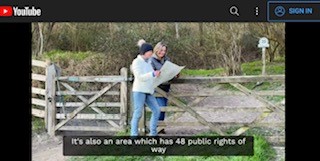
Coincidentally, after the workshop, the Surrey Hills Area of Outstanding Natural Beauty (AONB) asked if I would make a short educational video about the new Countryside Code and therefore this became the topic of my first movie.
Did you know that the first Countryside Code booklet was published in 1951 and that this year sees a re-launch to help people enjoy the countryside safely and respectfully?

In this 70th Anniversary year, with even more people spending time outdoors, the new version of the Countryside Code has been refreshed and includes advice to create a welcoming environment for everyone.
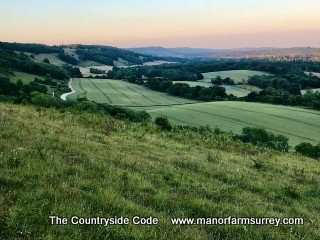
My little movie may not be a slick masterpiece, but it is a heartfelt summary of just a few of the things we can do to plan ahead and enjoy the countryside, being considerate, friendly and mindful of other visitors, the local community and those working in the countryside; caring for the environment and making space for nature, whilst growing food for us all to eat.
The film making and editing was certainly a new learning curve which I topped up with some extra research and practice, to produce this movie from Manor Farm, which I hope you will find interesting! https://www.youtube.com/watch?v=zg3RhUWos4M
It’s been a year since the first Covid-19 ‘lockdown’ began.
There was never any question in our minds about facing the unknown challenges ahead. We rallied together and continued farming throughout the year as did farmers across the UK. Crops still needed to be sown and harvested and our cattle cared for, so that British food continued to be available in our shops.
We’ve also been swept into the meteoric rise of on-farm Zoom calls and webinars; everything from cattle handling seminars to rewilding and have even purchased a few cattle via video link.
We're grateful to have reasonable broadband, but there are many rural locations and farm businesses that still don't have adequate broadband connection to fascilitate on-line meetings or much needed connections with other people, in what can already be a very isolating life, even before the pandemic.
We enjoy hosting visits to Manor Farm for schools, Colleges and Universities and hope that by doing so, we can share what we do here and why we are farming this land.
Therefore, today we were delighted to welcome via Zoom, the Bartlett School of Planning, University College London (UCL).
Topics for the talk and discussion were centred on farming in an Area of Outstanding Natural Beauty (AONB); making a living in farming, how and why Manor Farm has diversified, the planning system, the Environmental Land Management Scheme and what the future might bring!
Despite the pandemic preventing UCL from visiting us in-person today, it was great to have this opportunity to talk in some detail about farming in the Surrey Hills AONB and maybe next time we’ll be greeting the Undergraduates out in the fields!
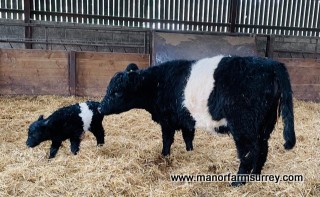
This afternoon was one of my favourite jobs, moving the cows and new-born calves from the calving barns, back out to the fields.
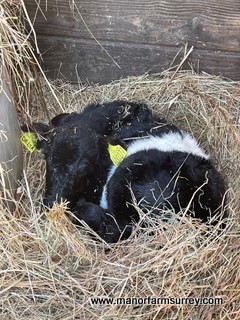
Bringing 16th March 2021 to a close, we have eleven more Belted Galloways to calve!
18th February 2021
I’m sorry to say, the Manor Farm website went off air for a while in January and when it returned, it did so without my January news page…which was somewhat frustrating to say the least! Computers -hey!
So here is a quick recap.
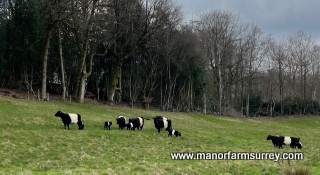
As the weather and fields became increasingly wet, some of the Belted Galloways were moved to new ground.
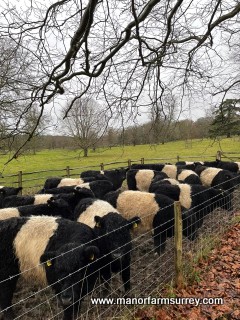
The heifers or young females that have not calved, remain at Netley, and will run with the bull for the first time in May.
The males or steers have moved to an open barn for a few weeks until the ground recovers and fresh grass begins to grow along the valley. They have a fresh bed of straw and feed on hay (dried grass and herbs) which was grown in our local pastures last summer.
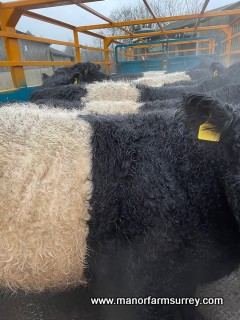
Our main group of cows and heifers were brought in from the fields ready for spring calving. They will calve indoors as they have for the past few years to provide increased biosecurity. We also have calving cameras which help us to keep an eye on what’s happening in the barns, even if we are elsewhere on the farm.
I bought some new cattle in the autumn with five heifers from Cumbria and two from Scotland; one of whom had a bull calf at foot.
Three of the ‘Appleby Five’ as I call them, were already in-calf when they arrived on the farm and as December was miserable, we gave them an entire barn for calving and they were shielded from the weather. Three good calves were born without any help required.
As the remaining two Appleby heifers had been turned out into the field with our bull, Mister M, it was noted that Nectar looked quite rotund, but as she wasn’t due to calve, we put this down to her enjoying hay a little too much!
And yet, she still surprised us with a heifer calf, born just before the recent cold weather.
Trixie is a lovely bonus to our herd, and she’s thriving on her mother’s milk.
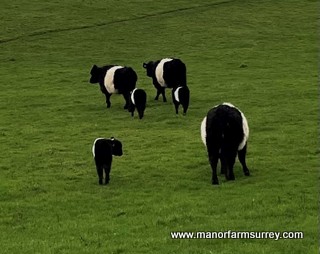
The small group of autumn and winter calves live outdoors with their dams.
There’s much work to be done on the farm and never enough days in the week, so it feels as though we’re always on the go and trying to catch-up.
Whilst we’ve continued to work throughout the past year and through each of the ‘lockdowns’, everything takes longer with Covid precautions in place, when tractors or trucks aren’t being shared or training courses cannot be held indoors.
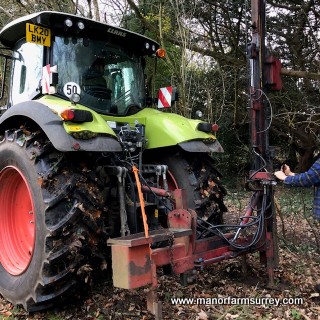
We’ve been fortunate to have one of our sons’ home during the pandemic and he’s been a great help repairing fences in readiness for spring and summer grazing.
There’s also much discussion and debate in relation to these terms and even a variation in people’s minds as to their definition or perceived level of importance to food production, landscape, heritage, environment and the rural economy.
I don’t think one-size fits all, nor that every farm must necessarily follow one specific or rigid route or be defined purely by one label or description. I believe that farmers can and do utilise a variety of techniques and elements which may be drawn upon and combine to create a sustainable and regenerative blend of food production whilst increasing ecosystems.
We are a mixed livestock and arable farm, growing rotational crops and grazing natural pastures, whilst integrating environmental work across the farm: pond restoration, hedge-laying and sowing pollen and nectar species within our field rotations.
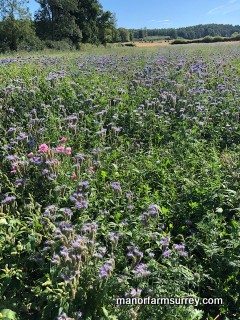
I think wildlife corridors between copses, ponds, fields and alongside hedges and ditches are a key element within a farmed landscape, providing areas in which birds, mammals, insects and even rare arable plants may shelter, feed and flourish.
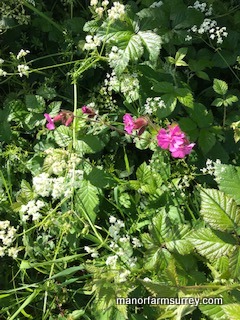
To support this biodiversity, wildlife and ecology we provide approximately 75km (46.6 miles) or the equivalent of 45ha (111 acres) of field margins planted for flora and fauna or winter bird feed, plus hedgerows in the region of 35km.
We endeavour to safeguard these parts of the farm especially for nature and therefore appreciate all the visitors to the Surrey Hills, who utilise the hundreds of miles of public paths and are kind enough to leave these eco-margins as a safe and quiet place for nature.
Our Belted Galloways undertake conservation grazing on a Site of Special Scientific Interest; they eat natural vegetation such as grass, herbs and shrubs throughout their life and have received the Pasture for Life (PFLA) certification mark.
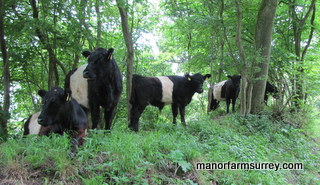
They graze on natural pastures and within woodland areas or on home grown forage such as hay in winter, and are otherwise known as 100% grass fed.
The cattle are a native and hardy breed which are ideal for this bespoke ‘habitat management’ which helps to restore or regenerate this rare chalk downland and its unique flora and fauna on behalf of Natural England, the National Trust and wider community.
Reducing tillage, diverse crop rotation and organic fertilisers combine to replenish soils. Over the past 30 years we’ve applied organic fertilisers to our cropping soils as well as farmyard manures that have been spread on the fields for generations.
We haven’t ploughed the land for about 25 years and have since used a minimum cultivation system which has reduced soil disturbance, compaction and erosion. We have recently purchased our second direct drill, which will sow the seeds of the next crop, directly into the soil of the stubbles of the previously harvested crop or into a cover crop. A zero tillage system.
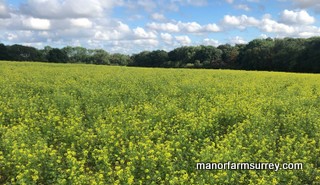
This cover crop mix includes mustard and wheat.
A cover crop between two cash-crops keeps the soil covered, protecting the soil from the elements, prevents erosion and soil disturbance and ensures growing roots within the soil, increasing soil ecosystems whilst providing food, nectar, pollen and shelter for wildlife above and below ground.
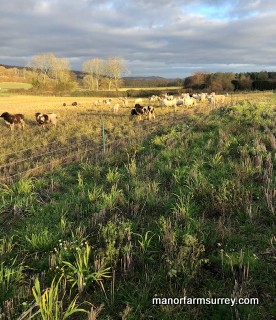
Integrating ruminants into arable field rotations further improves soil nutrients and biodiversity. As the livestock feed on the regrowth of the previous crop or leafy tops and fodder within the field, they manure the soil and gently incorporate some of the vegetation beneath their feet.
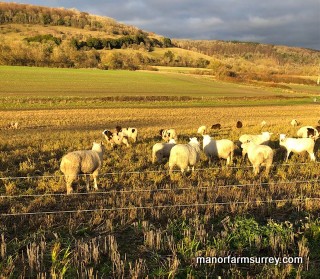
Whilst this is just one farm, I hope this demonstrates that whatever the terminology used, there are farmers up and down the country who’ve been incorporating a whole variety of positive farming and environmental techniques for decades, they continue to adapt and acknowledge that there’s scope to do more.
Farms may or may not fit within one category, farming system or the latest trend and nor should this be the main driver; one size does not fit all.
I see great potential for farms which draw upon a broader spectrum and within a framework of support for one another, taking pride in those elements of improved soils, ecosystems and healthy food production.
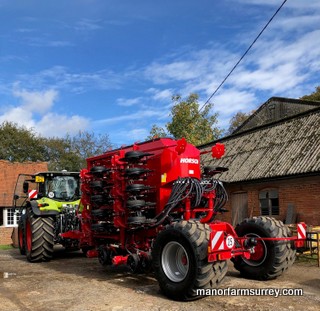
Our reduction in soil tillage and therefore reduction of soil disturbance or movement, began about 25 years ago when we stopped using a plough to turn the soil on the farm’s arable land. At that time, we invested in a Simba Freeflow drill followed by an Amazone Primera drill both of which required minimum or no tillage before planting the crops.
Terminology such as conservation tillage, no-till and zero-till generally describe seeding systems which cause the least amount of soil disturbance and retain the most soil coverage from previous crop residues.
In order to reduce soil disturbance still further across the farm we took delivery of a Horsch Avatar direct-drill last month.
The drill has single discs which create a narrow soil opening or slit, causing minimal soil disturbance and planting seeds directly into stubble; these hydraulically adjustable coulters provide consistent seed depth and a closing wheel which gently closes the slit in which the seed has been placed.
Seed placement is more precise which should improve crop emergence when other elements such as moisture are correct when drilling.
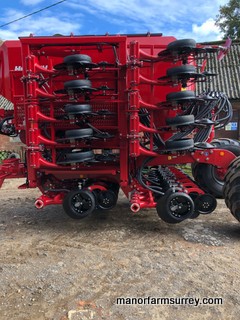
The Horsch Avatar will reduce soil disturbance, eliminate erosion and help the soil retain water, rainfall and higher levels of nutrients, reducing the use of other machinery, soil compaction and fuel and reduce the use of fossil fuels.
Zero tillage drilling with the stubble retained after the previous harvest, helps to improve soil by increasing biological activity, soil structure and fertility and with less traffic and compaction of the soil, less labour, machinery and fuel per hectare the sustainability of the farm will improve further.
The purchase of the zero tillage direct drill has been grant aided by Rural Surrey LEADER and The European Agricultural Fund for Rural Development: Europe investing in rural areas.
4th October 2020
I am pleased to announce that Manor Farm Belted Galloway Beef has become ‘Pasture for Life’ certified.
The Pasture-Fed Livestock Association brings together British farmers committed to producing high quality food in a more natural way.
More meat and dairy products are being promoted as grass-fed. However, until now the term has not been clearly defined and can be applied to virtually any farming system where grass forms just part of the animal’s diet. Therefore, the Pasture-fed Livestock Association is pushing hard to establish a legal definition of grass-fed to mean 100% grass-fed for the entirety of the animal’s life.
Healthier benefits of Pasture fed beef
· lower total fat levels
· higher levels of omega-3 fatty acids and a lower, more balanced, healthier ratio of omega-6 to omega-3
· higher vitamin and mineral levels than meat from grain-fed animals. Particularly rich in vitamins A and E, and minerals such as calcium and magnesium
· higher levels of conjugated linoleic acid (CLA) which supports heart-health
The Wotton herd of Belted Galloway cattle are naturally reared on pasture in the Surrey Hills Area of Outstanding Natural Beauty (AONB).
This native breed suckler herd comprises of cows, heifers and a bull. The calves are born and bred on the farm and remain at their mother’s side for nine months feeding on their nutrient rich milk, as well as beginning to graze alongside the herd.
The Belted Galloways graze on herb-rich pasture and downland throughout their life and therefore grow at their own steady pace whilst undertaking important conservation grazing; they are not rushed with grains and soya in the way other more commercial breeds might be.
It can be said that our pasture raised beef has its own unique ’terroir’, with our ‘Beltie’ beef full of flavour that reflects the qualities of the herbs and plants they eat and the soil beneath their feet.
The Certification Standards ensure that animals must be able to eat a natural diet, to graze pastures when the grass is growing and can be given conserved pasture in the form of hay and haylage, with just a few other agreed forms of forage such as home produced beet. Belted Galloways are a sturdy breed, used to out wintering in the Highlands and converting what would be classed as ‘poorer’ grassland into well marbled beef, so they are well suited to the conservation grazing they undertake on the North Downs helping to maintain that rare habitat with its unique flora and fauna.
The Belted Galloways turn grass and pastures that we cannot eat, into well flavoured dry-aged beef that we can eat.
19th August 2020
Our arable harvest 2020 drew to completion on 13th August, more swiftly than most years due to the reduced acreage sown last Autumn and the very dry weather we’ve experienced until just a couple of days ago. One advantage has been not requiring the grain drier this year; with the associated time and costs involved.
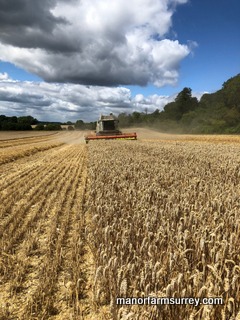
Harvesting Elicit wheat on Whitedown
To re-cap, at the end of harvest last year, two thirds of the arable land was sown with oilseed rape and wheat, however the remaining third was not sown due to the deluge of rain which began on 23rd September and barely let-up throughout winter. It wasn’t possible to access the fields and would have caused too much soil damage to even attempt it.
When the ground began to dry up this spring, it was just possible to drill 110 acres with spring barley and the remaining fields were left fallow.
We began this year’s harvest with 170 acres of oilseed rape which had an average yield, moving onto approximately 500 acres winter wheat and then the spring barley.
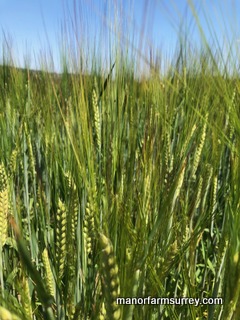
Spring barley during June
There were three varieties of milling wheat; Zyatt, Elicit and Firefly. The yields were down by as much as 50% on the lighter land and at best were an average yield. The cost of growing some of this crop was greater than the price received for the grain.
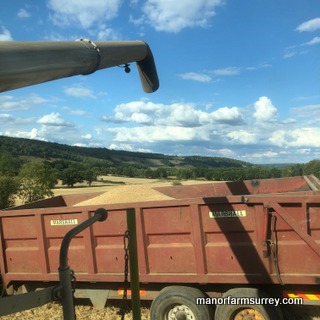
The combine harvester’s unloading pipe augers the grain into the trailer
It’s been about 20 years since we last grew spring barley and it has done quite well on the chalky, heavier soil; yielding 3 tonne an acre, some of which has been sold forward.
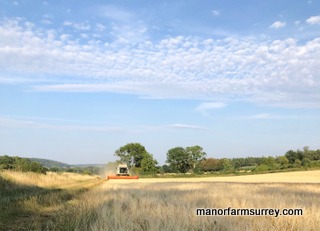
Despite the barley stems being a little green, it harvested without difficulty and the straw soon dried out in the blazing sunshine ready for baling. The grain was perfectly dry and was safely in the grain store before the rain arrived.
There were a few minor break-downs as would be expected during harvest when machinery and staff are working from 8am until 2am.
Due to the reduced acreage being harvested, plus the lower yields, this has resulted in half the number of straw bales produced.
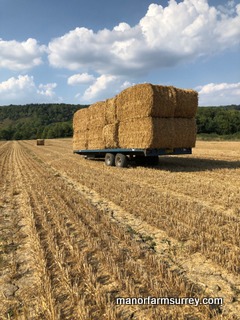
A proportion of the bales are sold off-farm and the remainder are utilised for bedding-up the Friesian x cattle overwinter or for Belted Galloway calving.
Another cash crop we grow is fodder beet, which is sown in March and harvested mainly between November and the following March, however it lasts well in the ground and we have continued to harvest this crop through the summer, as when we have an order.
We’ve had predominantly drought conditions since March with little or no grass available on many farms, therefore the fodder has been much in demand. With plenty to go around, we’ve also been supplying an Anaerobic digestion system in Surrey which takes food waste from restaurants in Surrey and London and recovers energy in the form of biogas, electricity and digestate. With restaurants closed during the Covid-19 pandemic and now only working to a lower capacity, the fodder beet has provided a consistent feedstock to keep the anaerobic digester functioning.
The digestate is an organic fertiliser which is returned to many farms around Surrey where it improves soil quality, aids water retention and avoids the use of artificial fertilisers.
16th July 2020
During the Covid-19 lockdown we’ve continued farming; with staff and family ensuring that all necessary livestock and field work has been carried out and the ever-present paperwork undertaken, including registration of calves born and cattle movements logged off the farm. Whatever the Covid19 daily briefings on the radio or television, we had a job to do and it was as if the news was eventually catching up with reality, especially when we heard that yes indeed; food production and farming is essential work!
The food that we grow, needs care and attention whatever is happening around the World and we all need to eat.
I found the first three months were rather blur, not knowing which day of the week it was and not really noticing Easter come or go. The roads were quieter at that time and we had key-worker licences to carry and display, just in case we were stopped.
We maintained physical distancing for team meetings and no one other than staff was permitted to enter any of the farmyards for deliveries or collection without prior notification. Any essential meetings with people outside our household; moved on-line.
Our Covid19 protocol became the norm; self-awareness, hand washing, disinfecting tractor cabs, opening gates with an elbow where possible or wearing gloves. Each vehicle having one dedicated driver and the only passenger allowed to share a truck has been from our own household. As the months have passed, it feels as though we’ve done what we can to safeguard our families and each other and from the beginning; we created our own working bubble before it became guidance or an instruction from the government.
Calving was completed on the day I last wrote! Wotton Elsa was born to Wotton Ellen and sired by Barwise Mister M.
The Belted Galloway cows and calves were moved to fields without footpaths, with plenty of space for grazing and natural shelter alongside hedgerows and under trees. They have experienced mixed weather and have needed to shelter from both rain and sunshine at times.
Whilst we can ensure the young calves are in a field without a path, unfortunately it’s common to see dogs from an adjacent footpath, being allowed to run through the fence-line and into the livestock fields, sometimes back and forth as if it were a game.
We realise that not everyone will understand how significant even a one-off deviation from the public path could be. For example, if a dog ‘simply’ runs into a field to have a poop, the owner cannot reach into the field to clear up after the dog, even if they wanted to.
Doggy deviations have caused issues of livestock worrying in the past with sheep being maimed and killed and cattle being chased and bitten by dogs.
Also there have been a number of cows contracting Caninum Neospora from dog faeces which is picked up by the cattle as they graze, resulting in some cows aborting their calf: often at about 7 months gestation or as a still birth, both of which are quite distressing for the cow and for us. However, that isn’t the end of the issue, because the cow is now a carrier and therefore should be removed from the breeding herd if the farmer is aware of the situation. However, if the cow did manage to successfully carry her calf full term and it was a heifer calf, the disease would be transmitted vertically to the heifer, who would join the breeding group a couple of years later, carrying the disease herself, unbeknown to the farmer. The disease can remain masked within a herd until miscarriages or still births occur.
There is no cure and no prevention other than dog owners keeping their pets under close control in the countryside and poop-scooping after their dog in all fields, as these areas of grassland are where our food is produced.
We have two pedigree bulls to ensure that neither of them serves their own daughters. Our small herd of native breed cattle is divided between the two bulls, Ethelred and Mister M.
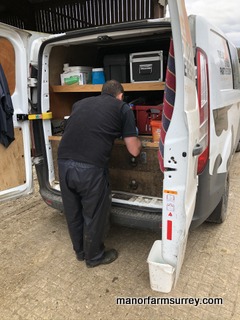
We had the bulls ready in the cattle crush for when the vet arrived and then maintained a safe distance (the length of a cow) between us throughout his visit.
Until now, Ethelred had passed every test and produced some wonderful calves over the past eight years. But the winter seemed to age Ethelred, he wasn’t holding his condition quite so well and finally he failed his fertility test. So, it was a very sad day that Ethelred left the farm for the last time in April.
The bulls are tested approximately six weeks before they’re due to serve the cows and heifers, in order to ensure that they are fit and fertile for working. However, if they’re found to be infertile it usually provides enough time to buy a replacement bull.
Due to Covid19 restrictions, a number of Belted Galloway sales were cancelled across the UK and farmers took to social media to advertise their livestock. Agriculture and food production are classed as Key Work and the life cycle of stock must continue, therefore some farmers managed to visit farms to view livestock if there was plenty of choice in their part of the country, whilst others relied on viewing stock via on-line video links.
I made a few inquiries and saw some fine looking bulls on-line, but they were either a little older than we required or were being viewed by more local people and snapped up quickly.
However, after weighing the options, I decided to keep Mister M for some of the girls and hire Hamish, our neighbour’s Belted Galloway bull to serve Mister M’s daughters. We haven’t hired a bull for many years due to a previous hire bull which had a fertility problem.
Therefore, just to be on the safe-side, I booked a fertility test and health check for Hamish and once he had the all clear, he joined the other girls here on the farm.
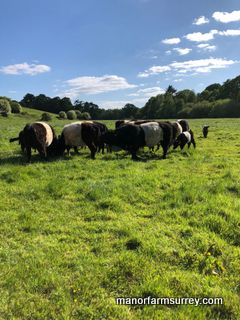
Here is Mister M arriving at the Cressbeds in mid-May.
After spending the past nine weeks working, Mister M and Hamish were removed from their bulling groups today.
Mister M has returned to fields in Abinger where he will spend summer grazing with four in-calf cows and Hamish has taken the short trailer-ride back to his home farm.
Fodder beet lifting and sales off farm have continued through spring and early summer. This may be later than most farmers are lifting, but we still had some crop in the ground and farmers are finding it a useful supplementary feed for their livestock, particularly where the grass is drought stricken.
Miles of fence repairs have been undertaken during lockdown; it’s one of those jobs where there’s always more to do. But with a concerted effort from various team members and lockdown family joining in (maybe even some father and son bonding?!) over many weeks, much has been achieved.
Tomorrow at 5am Laurence will drive the combine harvester over to Shalford before the roads get busy. He'll begin our combinable crops harvest of 2020 by harvesting 200 acres of oilseed rape during the next couple of days.