


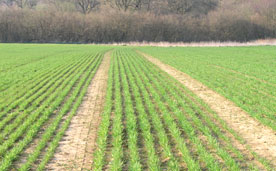
| CROPS | ACRES | SOLD FOR | HARVEST |
| Oil seed rape | 250 | Vegetable oil | July & August |
| Winter Wheat | 775 | Milling wheat 2/3 for bread flour, 1/3 for biscuit flour | August |
| Maize | 300 | Maize silage cattle feed. approx 2/3 sold as cash crop |
September October |
| Fodder beat | 125 | Livestock fodder |
late autumn onwards |
| Spring wheat | 40 | ||
Arable
The average field size is 17 acres. The fields are divided by hedgerows and copses and there are 6m margins around the fields which are cultivated or managed for flora and fauna.
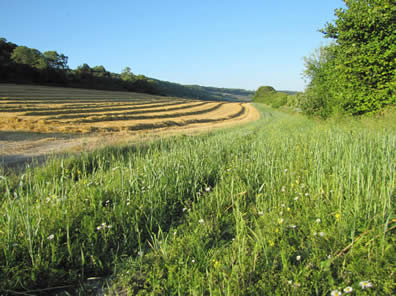
These amount to over 75km (46.6 miles) or the equivalent of about 45ha or 111 acres of field margins such as those sown with cereals that are unfertilised and left unharvested specifically for wildlife and as winter bird feed, others that are cultivated to encourage the rare arable weeds that have been found during plant surveys on the farm.
The soil type is predominantly sand, with chalk and clay fields adjacent to the North Downs.
The crops that are grown, vary from year to year according to the soil type, crop rotations, demand for certain foods and price. There are numerous varieties of one crop and these have different characteristics and uses and may be sown in winter or spring.
Crops grown in the past include barley, beans, peas, linseed, triticale and rye.
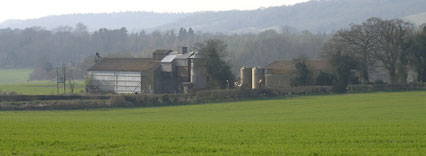
Crops currently grown include wheat, oilseed rape, fodder beat and maize. These are sold to grain merchants for a number of uses; the oilseed rape is crushed to produce vegetable oil for cooking with a bi-product of rape meal which is sold for animal feed and the winter wheat is grown to produce flour with specific properties suited to bread or biscuit making.
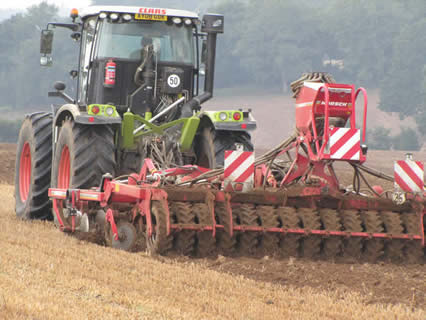
The photo aboves shows a Claas Xerion tractor which has a 380 horsepower engine and is capable of drawing multiple pieces of kit at one time; such as a cultivator and then a press if required. This can reduce the number of passes required across the field.
The Horsch cultivator prepares the ground before drilling.
Although there are still two ploughs on the farm, those have not been used for many years; instead we undertake minimum tillage of the soil.
Whilst 380 hp is not the equivalent of 380 horses; our current machinery can work approximately 100 acres per day compared with Laurence's grandfather, Edward Matthews working one acre per day in 1935 with two horses and a plough.
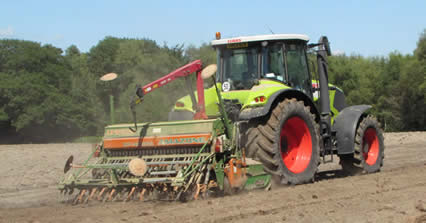 The Horsch drill is 6m wide and can hold 3 tonnes of seed and can drill 100 acres per day. We call the sowing of seed 'drilling'.
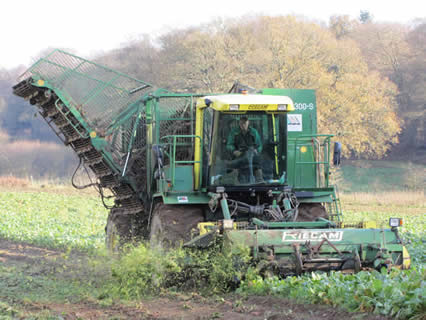
Fodder beet is harvested or 'lifted' from late autumn through to spring or summer and can be left in the soil until required. Combinable crops such as wheat and barley are harvested during summer, maize is silaged in September/October or alternatively in November we harvest maize with the combine harvester and that is sold off farm, to grain merchants for animal feeds.
Wheat and oilseed rape are also grown as non food crops, the wheat
for ethanol production and the oilseed rape for biodiesel. By 2010 it became mandatory to have 5% ethanol in petrol and 5% biodiesel mixed with diesel. By September 2021 petrol with 10% ethanol will become available at service stations.
Oilseed rape has been grown commercially in Europe since the 13th Century when it was primarily used as a fuel for lanterns.
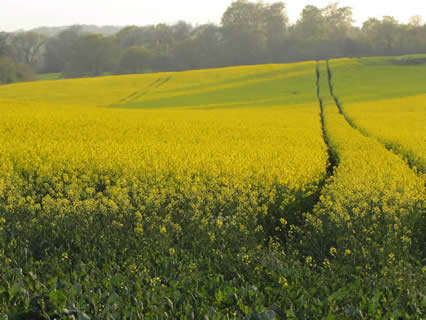
Every year is different due to rotations and any new crop varieties on the market, however the choice of crops that can be grown on these lower grade soils is fairly limited.
The farm used to be in a Nitrogen Vulnerable Zone (NVZ) which meant there was a restriction on the amount of organic and manufactured nitrogen which can be applied to the soil. The restrictions were put in place to reduce the amount of nitrogen passing through to ground water reserves.
However with the targeted use of arteficial fertiliser we have reduced the levels of nitrogen, to below the threshold set by the Environment Agency (EA). With reference to accurate measurements and recording of data by the Environment Agency, we were able to challenge the EA and have the classification withdrawn by them.
Therefore the farm is no longer in an NVZ in the Mole Valley, Pippbrook and Tillingbourne catchment areas for both ground and surface water and we continue to maintain these reduced levels.
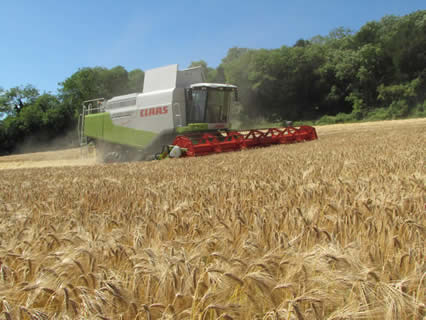 When the combine harvester is moved between fields, the 7.6 m header or cutting bar is removed and placed on a trailer which is towed to the next field.
The grain is emptied into a trailer by the loading arm of the combine harvester and when the trailer is full it is taken to the grain store for drying if necessary during wet summers, for cleaning and storeage.
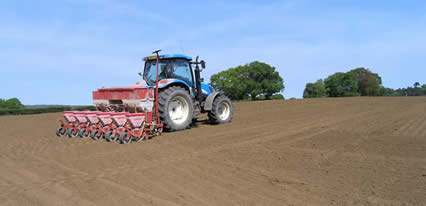
Maize is drilled (sown) in April or May with a specialised maize drill and the soil ideally needs to be 12 degrees centigrade for it to germinate, therefore drilling won't begin until the conditions are good.
Maize is silaged in September or October, however this is subject to the crop having enough sunshine over the summer.
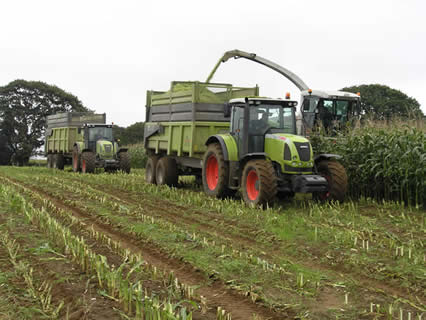
When maize is harvested for silage, the entire crop is cut into small pieces which are fed into a trailer that moves alongside the forage harvester.
Silage making happens within the space of a few weeks; the trailers travel to silage clamps at different locations on the farm.
Silage undergoes anaerobic fermentation, the extraction of energy from carbohydrates in the absence of oxygen.
The chopped maize is placed in an area called a clamp where it is compressed by the wheels of a tele-handler to expel oxygen before covering with plastic sheeting. The sheeting is held in place to ensure the silage remains in anaerobic conditions until it is required as winter fodder.
The crops grown from year to year can vary. One of the previous crops grown here was hemp. We grew hemp for GOOD Oil; a natural and pure culinary oil of cold pressed hemp seed which is sold in leading supermarkets and health shops. The seed was taken from our farm to be turned into oil in Devon whilst the straw was taken away to be utilised as an eco-friendly building material and the fibre as insulation in the doors of BMW cars. The dust was cleaned from the seed and supplied to worm farms!
It’s a very versatile crop with a very long growing history.
Fertilisers are used to feed the crops; arteficial fertilisers which are made using fossil fuels, organic sludges, recycled fertilisers such as paper and the digestate from anaerobic digestion systems.