


 EDUCATIONAL VISITS Manor Farm is fully accredited by the Countryside Educational Visits Accreditation Scheme (CEVAS)
 THE FARM
Contact us for availability.

Archived News
22nd May 2008
After digging a 400m trench, laying a water line, back-filling and having the water connected, we were ready to move cattle to a field full of lush grass at Upfolds. Expecting a gush of water to fill the trough, Laurence was surprised last night to find a tiny trickle and apparently no water pressure. After trying to resolve the problem on site for the last 3 hours, Laurence is now telephoning the water board to ask them to investigate. Without the water we cannot move the cattle which then causes a back-log with other livestock movements on the farm.
From one phone call to the next, Laurence has now been phoned by Colin who is a sales rep for an agricultural supply company. Colin visits the farm at Shalford and Silent Pool every week to check the crops at each site and see what progress they are making.
In the course of one phone call Laurence has just spent £12,000 on 35 tonnes of Double Top which has the sulpher and nitrogen levels required by oil seed rape and £34,800 for 100 tonnes of KNS a compound of potash, nitrogen and sulpher, ordered now ready for 2009. This was a fairly short but never the less, very expensive conversation!
I think there's a misconception that farmers apply fertilisers and chemicals willy-nilly, but I can assure you that we take very seriously our use of these products and only do so when necessary for the health and growth of the crops. This was just one of many costs that are budgeted for each year.
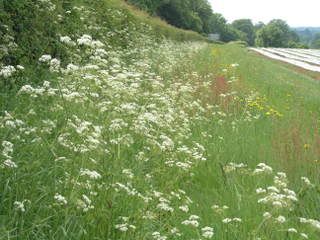
We encourage wildlife along hedgerows and in the 6m margins around the fields and these areas will not have any chemical or fertilisers applied. There are many beautiful plants along banks and verges, even alogside the main roads at this time of year providing nectar for numerous species of insect. Today this field headland had clouds of butterflies flitting about in the warm sunshine.
Dick, Amanda and Simon (who is helping out occasionally) are at Albury vaccinating cattle, with the remaining calves and sheep to vaccinate before the weekend. It has taken two weeks to vaccinate about 1200 cattle against Bluetongue Virus 8. we will have a break from this work for a week and then start the whole process again, vaccinating each group in the same order so that the second dose is given three weeks after the first.
Back