


 EDUCATIONAL VISITS Manor Farm is fully accredited by the Countryside Educational Visits Accreditation Scheme (CEVAS)
 THE FARM
Contact us for availability.

Archived News
16th July 2020
During the Covid-19 lockdown we’ve continued farming; with staff and family ensuring that all necessary livestock and field work has been carried out and the ever-present paperwork undertaken, including registration of calves born and cattle movements logged off the farm. Whatever the Covid19 daily briefings on the radio or television, we had a job to do and it was as if the news was eventually catching up with reality, especially when we heard that yes indeed; food production and farming is essential work!
The food that we grow, needs care and attention whatever is happening around the World and we all need to eat.
I found the first three months were rather blur, not knowing which day of the week it was and not really noticing Easter come or go. The roads were quieter at that time and we had key-worker licences to carry and display, just in case we were stopped.
We maintained physical distancing for team meetings and no one other than staff was permitted to enter any of the farmyards for deliveries or collection without prior notification. Any essential meetings with people outside our household; moved on-line.
Our Covid19 protocol became the norm; self-awareness, hand washing, disinfecting tractor cabs, opening gates with an elbow where possible or wearing gloves. Each vehicle having one dedicated driver and the only passenger allowed to share a truck has been from our own household. As the months have passed, it feels as though we’ve done what we can to safeguard our families and each other and from the beginning; we created our own working bubble before it became guidance or an instruction from the government.
Calving was completed on the day I last wrote! Wotton Elsa was born to Wotton Ellen and sired by Barwise Mister M.
The Belted Galloway cows and calves were moved to fields without footpaths, with plenty of space for grazing and natural shelter alongside hedgerows and under trees. They have experienced mixed weather and have needed to shelter from both rain and sunshine at times.
Whilst we can ensure the young calves are in a field without a path, unfortunately it’s common to see dogs from an adjacent footpath, being allowed to run through the fence-line and into the livestock fields, sometimes back and forth as if it were a game.
We realise that not everyone will understand how significant even a one-off deviation from the public path could be. For example, if a dog ‘simply’ runs into a field to have a poop, the owner cannot reach into the field to clear up after the dog, even if they wanted to.
Doggy deviations have caused issues of livestock worrying in the past with sheep being maimed and killed and cattle being chased and bitten by dogs.
Also there have been a number of cows contracting Caninum Neospora from dog faeces which is picked up by the cattle as they graze, resulting in some cows aborting their calf: often at about 7 months gestation or as a still birth, both of which are quite distressing for the cow and for us. However, that isn’t the end of the issue, because the cow is now a carrier and therefore should be removed from the breeding herd if the farmer is aware of the situation. However, if the cow did manage to successfully carry her calf full term and it was a heifer calf, the disease would be transmitted vertically to the heifer, who would join the breeding group a couple of years later, carrying the disease herself, unbeknown to the farmer. The disease can remain masked within a herd until miscarriages or still births occur.
There is no cure and no prevention other than dog owners keeping their pets under close control in the countryside and poop-scooping after their dog in all fields, as these areas of grassland are where our food is produced.
We have two pedigree bulls to ensure that neither of them serves their own daughters. Our small herd of native breed cattle is divided between the two bulls, Ethelred and Mister M.
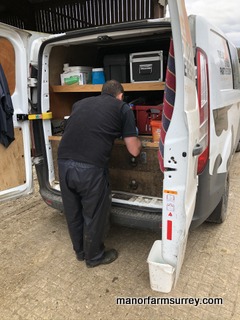
We had the bulls ready in the cattle crush for when the vet arrived and then maintained a safe distance (the length of a cow) between us throughout his visit.
Until now, Ethelred had passed every test and produced some wonderful calves over the past eight years. But the winter seemed to age Ethelred, he wasn’t holding his condition quite so well and finally he failed his fertility test. So, it was a very sad day that Ethelred left the farm for the last time in April.
The bulls are tested approximately six weeks before they’re due to serve the cows and heifers, in order to ensure that they are fit and fertile for working. However, if they’re found to be infertile it usually provides enough time to buy a replacement bull.
Due to Covid19 restrictions, a number of Belted Galloway sales were cancelled across the UK and farmers took to social media to advertise their livestock. Agriculture and food production are classed as Key Work and the life cycle of stock must continue, therefore some farmers managed to visit farms to view livestock if there was plenty of choice in their part of the country, whilst others relied on viewing stock via on-line video links.
I made a few inquiries and saw some fine looking bulls on-line, but they were either a little older than we required or were being viewed by more local people and snapped up quickly.
However, after weighing the options, I decided to keep Mister M for some of the girls and hire Hamish, our neighbour’s Belted Galloway bull to serve Mister M’s daughters. We haven’t hired a bull for many years due to a previous hire bull which had a fertility problem.
Therefore, just to be on the safe-side, I booked a fertility test and health check for Hamish and once he had the all clear, he joined the other girls here on the farm.
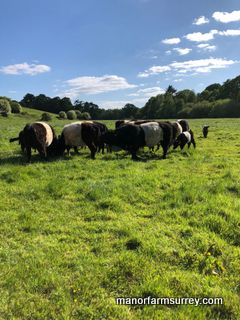
Here is Mister M arriving at the Cressbeds in mid-May.
After spending the past nine weeks working, Mister M and Hamish were removed from their bulling groups today.
Mister M has returned to fields in Abinger where he will spend summer grazing with four in-calf cows and Hamish has taken the short trailer-ride back to his home farm.
Fodder beet lifting and sales off farm have continued through spring and early summer. This may be later than most farmers are lifting, but we still had some crop in the ground and farmers are finding it a useful supplementary feed for their livestock, particularly where the grass is drought stricken.
Miles of fence repairs have been undertaken during lockdown; it’s one of those jobs where there’s always more to do. But with a concerted effort from various team members and lockdown family joining in (maybe even some father and son bonding?!) over many weeks, much has been achieved.
Tomorrow at 5am Laurence will drive the combine harvester over to Shalford before the roads get busy. He'll begin our combinable crops harvest of 2020 by harvesting 200 acres of oilseed rape during the next couple of days.
Back