


 EDUCATIONAL VISITS Manor Farm is fully accredited by the Countryside Educational Visits Accreditation Scheme (CEVAS)
 THE FARM
Contact us for availability.
Archived News
5th April 2020
When I established this website in 2007, I would update this news page at least once a month with latest happenings on the farm. Now I am busier than ever with the Belted Galloways and selling ‘Beltie’ beef, getting involved in the promotion of British farming and local produce via social media as well as a few diversification projects which have filled any spare time we may have had.
Somehow, we seem to be busier than ever, so I was determined this year to spend more time with family and to plan some new adventures that I might undertake before I get too old!!
But as ever, life has taken its own pre-determined course. And here we are in April 2020 amidst the COVID-19 pandemic, with all but essential workers in the UK advised to stay at home and stay safe; to help to ‘flatten the curve’ of the spread of this virus.
I posted a video on Twitter recently; a ‘thank you’ to all front line NHS staff, care workers and emergency services and a little about how farmers are continuing their essential work caring for animals and crops, to produce safe, nutritious and sustainable British food for us all to eat #FoodArmy #FeedTheNation
The food chain is having to adapt very quickly; whereby food was previously being grown for restaurants, schools, Universities, museums etc and supplied in large quantities; these are no longer required. However, with families staying at home, much more food will now be home-cooked and everything from flour to meat or eggs, which would have been packaged in large quantities for thousands of food outlets, is now having to be redirected and packaged in smaller quantities to be sold in supermarkets. There’s some fantastic, creative work going on behind the scenes across all parts of the food chain, to ensure these huge logistical changes are happening in a very short space of time.
However, since I drafted that last paragraph earlier in the week, things are changing swiftly and I suspect some elements of the big buying power of supermarkets, may already be to the detriment of long-term food security and improved self-sufficiency within the UK.
Farmers like ourselves produce beef to high standards of welfare and this goes hand in hand with environmental work across farms up and down the country.
We were due to sell a group of beef animals from the Friesian x herd as part of the normal cycle of production and to specifications which are set by the abattoir. We’ve now been told that they’ll be taking less cattle even though the finished stock has reached the requested conformation or grading, and which just last week they had wanted to buy.
We then heard yesterday that one buyer is supplying cheaper imported Polish beef for two of the big supermarkets and they appear to already be following the money and looking for profits rather than buying the British beef that is ready on many farms and has been produced to their specification.
Farmers will continue to tend the crops in the fields and the livestock they care for, working towards what I hope will be a sustainable and more self-sufficient provision of UK food with a more ‘bottom up’ rather than ‘top down’ approach to food and farming in the future.
We put strict COVID19 safeguarding measures in place a few weeks ago, our team now only drive specific vehicles including tractors, trucks and tele-handlers. There is one driver per vehicle and no passengers unless from the same household.
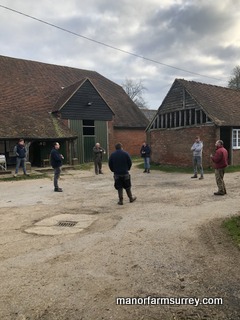
In a normal week, as many as five of our staff could have driven the two tele-handlers on a variety of jobs such as loading fodder beet onto trailers or lorries for deliveries off the farm, lifting fertiliser into the spreader or bedding up the calving barns.
In a COVID19 week, each of the tele-handlers now has its own dedicated driver. Those two drivers have their own work to complete, as well as the extra tele-handler jobs that other members of the team used to undertake. We try to share the other jobs such as cattle checking and fence repairs to share the work-load.
This spring we had a smaller number of Belted Galloways to calve and planned to have a further eleven due in the Autumn.
The calving barns are bedded up with fresh straw and calving is in a safe, dry environment with higher biosecurity than the busy footpaths and fields around here can provide. The cows are given vitamins and minerals and hay to eat. We’ve found it’s important that the dams don’t get too fat as this causes calving problems.
Calving is almost over, with just one more to arrive. Everything has gone smoothly except for two cows who didn’t calve when due; so, these were checked by the vet last week and as suspected have slipped their calves at some stage since the pregnancy test in August last year. Blood samples have been taken from those two which might give us some explanation for why they miscarried.
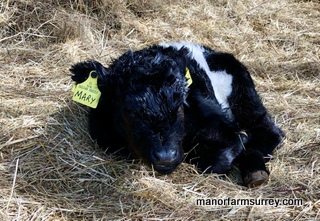
Wotton Lady Ann had her calf about a month early; a perfect little heifer named Mary but very quiet for the first few weeks, sleeping in the soft hay beneath the hay rack in between feeds.
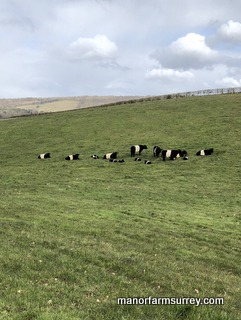
We turned most of the cows and calves out to grass last week. Ethelred’s group are grazing Upper and Lower Park (Ellix Wood) and Thorn Grove and Mister M’s family are grazing in the fields we call ‘Cressbeds’.
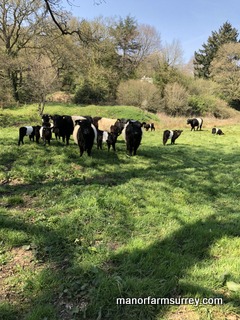
It’s great to have the cows back onto grass now; turning grass into nutritious milk for the calves who will stay with their mothers for about nine months, but will soon also begin to graze, as they gradually eat more grass and drink less milk over the coming months.
The Surrey Hills Business Park is a diversification project on the farm which helps us to continue to farm and to undertake Higher Level Stewardship across a large area of the Surrey Hills Area of Outstanding Natural Beauty (AONB).
One tenant of the business park is Brooks Life Sciences, who bought out 4Titude two years ago. Brooks Life Science products are now directly focused in support of vaccine discovery and medical science to accelerate the global response and cure to the COVID-19 virus. There are many bio-science businesses adapting their production lines, and Brooks Life Sciences which is already internationally renowned, has stepped up to help with this vital global challenge.
Due to a very wet Autumn we couldn’t get out onto a third of the land that we’d intended to sow with winter wheat and as the ground has only dried up enough in the past three weeks, this has meant a change of plan; 100 acres will be left fallow, 100 will be drilled with maize and 112 acres will be spring barley.
Another 25 acres of fairly poor land that would have gone into winter wheat, has instead been drilled with spring barley, peas and grass. If successful, the barley and peas will be harvested in August and made into silage for the Belted Galloways and the grass will be grazed from next spring or possibly this Autumn depending on how well it’s established.
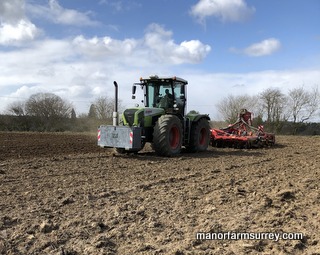
Once the ground was dry enough, digestate was spread in the fields from an anaerobic digestion system. Following on from this organic fertiliser, Edd drives the Xerion tractor and Horsch cultivator which undertakes minimum tillage before the crops are sown.
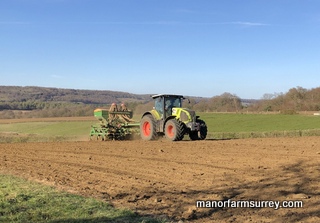
David uses the Amazon drill to sow the barley and peas about 1.5” deep and the grass seed just within the top surface of soil.
This year’s crops include 200 acres of Oil seed rape, drilled at Shalford in August last year and 600 acres of winter wheat which we managed to drill before the extreme wet weather moved in; this will be harvested in July in fields at Cranleigh, Wotton, Abinger and Gomshall.
110 acres of Spring barley for malting, was sown last week in our heavier soils at Park Farm, Coomb farm and Whitedown and will be harvested in August.
When the soil temperature warms up in April or May, 250 acres of maize will be drilled.
Back