


 EDUCATIONAL VISITS Manor Farm is fully accredited by the Countryside Educational Visits Accreditation Scheme (CEVAS)
 THE FARM
Contact us for availability.

Archived News
9th February 2020
Since bringing the Belted Galloways back from their conservation grazing on the North Downs, it’s been a time for managing the herd, weaning, foot trimming, sorting the groups and moving to winter grazing.
The Belted Galloway suckler herd is grass fed all year round, with extra grass-based fodder as required during winter or at calving. You may see our Belties in the fields around Wotton, Abinger, Shere and Gomshall as well as on the North Downs from approximately April until late Autumn or winter depending on the ground conditions.
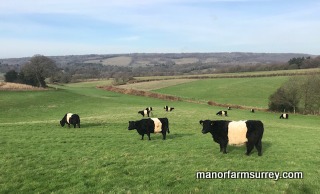
This is Ethelred’s group of in-calf cows, currently grazing with the North Downs in the distance behind them.
The two groups of in-calf cows will come in from the fields next week and will be housed in barns during calving to ensure better biosecurity and safe handling. The barns are bedded up with straw from last year’s harvest and the cows will have sweet smelling, home grown hay or haylage to eat.
We have cameras in the calving barns to keep an eye on the cows, even when we are working elsewhere on the farm.
The bulls, Carsluith Ethelred and Barwise Mister M are currently out, running with a few heifers. The heifers will be pregnancy tested in April and hopefully will be due to calve in Autumn.
Arable field work has been limited due to a fairly wet Autumn and winter thus far.
Following on from last year’s harvest, we’ve managed to drill 600 acres of milling wheat; Elicit, Zyatt and Firefly. Firefly is a new variety for us this year.
We hope that the ground conditions will improve in the next two weeks so that the remaining 300 acres can be drilled with winter wheat. However, if not, much of that area will remain as fallow which will result in a third less potential income from wheat in 2020.
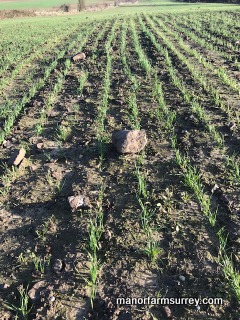
This wheat is emerging at Park Farm. The ground is quite stony with lumps of iron stone. This field grew oil seed rape last year.
It’s not good practice to grow the same crop in the same field every year, therefore different crop types are rotated around the fields. We need to grow crops that will survive and thrive in these grade three soils and which are viable for the business, therefore a field which grew wheat last year, could be growing oil seed rape this year and fodder beet in 2021.
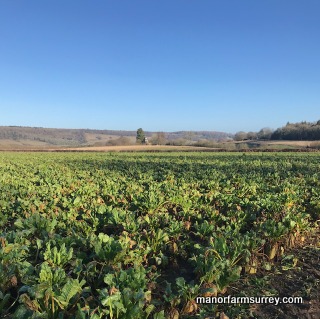
Fodder beet grows well on the sandier soils and currently forms part of the crop rotation. We harvest the fodder beet between September and March and the beet remains fresh whilst still in the soil. The fodder beet is sold to farmers and smallholders across the south east, as winter rations for sheep, pigs, horses, farmed deer, dairy and beef cattle. Inquiries can be made to: 07774 275930
The majority of maize grown on the farm was harvested in October by contractors with a forage harvester. The entire plant is cut, chopped and carted to a silage clamp, which is a level area with two or three walls.
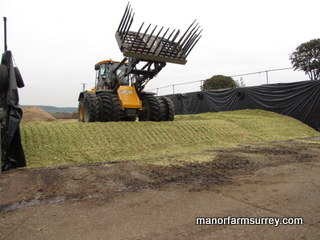
The chopped maize is tipped into the clamp area, compressed by a tele-handler or tractor to expel oxygen and covered in sheeting. Natural fermentation of the ensiled maize in anaerobic conditions, preserves the forage until winter, when it is either sold or fed to our Friesian x cattle.
Back