


 EDUCATIONAL VISITS Manor Farm is fully accredited by the Countryside Educational Visits Accreditation Scheme (CEVAS)
 THE FARM
Contact us for availability.

Archived News
4th September 2019
Harvest was hindered by intermittent rain in August, frustratingly with rain one day and fine the next, but not quite enough time to dry the crop in between showers.
The final fortnight, with a few long nights and Christopher taking on most of the combine driving, brought the last of the wheat in from the fields.
The bad weather resulted in reduced grain quality and more brittle straw.
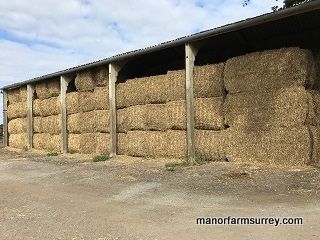
The straw has been baled up into about 800 Heston bales which are 8’x4’x4’ and weigh in the region of 600kg each. These were loaded onto flat-bed trailers and transported from the different harvest locations; back home for storage in several barns where they will remain dry until used on the farm.
We grew three varieties of milling wheat; Skyfall, Zyatt and Elicit with the aim of meeting the quality required for bread or biscuit making. However, if weather conditions reduce the grain quality of the milling wheat, it will only be purchased by the grain merchant as a ‘feed wheat’.
It’s worth noting, that farmers are often criticised for growing crops for animal feed, whereas in this type of situation the crop has been damaged by weather and doesn’t meet the quality to function as a milling wheat for human consumption. The feed wheat is sold to a merchant who sells it on to for many uses such as an ingredient of dog food and wild bird food.
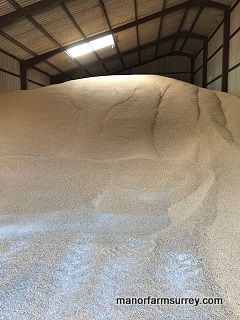
The yields of approximately 3.5 Tonnes per acre were quite promising on our grade 3 soils, with a total of 3,300 tonnes going into the grain stores.
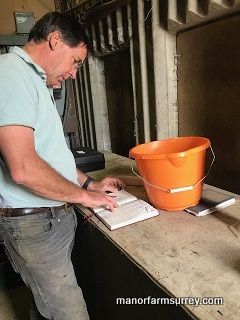
Samples are taken from every trailer-load of grain that is harvested and we keep records of the moisture content, temperature and the specific weight (density of product) of each load.
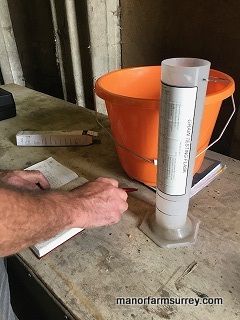
Grain merchants visit the farm to undertake their own grain sampling, checking protein content, screenings and the Hagberg Falling Number (HFN).
The Hagberg Falling Number is a test that measures the number of seconds it takes for a plunger to fall through a mixture of wheat flour and water. The plunger falls slowly if the mixture is thick with starch and is faster if some of the starch has converted into sugar by the enzyme, alpha-amylase.
A high Hagberg falling number is an indication of low alpha-amylase activity which is good for bread making. Large-scale bakeries work with an ideal HFN range of 250–280 seconds.
Unfortunately, due to the rain and delay in harvesting, about half of our wheat grain was reduced in quality and didn’t meet the grade for milling wheat. This has caused a drop of about £7 per tonne in price paid on half our wheat harvest, or a reduction of £11,550 for the grain that will become ‘feed wheat’.
We tend to sell wheat in the Autumn, but due to a possible exit from the EU on 31st October and after various conversations with grain merchants, Laurence decided to sell much of it before that deadline due to the uncertainty surrounding trade in the coming months. In the last three days 1,000 tonnes has been transported to Sheerness’ Port for export, 500 tonnes to a feed mill and 1,000 tonnes to a further merchant for collection in October.
Following the harvest of wheat at Shalford, the fields were cultivated and drilled with oilseed rape about two weeks ago. The plants are emerging and will have benefitted from the rain early this morning.
The fields around Park Farm and Coomb Farm have been cultivated and will be sown with wheat starting in mid-September.
For nine weeks the bulls ran with their own small group of cows and heifers. The bulls are then removed from the fields and we allow at least 35 days before having the cows and heifers pregnancy diagnosed.
The results for our older bull, Ethelred were relatively good, including his maiden heifers being in-calf. However, it was disappointing to find that six of Mister M’s group were not in calf, four of which were his maiden heifers. The vet took blood samples from the empty females and the results were clear, not indicating anything untoward; therefore, Mister M will have a further fertility test next week to see whether there are any changes since his last check in the spring.
All being well, we expect 26 calves next March-April.
When I established this website in 2007, I used a camera to take all the photographs. Things have changed so rapidly in the past few years and I take many more videos now using my phone because that’s always with me and will use those to ‘post’ our farming activities or wildlife onto Twitter.
However, I am glad to have remembered to take a few still pictures of the orchard recently and some dis-used nests!
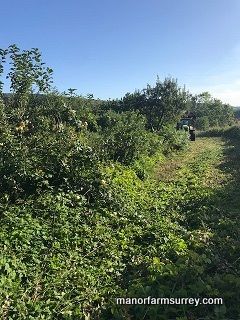
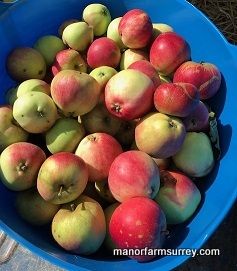
We have an old orchard which we leave as a wildlife corner, only entering occasionally for pruning, topping the brambles to prevent them from engulfing the fruit trees and apple picking in September.
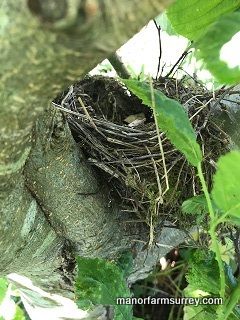
Whilst walking a Bramble clad field margin recently, I was picking the odd blackberry along the way and was fascinated to find a bundle or ball of leaves and grasses in amongst the spiky brambles. On closer inspection there was a hidden entrance and tunnel into the centre of what I believe is a harvest mouse nest.
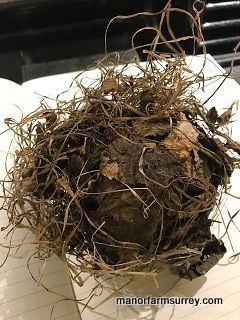
The nest shows how clever and adaptable wildlife can be, creating a dry, secure home from the simplest materials. It really is a thing of beauty in my opinion.