


 EDUCATIONAL VISITS Manor Farm is fully accredited by the Countryside Educational Visits Accreditation Scheme (CEVAS)
 THE FARM
Contact us for availability.

Archived News
31st July 2019
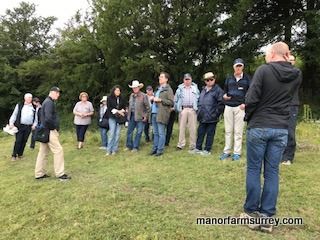
Last weekend we welcomed a group of Australian and New Zealand farmers to Manor Farm. The group are on a tour of many farms, rural enterprises and Agricultural shows across Ireland and the UK which has been organised by Fiona Lake, a professional rural industries photographer and advocate.
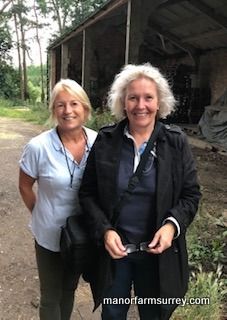
This was the first time I had met Fiona in person, having only ever spoken with her via social media and email in the past. However, having seen some of Fiona’s incredible photography of outback Australia and her outward looking attitude towards farming Worldwide, I was delighted that she wanted to bring Quadrant Tours to visit us and hear about farming in Surrey.
In organising this visit, my aim was to show the different aspects of our farming enterprise and how we need to dovetail our mixed arable and beef farming with our conservation work and biodiversity, whilst diversifying and future proofing the business.
All this must be achieved in a designated Area of Outstanding Natural Beauty (AONB), just 20 odd miles from London and with high visitor numbers along the Public Rights of Way network, which criss-cross the fields in which we grow crops and graze livestock.
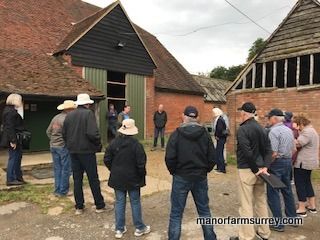
We talked about the history of the Matthews family farming in Somerset and how EDG Matthews took a tenancy in Cowden, Kent before moving his family, staff and livestock to Manor Farm in 1935.
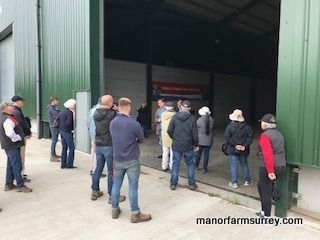
Conversation included everything from land tenure to soil types, the formation of the North and South Downs and the marine deposits in the chalk, minimum tillage to Red Tractor Farm Assurance and grain storage to conservation grazing. The conversation flowed for five hours and could quite easily have continued!
We took a short climb onto Holcomb Down from where our visitors could look out across the patchwork landscape of arable fields and pasture, hedgerows and woodland and south over the Weald. We were joined for the afternoon by Rob Fairbanks, Director of the Surrey Hills AONB who explained the designation of the area, which in brief, is to conserve and enhance the natural beauty of the landscape, to enable the quiet enjoyment of the countryside whilst having consideration for the interests of those who live and work in the AONB.
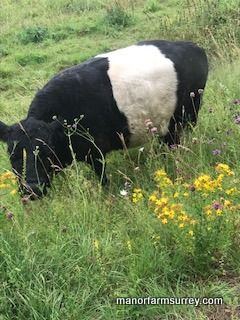
On the Downs we also met some of our Belted Galloway herd, discussed conservation grazing on a SSSI and why I choose to sell the ‘Beltie’ beef direct from the farm; connecting with consumers and giving them the opportunity to know exactly where and how their beef is produced from farm to fork.
To round off our Manor Farm tour, we looked at some areas of the farm where we grow wild flowers and grasses for pollinators which are located in areas interlinked with other habitats such as ditches, hedgerows and field margins some of which are sown with crops to feed birds in winter and other lengthy grass margins for small mammals, insects and birds such as Barn Owls which use the area for hunting.
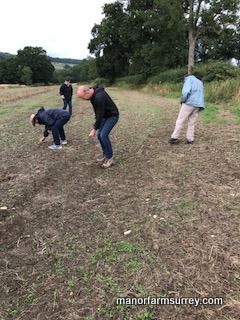
Due to the small size and increasing isolation of populations, the Small Blue butterfly (Cupido minimus) is under threat and the Butterfly Conservation group have been undertaking work along the North Downs to try to support this species. Kidney Vetch is the sole food plant for the Small Blue butterfly and the larvae live only in the flower heads.
Having collected some native Kidney Vetch (Anthyllis vulneraria) seed from the Butterfly Officer, it was great having the Australian and New Zealand farmers getting involved and helping us to safeguard UK biodiversity by sowing the seeds onto bare ground and scratching some soil back over them.
I hope that we provided a good overview of farming, food and wildlife in an AONB with increased external pressures and proximity to London. Each farm on the Quadrant tour will provide a myriad of contrasts the length and breadth of the country.
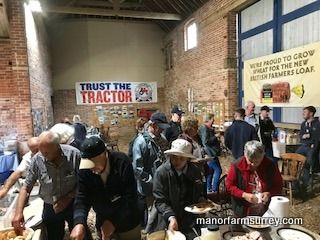
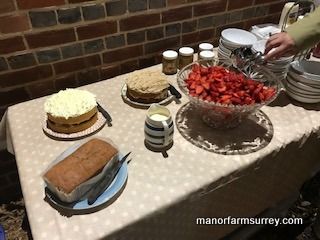
We completed our evening with a hog-roast, home-made cakes and British strawberries and cream!
The previous week Laurence and I went to the Lambeth Country Show to help ‘man’ the National Farmers Union (NFU) #BackBritishFarming exhibit. The Lambeth Show is in its 45th year and is the largest free family festival in the country.
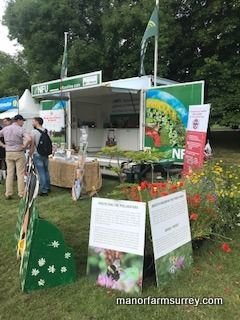
The NFU exhibit had some beautiful wildflowers, a native hedge and crops on display which drew visitors in. Alongside the crops were their respective grains, oilseeds, pulses and examples of their by-products.
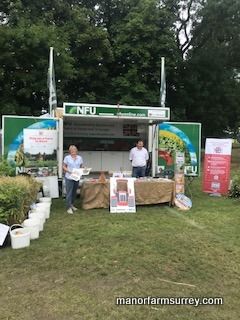
We spoke with people of all ages and answered questions about how we farm and what we grow and we received a lot of interest from school teachers and community and Scout group leaders interested in arranging a visit to a real working farm, so I shall be following up on these inquiries.
One recurring issue for educational visits is the cost of transport and I would like to see the government supporting every school with transport out to a farm, at least one class each year to help re-connect children with farmers, farming and to see how the food they eat is produced.
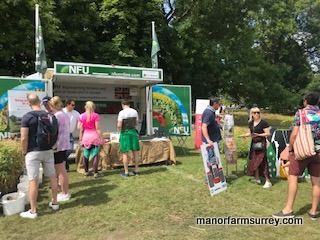
Children and adults enjoyed using a hand operated grain mill to see how grain is turned into flour and ‘milking’ the model cow proved very popular!
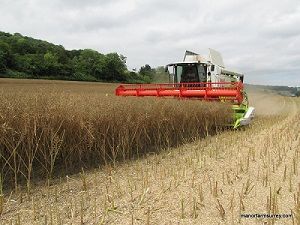
Harvest 2019 began with oilseed rape (OSR) at Park Farm and along the foot of the North Downs towards Westcott. 250 acres were originally sown, but 20 of these were written off due to pigeon damage and some drainage issues.
There is only a short window of time in which to harvest our crops according to weather conditions and subject to any mechanical breakdowns. Therefore, if the crop isn’t damp with dew, harvesting will continue into the night and begin again the following day once the dew has dried off in sunshine or a breeze.
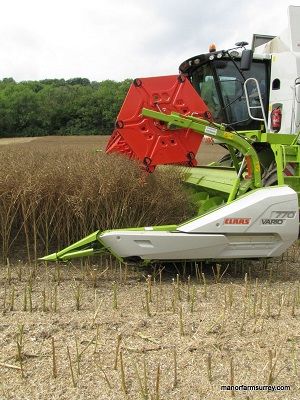
The weather was dry and hot for the OSR, with temperatures eventually reaching 37 degrees on the final day. Our concern this year has been that the OSR pods could pop open in the extreme heat, with the seeds simply falling to the ground before they could be harvested.
Oilseeds are tiny black seeds which are over 40% pure oil. Rapeseed oil is one of the highest quality vegetable oils, has low saturated fat and is high in omega-3.
The crop should be below 9% moisture content at harvest and above 6% otherwise the seeds begin to crack.
The oilseed will be sold to a grain merchant in due course.
The harvested OSR fields will have organic fertiliser spread, probably starting tomorrow and this will be followed by the cultivator. In late September/early October these fields will be drilled (sown) with wheat.
Back