


 EDUCATIONAL VISITS Manor Farm is fully accredited by the Countryside Educational Visits Accreditation Scheme (CEVAS)
 THE FARM
Contact us for availability.

Archived News
3rd March 2019
Winter is a time for any tree planting, hedge laying, coppicing, pond work and trimming back any overhanging vegetation encroaching over public rights of way or field boundaries.
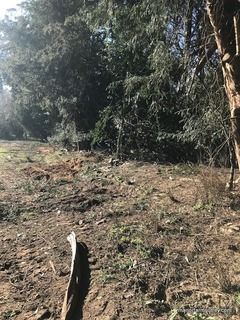
We have been clearing the boundary in the Glebe where neighbouring trees including Yew and Laurel had fallen branches across the fence line.
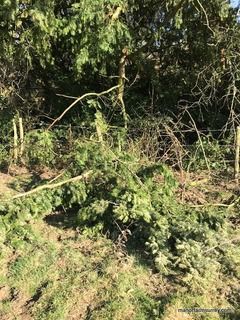
Both these species are poisonous to cattle and the livestock will eat them if within reach, particularly if there’s snow on the ground and they can’t find enough grass.
Once the trees have been cleared a replacement stock fence will be erected.
In 1849 a railway was constructed between Reading and Reigate Junction, with the line passing through the farm from Gomshall to Dorking. A culvert was constructed to carry water and run-off from the railway onto what we call Sandy Meadow.
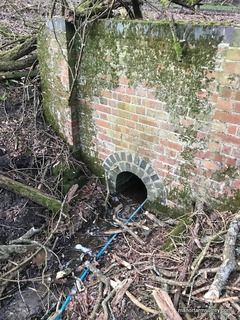
Either at the time the railway was constructed or when the water began to be used by Park Farm; the water course was dammed to the south east of the culvert. This created a large pond-like area with a sluice.
A brick-built construction at the southern end used to house a pump used to force water uphill to Park Farm.
The water is no longer pumped up to the farm house, but it still flows from the railway line into the pond area, bringing with it an accumulation of silt.
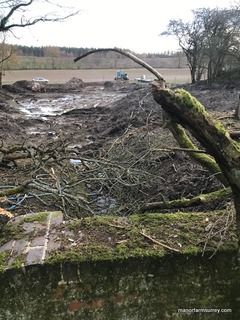
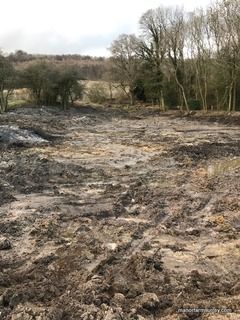
Laurence remembers dredging the Sandy Meadow pond in the 1980’s, but over the years it has silted up again and become quite stagnant.
Work has been underway clearing the sludge in last few weeks, creating many levels within the pond to provide a variety of water depth for wildlife. It looks grey and lifeless at the moment, but it won’t be long before flora and fauna colonise this reclaimed pond and the surrounding banks.
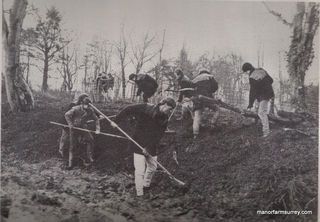
In 1986 the pond at Coomb farm was dreged by the conservation team who had their base at Coomb Farmhouse; here the team finish off the banks ( black and white photo).
In February 2016 we dredged the Coomb farm pond for our landlord.
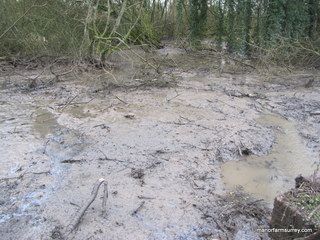
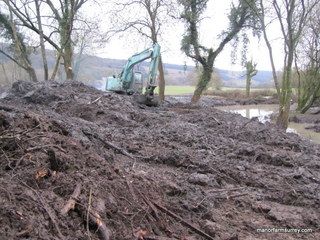
The work being undertaken February 2016
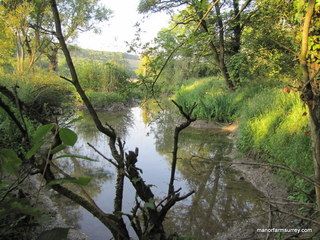
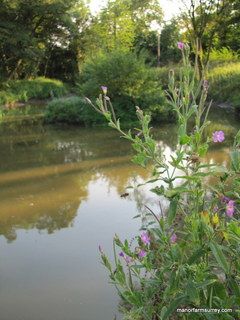
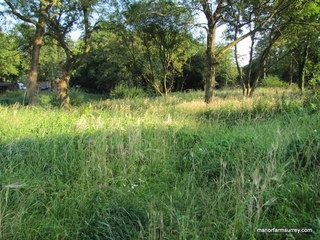
By August 2016 the banks were greened up with naturalised vegetaion and light was able to reach the water and the various surrounding habitats, so it won't be long before the Sandy Meadow pond will have the stagnant silt replaced by refresh water and invigorated with wildlife.
Livestock are cared for by our team throughout the year, with the out-wintering Belted Galloways needing regular checks, whilst the Friesian cattle which are housed in barns during the winter, being fed and bedded-up with fresh straw. Water troughs need defrosting or ice-breaking on the coldest mornings, although this year feels positively balmy compared to last!
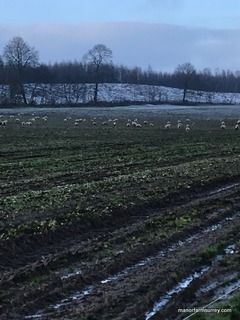
A few hundred sheep are over-wintering on the farm; they have followed in behind the cattle on some of the pastures and you may also see them going into the fields that have been harvested of fodder beet. The sheep eat up any remaining fodder beet and leafy tops and naturally spread their manure as they graze.
Electric fencing is used to keep the sheep on the area to be grazed and at the same time keeping them off the field margins which are provided for wildlife.
Whilst farming here to grow UK food, we also provide field Margins and hedgerows which are important habitats and corridors along which wildlife can travel, shelter and feed.
There are many types of unfertilised conservation headlands and field corners across that we provide on land we farm, stretching across 25 miles east to west;
· Enhanced wild bird seed plots; sown with wild bird food to fill the ‘hungry gap’ in winter specifically for birds.
· Cultivated fallow margins for rarer arable plants; these field headlands along the foot of the North Downs specifically benefit native ‘weed’ species. Natural England undertake plant surveys and have discovered the return of rare species.
· Buffer margins along cultivated land; these grassy headlands provide food for small mammals and are used as hunting ground for owls; a barn owl has been hunting during late afternoon to get enough food during colder weather.
· Grass areas as part of management of field corners
· Reversion to unfertilised grassland to prevent erosion
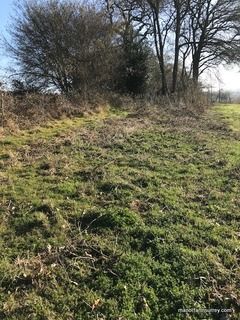
The margins may not look terribly exciting at first glance, but they are of great value to wild plants and mammals. For example, the margins on the north edge of the fields, that run along the foot of the North Downs between Park Farm and Westcott are ‘cultivated fallow margins for rarer arable plants’; they are part of the Higher level Stewardship Scheme (HLS) and as such we are tasked with keeping people off these areas.
With hundreds of walkers, cyclists, horse riders and dogs visiting this food producing area every week not everyone will realise how important it is for us to establish and maintain these stewardship areas and protect them from public pressure.
Unfortunately, there has been disturbance and damage to the flora and fauna in some of the stewardship margins, hedges and copses by some walkers and dogs, horseriders and even unregistered motorbikes so it has become necessary to re-fence some of the field boundaries to safeguard wildlife, whilst leaving the definitive right of way outside the field.
There is not a ‘Right to Roam’ in Surrey, however we are fortunate to have over 2,000 miles of public footpaths (yellow arrows), bridleways (blue) and byways (red) in Surrey along which we can ‘pass or repass’ to reach a destination, plus areas such as the North Downs, across which there is more general access.
Some public rights of way have coloured waymark arrows (as mentioned above) particularly where a route is not obvious, but it is recommended to use an Ordnance Survey map (Pathfinder map 1:25,000) to ensure you are on the definitive rights of way.
This is a living and working landscape that has produced food for hundreds of years, a bit like a factory floor that also has ponds, hedges, woodland and public paths going through it and we thank all of you who appreciate the countryside, wildlife and UK food production and remain on the public rights of way when visiting this farmed landscape.
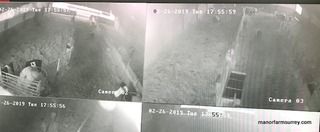
The Belted Galloway cows have moved back from the fields ready for calving in March and with cameras in the barns we can keep an eye on what’s happening via our mobiles, day or night.
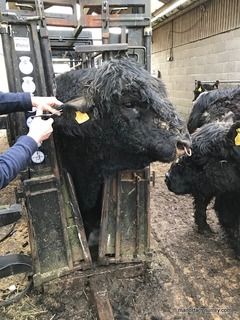
We trimmed the cows ears in order to be able to read their tags clearly in the calving barn, without needing to get too close to them! Both Ethelred and Mister M, the bulls also had a trim.
Farmvention (when farming meets invention) is a new national competition run by the NFU aimed at primary school children. Last year over a thousand children entered the competition and they could choose from three exciting problem based challenges designed to make children think about the day to day issues faced by farmers and growers in England and Wales, each challenge was supported by curriculum linked resources created in partnership with the Association for Science Education (ASE).
Next week we are hosting farm visits for two of the winning schools; Ronald Ross Primary, Wandsworth and Wonersh and Shamley Green Primary.
We look forward to welcoming you all to Manor Farm!
Back