


 EDUCATIONAL VISITS Manor Farm is fully accredited by the Countryside Educational Visits Accreditation Scheme (CEVAS)
 THE FARM
Contact us for availability.
Archived News
For the past two years we had contractors harvesting for us, since our previous combine harvester caught fire whilst harvesting wheat.
So it's quite exciting that our new Tucano Claas combine harvester has travelled from Germany to Sussex (on a lorry) and after going through its pre-harvest checks it was driven to Dunsfold on Friday, where Laurence began harvesting oil seed rape (OSR).
The yield is below average and the seed is very dry in the first fields. The soil, if you can call it that, is very rutted clay and is now as hard as rock in this continuing dry weather.
The tiny black seeds from the OSR crop are at least 40% oil when crushed. The seed has been pre-sold and will go on to produce cooking oil.
We have 500 acres of OSR to cut before cleaning out the tank and then harvesting 15 acres of barley for our neighbour, a job that should be completed in three hours. Then it will be back home to start on 700 acres of wheat. This year we have grown Skyfall and Zyatt, both milling wheat varieties.
Just to catch up on Belted Galloway news. We moved all the calving to springtime a few years ago for practical reasons with workforce and so that the cows with young calves at foot could be turned out onto fresh grass.
However a few cows are out of synch due to last year 's Schmallenberg Virus causing them to abort, so they've added to the numbers grazing the chalk downland for Natural England and the National Trust this summer.
The majority of calves were born March-April except for the final two, called Nimbus and Wotton Nell who arrived on 16th May, I'm sure they waited for better weather! A total of 31 calves were born; 14 steers and 17 heifers.
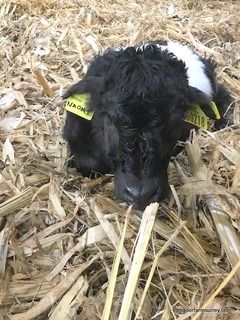
The Belted Galloways underwent their 4 yearly TB testing; everything went well and in less time than anticipated which was a bonus.
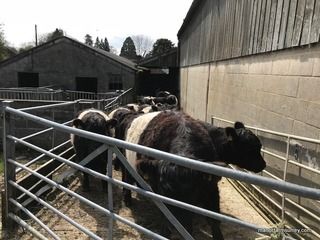
Once this task was complete we spent a few days sorting out the cattle and moving them to their summer fields.
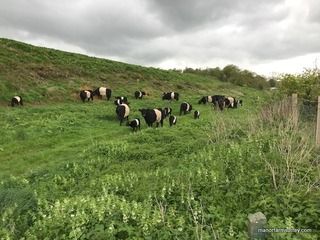
Carsluith Ethelred and Barwise Mister M joined their ladies for 8 weeks in fields without public rights of way, so they could enjoy their work without disturbance. They were removed from the fields on 4th July and we'll discover which of the cows is in calf on 20th August.
We hosted two contrasting visits recently but with a common theme; farming and education.
Eardley Primary School visited with children from Years 4-7. They were an inquisitive group with lots of questions for us about the various aspects of farming and food production we introduced them to; livestock, arable, machinery, food traceability, quality assurance and how mechanisation and science, such as the automatic milk machines improve farm efficiency but also importantly increase monitoring, health and welfare. The children had an enjoyable visit and seemed to take away a wealth of information which I hope will be just the start of their interest and knowledge about where their food comes from.
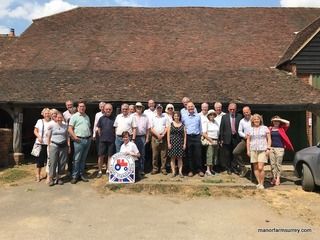
The following day the Surrey Hills Area of Outstanding Natural Beauty (AONB) held their annual tour which gave an opportunity for the AONB Partners to experience new areas and issues within the Surrey Hills AONB looking at policy and projects in relation to the future of food and farming; viticulture, rural enterprise; the arts, recreation, access and tourism.
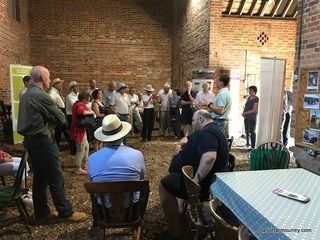
This included a visit to Manor Farm with an introduction by Laurence including a potted history of how his grandfather came to be farming in Surrey, his involvement in the war effort and how things have changed and evolved through his father's generation and to the current farm enterprise, environmental work and diversification.
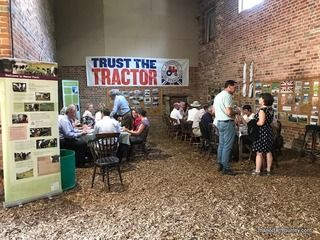
I was asked to outline our 'Countryside Classroom' and how we are connecting young people with the countryside and where food comes from; to explain what this entails on a practical level such as planning, H&S, costs, time and why do we do it!
We host visits because we want more people to know where their food comes from, for them to connect with the people growing food and for them to fill their senses and minds with memories and an understanding of how the food they eat is produced.
I explained that during the 'Year of Food and farming' in 2007 the then government wanted to get every school child out onto a real working farm. The government offered free transport and farmers like us went on a CEVAS training course. CEVAS stands for Countryside Educational Accreditation Scheme which is a nationally recognised accreditation. Further to our own training the farm was inspected and became fully accredited to host educational visits.
Unfortunately our own experience would lead me to say that the government's 2007 vision didn't reach its potential. For example I wrote to over 30 schools in Surrey offering free transport and free farm visits linked to the national curriculum but not one school at that time replied!
So instead we began to work with the Country Trust who would find inner city schools that did want to reconnect with farming and the countryside. The Country Trust continues to this day, matching city schools with Manor Farm and extending the connection between children, farmers and the food we all eat.
We used to host various local walks and talks before 2007, but since becoming CEVAS accredited we have provided not for profit educational visits to hundreds of children, young people and adults but of course it all takes time. We might question how much longer we can give up approximately 12 man hours for some of the visits, instead of farming and earning a living as things become more challenging due to BREXIT (but that's another whole topic of conversation!).
To round up our 'Countryside Classroom' with our Surrey Hills AONB visitors, Laurence gave a mini demonstration of how we learn about arable farming with a school group, including the crops we grow, what machinery and care of the soil and plants is required, thinking about the differences between the buckets of seeds and grains we pass around the group; letting the grains run through their fingers is a popular activity (hand washing after)and discovering the large variety of foods produced from the many crops grown here and across the UK and comparing with other parts of the world.
Here is a quote I have on my pin board and I think it could be a fitting answer to the question: Why visit a farm?
“What people don’t understand, they won’t value; what they don’t value, they won’t protect; and what they don’t protect, they will lose.” (Charles Jordan)