


 EDUCATIONAL VISITS Manor Farm is fully accredited by the Countryside Educational Visits Accreditation Scheme (CEVAS)
 THE FARM
Contact us for availability.

Archived News
24th August 2017
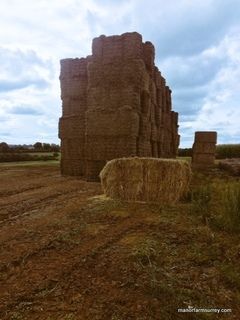
Stack of oil seed rape straw (not the single bale)
Harvest was completed a few days ago, with straw bales loaded onto trailers and sold direct off the field or moved back to be stored in barns for winter cattle bedding.
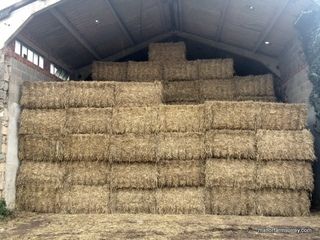
Wheat straw for winter bedding
We had fantastic weather in June and the wheat was looking very good as it ripened, but as harvest began the wet weather also arrived giving us above average rainfall in July and August!
This resulted in three quarters of the harvested wheat grain having to be put through the dryer to reduce the moisture content to below 15% before that could be stored. We still have 500 tonnes of grain to dry.
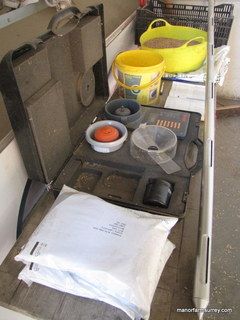
The yields and kilo-weight were above average for the wheat and protein levels were good, but the Hagberg Falling Number (HFN) was below 240 which is the level required for bread making.
To measure the kilo-weight, a 100 litre container is filled with grain and weighed. The weight of the filled container must be 72kg for feed wheat (used in cattle, horse, chicken food etc) and 76Kg for milling wheat. Our wheat has been 78-79 kilo weight.
Wet weather causes chitting or sprouting in the wheat before it can be harvested, this causes rapid production of the enzyme alpha-amylase which degrades the starch in the grain.
Samples of our grain are sent to the grain merchants and they undertake the HFN test which measures the enzyme activity in each sample. The test which was developed in the 1950's was first done by hand but is now a quick mechanised test.
Although we grew a milling wheat variety, it can now only be sold as feed wheat due to the HFN being below 240. This is the same situation for most farms across the south resulting in an increase of feed wheat on the market, reducing the price paid to farmers.
On a better note the oil seed rape (OSR) was above average yield for our soils and the quality is good with above 40% oil levels.
As we rotate our crops and fallow land, our view of the landscape changes most years.
At the moment 320 acres, out of 800 acres that was wheat last year is being drilled with OSR and the remainder will be sown with maize, fodder beet and 2nd wheat.
Another 300 acres will be sown with wheat where there was OSR, and some of last year's fallow will grow wheat, whilst the land at Normandy will be left fallow after the wheat just harvested!
Ladies in Beef was established to tell the story of British Red Tractor beef.
The group was formed to help promote and drive awareness of the quality and versatility of British beef to consumers using a country-wide network of dynamic lady beef ‘champions’. They organise Great British Beef Week in April and attend various events across the country.
When I received an email from LIB looking for members to take part in Adam's Farm at BBC Countryfile Live I thought it could be a great way to support Ladies in Beef, of which Adam Henson is patron and to share our passion for British farming and Red Tractor Beef with a large number of visitors to the event and wider still, through coverage on BBC Countryfile .
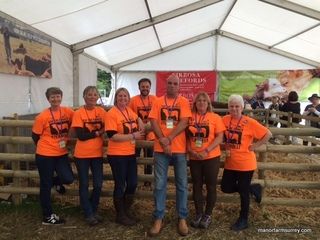
I was at Blenheim Palace on the third day of the event and being a Saturday it was incredibly busy. There were five of us Ladies plus three Gents in 'Team Beef' that day and we had a constant flow of visitors coming to talk with us and asking a varied questions. The Red Tractor key rings/supermarket trolley coins (new shape £, so very popular!), pens, stickers and beef recipe cards were all very popular and a good conversation starter.
I took a cattle passport with me and various large photographs from Manor Farm of our cattle to provide visual links between the farm and the cattle that were at Countryfile Live.
We talked about the various foods that visitors had seen with the Red Tractor logo and about the high standards required for Red Tractor Farm Assurance and discussed everything from passports and ear tags, unique ID numbers, high welfare, traceabilty of cattle and beef, differences between beef farming methods, suckler herds, beef raised from dairy calves, to Higher Level Stewardship and grazing management of Sites of Special Scientific Interests.
Dozens of sheep, pig, dairy and beef farmers could easily be spotted in their colourful 'ask a farmer' T shirts. Here is 'Team Beef' in orange!
Whilst getting involved at Countryfile Live undoubtedly spread the word about British farming to a large number of visitors at the event itself, I would have hoped and expected that the visitor engagement, given their serious interest and thoughtful debate about British farming, should have been a fantastic opportunity for the BBC to share with all the viewers of Countryfile on 20th August, a large number of whom wouldn't have attended Countryfile Live in person and I'm sure would have found these conversations fascinating.
Sadly all the effort and passion for British farming that shone out from dozens of farmers during the event wasn't shown on TV.
I hasten to add that I'd hate to be shown on TV - leave that to others!
Back