


 EDUCATIONAL VISITS Manor Farm is fully accredited by the Countryside Educational Visits Accreditation Scheme (CEVAS)
 THE FARM
Contact us for availability.

Archived News
11th July 2017
Back in May the vet came out to check five Belted Galloway cows which hadn't yet calved. They were diagnosed as pregnant but must have lost the calves that had been due in February/March, got back in calf and are now due between August and November!
Blood samples were taken from three of the cows that had been due early in the spring and they have all been confirmed as having antibodies to Schmallenberg Virus (SBV) and Neospora Caninum, both of which can cause abortion.
As mentioned last time SBV is transmitted by midges, whilst Neospora caninum is a parasite whose definitive host is a dog. The parasite's reproduction occurs in the intestine of the dog and it sheds oocysts in the dog faeces. These spores can be ingested by grazing cattle (known then as an intermediate host) which if pregnant can cause abortion or a stillborn calf.
We won't breed from cows confirmed with Neospora caninum as this can be transmitted from the cow to an unborn calf and there is a risk that the canine host will ingest the afterbirth of an infected cow or tissue from an aborted calf out in the field, which then completes the lifecycle of the parasite.
It's hoped that with SBV antibodies these cows should now be protected from that virus. The final two cows in this group of late calvers will also have the blood tests next time we bring them into the yard.
Preparation for harvest is ongoing with trailers being serviced and the grain stores being dusted (yes I did say dusted!) and vaccumed.
The last of the peas, about 2-3 loads should be collected by Gleadell today which will free up storage for this year's crops.
Maize silage is being sold as a cash crop to amongst others, a Hampshire dairy farm where it's being fed to supplement the grazing and support the milk yield and to an AD system in East Anglia.
Fodder Beet For Sale We are growing 250 acres of fodder beet this year, with lifting between about October and March and are taking orders now in readiness for the autumn, inquiries can be made via the contact tab above or telephone: 07774275930
The 12 year old Mecmar grain dryer has a few worn parts through general wear and tear, so replacement bearings and a central auger have been ordered from Italy.
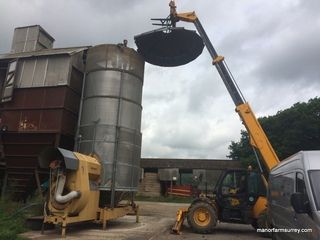
The central auger circulates the grain in an upward direction within an inner chamber and when the grain reaches the top it falls into an outer chamber. Hot air is then blown sideways through the grain to dry it. The tube in which the auger sits has also become worn in places causing some of the grain to leak out into the wrong chamber rather than being transported upward. That tube will also be renewed.
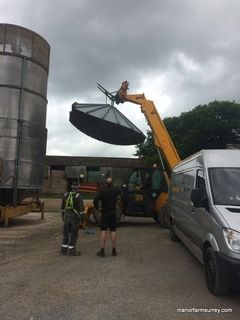
The grain dryer is an essential piece of equipment for a wet summer but there are also occasions in relatively dry harvests when grain needs to have the moisture content reduced a little before storage.
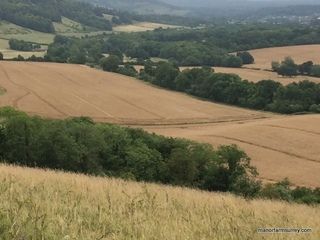
The oilseed rape (OSR)harvest will begin in about a week and if it comes off well, the 300 acres should be harvested in five days with about 50-60 acres per day if the weather remains dry.
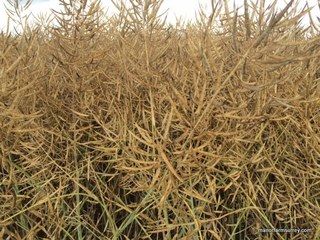
Contractors will be harvesting for us again this year since our combine harvester was burnt to a cinder during harvest 2015. We still haven't got round to buying a replacement.
Following on from the OSR we'll have 900 acres of wheat to harvest and are just talking about how we might be able to continue to harvest during the 2017 Prudential cycle race when 25,000 amateur cyclists take over the roads. After a year of farming and working towards harvest we can do without any delays once the crops are ready and the weather is fine.
The day of the cycle race falls during the wheat harvest and last year it prevented us from working because the roads were closed and we had no access to the fields of wheat nor a road to transport the grain back to the farm.
As crops are grown in rotation, those that were wheat fields last year may be fodder beet, maize, OSR or fallow this year . So we are hoping that the fields of wheat which are growing along Raikes Lane will be fit to harvest during the race on 30th July as that should enable the harvest to continue, with corn carting directly from the fields to the grain store at Raikes Farm.
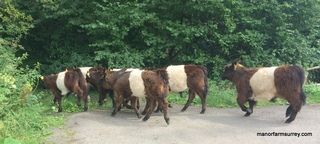
Last week we moved the Belted Galloways from the Cressbeds, the short distance via Paddington Mill to the fields at Abinger Hall.
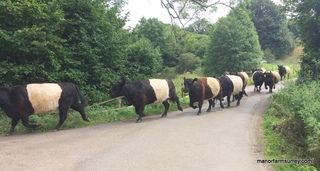
The cows know the route well as does Ethelred the bull, who will obligingly follow his girls. It was the first time the calves had changed field on foot and they were happy to saunter along behind. There should be enough grass in the new field for quite a few weeks.
We've received a Tuberculosis Tracing Test Notice from the Animal Health and Plant Agency. The notice informs us that following a recent disclosure of a TB incident on a farm from which we bought Friesian calves eleven months ago, we must now have six calves tested for TB. This will apply to each and every calf that was sold off that farm and potentially to a number of different farmers each of whom will arrange for their vet to carry out the TB tracing tests by a set date.
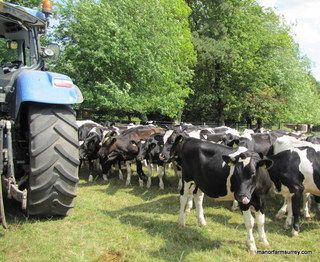
The six Friesians to be tested here, were in four locations so Reece drove the cattle crush to each site and Ben Brearley from the Livestock Partnership carried out the first part of the TB test today (day 1) and he will return on Thursday (day 4) for the results.
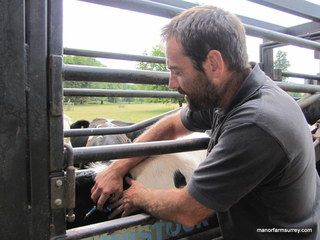
Ben trimmed the neck in two places on the neck of the animal and measured and recorded the thickness at both sites. The two sites are then injected under the skin, one with tuberculin bovis and the other with tuberculin avium.
On Thursday the skin reactions will be measured and compared to provide a result.
Back