


 EDUCATIONAL VISITS Manor Farm is fully accredited by the Countryside Educational Visits Accreditation Scheme (CEVAS)
 THE FARM
Contact us for availability.

Archived News
9th May 2017
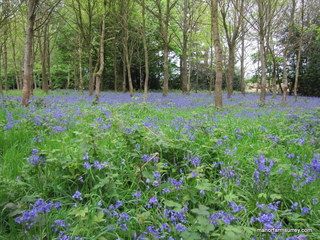
Bluebells still flowering
May is a beautiful month and the farm is brimming with wildlife. Amongst my favourite species are the Swallows which have returned to mate after their incredible journey from South Africa. It never ceases to amaze me when I hear the chattering of swallows overhead, that they have flown up to 200 miles per day for between five and twelve weeks dependant on their speed, body condition, the route flown and the weather.
As soon as they arrive, these small birds certainly make their presence known with their familiar call and aerobatics as they swoop about the farm yard and across the fields, where they feed on insects and drink from ponds and scrapes whilst still on the wing. An open sided hay barn provides the perfect nesting site and we should see a couple of broods fledge during the summer.
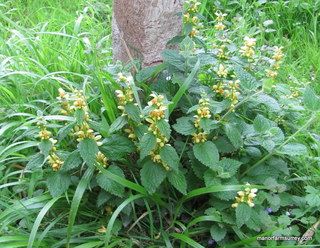
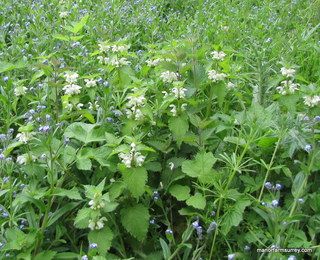
Yellow Archangel is a hedgerow and woodland plant which is not as common as White dead-nettle.
There was plenty on the farm for Chilworth Community Playgroup to see today. Twelve 3-5 year olds and their leaders travelled by public bus through beautiful countryside to visit our farm for the third consecutive year and it was great to welcome them back.
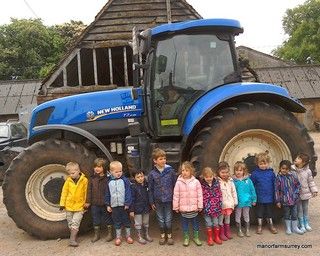
When I asked them what their favourite part of the visit was, there was a cheer for the calves, sheep, lambs, pigs, hens, ducks and tractors. Everything!
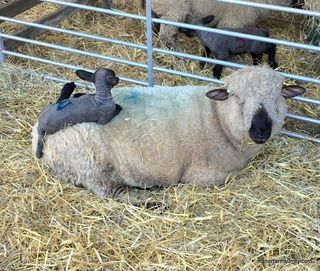
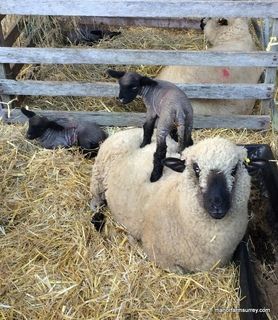
Lambing has gone very smoothly although there were a couple of ewes taking their time, with the final lamb born last week.
The lambs have been tagged in each ear in line with Defra regulations, providing flock identification and traceability. The numbers sprayed on the sides of the ewe and her lamb provide us with a quick and easy way of matching up lambs with their mums, even at a distance. The red numbers denote ewes with a single lamb and the blue numbers are for twins.
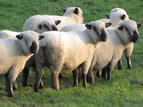
The Hampshire Down sheep are a native breed, born with a black fleece that becomes cream coloured over the body, with the exception of the legs and parts of the face which remain black.
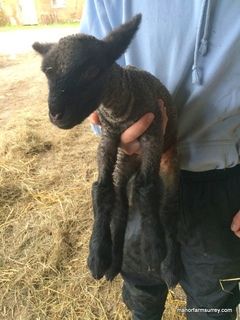
This little lamb needs to grow into those long legs!
At the beginning of the calving period one cow had a stillborn calf infected by the Schmallenberg virus (SBV). This calf was deformed with fused joints.
SBV is transmitted by midges during summer and autumn when the insect takes blood from cattle and in doing so it transmits the virus to the pregnant cow. The infection then passes down to the calf and may cause abortion or a deformed calf at term.
The vet is coming out this week to take blood samples from five cows that should have calved, but haven't. They were diagnosed as pregnant last August but now it seems they are empty.
It may be that the blood samples from the empty five will also indicate SBV as the cause of these mid term abortions.
Despite some unanswered questions at the moment, the herd has increased by 32 fit and healthy calves so we must remain positive.
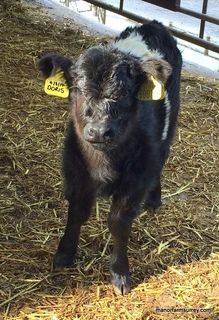
The cows and calves have been sorted out into their summer grazing groups and taken to fields without public access because the bulls will be going back out with them next week.
The calves feed on their mothers' milk for nine months giving them the very best start. After a feed the cows will often hide their calf in long grass or undergrowth whilst they go off to graze and at other times the calves can be seen in a group or creche, with one of the cows taking turns to supervise the youngsters.
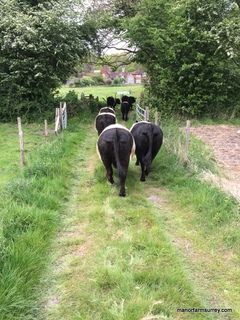
The retired girls sauntering along, en-route to the North Downs.
We have a group of Beltie cows that have taken retirement and no longer go to the bull, but they continue to play their part in conservation grazing on the North downs. They moved onto Hackhurst Down last week and will be moved gradually eastward throughout the summer.
Spring cultivations have included cultivating, fertilising, power harrowing, drilling and weed control.
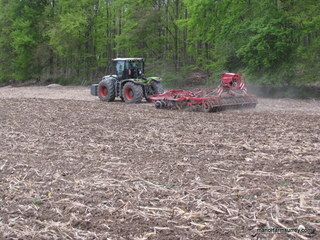
Cultivator at work
One of the fertilisers used is recycled food waste in the form of digestate from anaerobic digestion (AD) systems in the south east. Whilst it's disappointing that so much food is wasted nowadays, at least when it's collected from homes, it can be taken to an AD system whereby during a biological process it is converted into fertiliser and renewable energy, rather than going into landfill and increasing carbon emissions.
The fertiliser or digestate improves the soil structure, water retention and nourishment for the next crop.
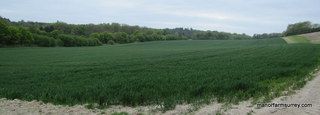
Last Autumn about 850 acres of wheat was drilled; the variety is Skyfall , a milling wheat that has been growing well on the heavier soils, but the lack of rain is having an adverse affect on the wheat growing on light, sandy soils. The crops could all do with some significant rainfall, as April has been particularly dry. If dry conditions continue, the quality and yields will decrease.
We've planted several hundred hedge plants but at least it has been possible to water those.
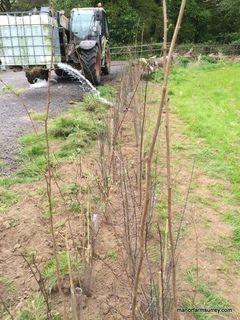
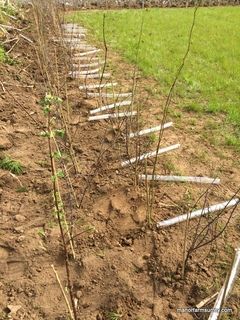
The spiral plant protectors ready to go around the stems of the hedge plants.
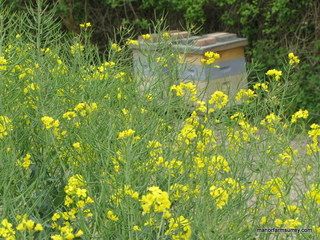
A few more bee hives (for honeybees) have been placed alongside the fields and the bees seem very busy in the oilseed rape.
Back