EDUCATIONAL VISITS Manor Farm is fully accredited by the Countryside Educational Visits Accreditation Scheme (CEVAS)
 THE FARM
Contact us for availability.

Archived News
18th March 2017
Calving is well under way with 19 newborn calves added to the suckler herd; 9 heifers and 10 bull calves so far, with another 18 to come. We can register pedigree calves with the Belted Galloway Society if they meet the breed requirements and have a pedigree dam and sire.
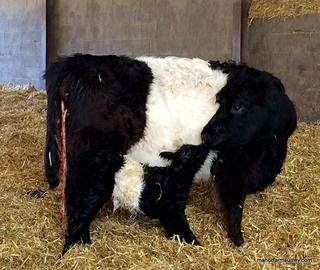
Wotton Pearl with her calf Wotton Gem
Our pedigree herd has the prefix 'Wotton', so for example 'Wotton Pearl' has given birth to a heifer calf with a complete belt and no other white markings and will be registered as 'Wotton gem'.
When the pedigree bull we hired a few years ago threw a few mis-marked calves they couldn't be registered, but we kept some of the good natured heifers such as 'Ella' who is entirely black, as she can still provide more cattle for conservation grazing on the North downs.
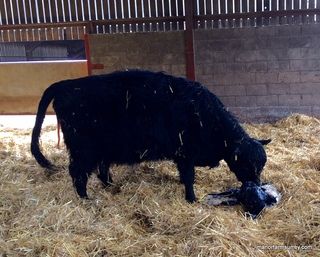
Ella licking clean her newborn calf Louis
It was interesting to find her first calf had a perfect belt and yet this year her bull calf named 'Louis' has two long white socks at the front and two shorter socks on his hind legs which are hidden in straw.
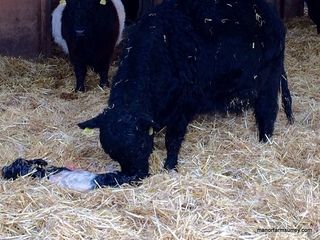
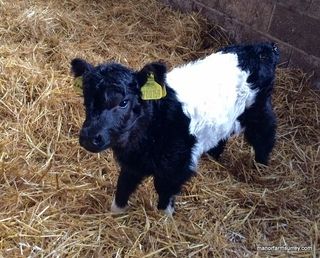
Louis is a good strong bull calf and so very cute!
The great thing about Belted Galloways is their hardiness and their usual ability to get on with calving by themselves.
We used to calve our Belted Galloways outside but it's been necessary to take precautions against Neospora Caninum, a parasite with a canine host. Adult cattle may become infected by ingesting oocysts in grass and soil contaminated by dog faeces which can cause miscarriages and infertility in cattle.
By taking biosecurity measures we minimise potential infection and break the cycle between the canine host and cattle by bringing our Belties inside for calving.
We have live infra red cameras in the calving barns which enable us to view the cattle on a computer or our phones, providing an overview of what the cows are doing whilst we are working elsewhere, between the regular checks made in person.
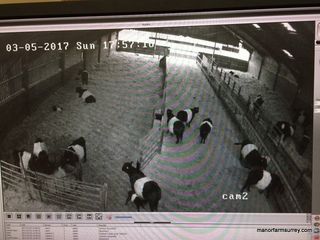
The cameras give some added reassurance inbetween barn visits.
Now that the calves are a few days old they like to charge about the barns creating an amusing distraction in the office when I'm meant to be writing! We look forward to turning the cows and calves back out to grass in the coming days.
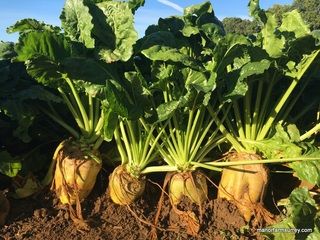
We've grown 3,500 tonnes of fodder beet this year which we feed to our Friesian cattle, pigs and sheep and sell to other livestock keepers in the south east. We are taking orders for next year or details of anyone interested in buying beet next winter for horses, pigs, sheep and cattle, please call 07774275930. Fodder beet grows well in our lighter soils and the crop lifts in a clean condition, not needing to be washed before use.
Historically glebe land used to provide an income from farming for the local clergy. The area to the east of St. John the Evangelist church is still called the Glebe and it continues to be grazed by cattle.
Laurence can remember his father ploughing and reseeding the Glebe hillside with grass twice in 50 years with the last time being in the 1970's.
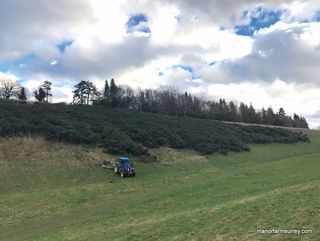
Every few years we need to cut back the encroaching gorse as it quickly invades 4-5 acres of grassland and whilst working in the valley we also cut back the footpath alongside the ponds to help walkers remain on the definitive route.
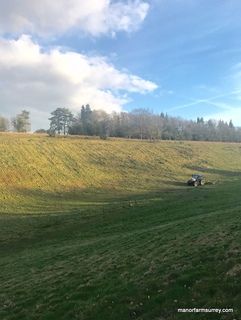
This sort of work is undertaken in the winter months and before the nesting season, as is hedgelaying. Hedges are used to create a stock proof enclosure but where the field is no longer used for livestock we still maintain the hedgerows as wildlife corridors linking other hedges, woodland and grassland for mammals, insects and birds.
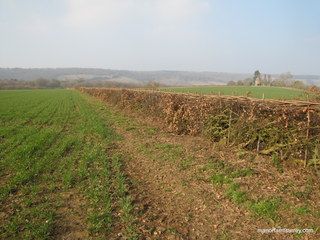
This hedge has been laid in stages over three years.
The final stretch of hedge at the northern end of the 17 acre field has been laid by a team of keen Surrey hedgelayers. The base of the upright stems of the hedge are partially cut into and laid down, to not quite a horizontal position so that sap can still rise. Hazel stakes are placed along the hedge line with flexible hazel binders woven between them to hold the hedge steady. New growth will sprout from the base of the hedge, thickening up the vegetation and revitalising the hedge for coming years.