


 EDUCATIONAL VISITS Manor Farm is fully accredited by the Countryside Educational Visits Accreditation Scheme (CEVAS)
 THE FARM
Contact us for availability.

Archived News
12th November 2016
We have a grazing agreement with Natural England to graze the North Downs each summer between Gomshall and Dorking, at the end of which they are sorted into groups and taken to lower pasture for overwintering.

At the end of summer the cattle were keeping their heads down, grazing longer to try to gain the food they needed. It was time to come home.
Back in August five of the in-calf cows were chased from their field and spent the rest of summer with the yearlings further west. The 'magnificent five' have now been returned to their correct group.

Half the in-calf cows have been moved to Abinger Hall which meant that Ethelred the bull could join them back out at grass instead of the bull pen, whilst Mister M was able to rejoin the others which are now in West Lawn.

The yearlings moved back to Raikes Farm and the non-breeding cows remain on the Downs but will move to the Parkland at Landbarn Farm next week.
The Belted Galloway cattle overwinter outside and with low sugar content in the grass this time of year, we give them home produced haylage to provide them with the energy they need.
The Belted Galloways are in eight locations at the moment and without other distractions it can take 2-3 hours to check them. The Friesians are at four sites.
The Friesians are overwintered inside and are fed a ration which is calculated and monitored by a nutritionist and includes the fodder beet and maize we grow. There is one last group still to be brought in from Netley.
The fodder beet was sown between March and April and we began lifting it in September. As well as feeding to our Friesians, sheep and pigs, it's also sold as a cash crop and is lifted fresh to order.

Fodder beet is a root crop which is lifted from the soil. The leafy tops are removed by the harvester and conveyed into a large basket behind the cab.
The fodder beet grows well in our sandy soils and is clean when lifted, making it popular with livestock farmers and horse owners from Hampshire to Kent.

Many factors limit what grows successfully on the farm, but in particular by soil type, pests and diseases and the weather.
Last year we grew peas, barley, oilseed rape, and wheat as combinable crops (harvested with a combine harvester) but made no money from the peas and barley, so this year we've sown 240 acres of oilseed rape and 840 acres of wheat between August and October.
15 acres of a class 1 milling wheat were sown last night as part of a trial of a new variety to the UK. The ground was prepared and drilled before today's predicted rain which should help establish the crop.
Farming is about more than 'just' field work, it's also about watching the markets and exchange rates and making business decisions based on world events, with a prime example this week.
Seeing that Trump was in line to win the Presidential election, Laurence sold 800 tonnes of milling wheat in the early hours of Wednesday morning.
The price of wheat has fallen by about £5/tonne in the UK since Wednesday, so we would have made £4,000 less if Laurence hadn't made that judgement. But as he says, the price could rise again over coming weeks and he has to make decisions to sell grain based on the facts in front of him at the time.
We attended a Brexit consultation meeting organised by the National Farmers Union in early September and completed the members consultation questionnaire to provide feed-back about the future of farming post Brexit.
That meeting led to me inviting a team from Defra to our mixed farm to see what we do here, discussing all manner of post Brexit farming and how various scenarios could impact upon our own farm business and other agricultural sectors.
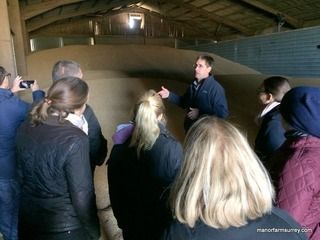
Discussions included older and new grain storage and machinery, precision farming, quality control, and cosistency of products.
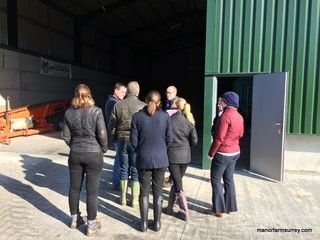
As farmers it's important to be open and provide frank comment and information about the difficult issues facing UK agriculture with those who are working towards a model for post Brexit food, farming and countryside.
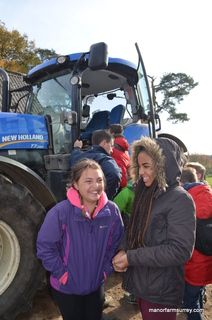
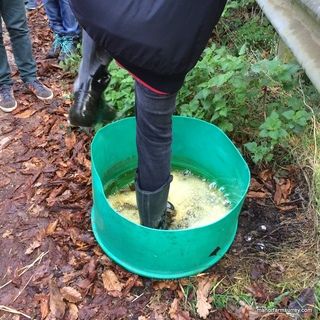
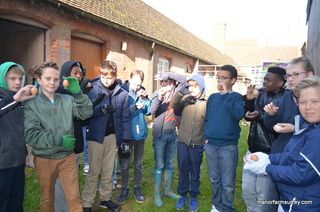
Having collected the hen's eggs, I am looking forward to hearing what the pupils cooked with the two dozen they took back to school!
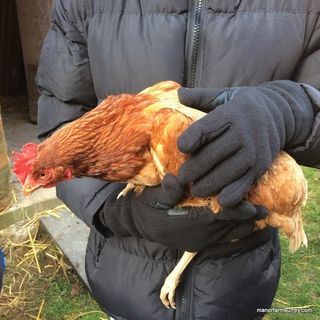
Meeting the hens.
What began as a suggestion for us to take on a handful of cows and a bull, all long since gone, took us into rearing a suckler herd about ten years ago.
We introduced new blood lines with a number of bulls and bought a herd of cows with calves at foot from the west country. This has resulted in the Wotton Herd of pedigree Belted Galloways and each heifer we register with the Belted Galloway Society has the Wotton prefix.
We currently have 92 head of Belted Galloway cattle on the farm including two bulls, with a further 40 calves due next spring.
The Belted Galloway heifer calves born on the farm are kept as replacements for the older cows and the male calves or steers are reared for beef. Four of these have recently been butchered and sold direct from the farm.

This entails a fair amount of work selling the beef in advance, to ensure the entire animal is sold and collected in one go. I am quite proud to have sold all the Beltie beef we have produced in the past ten years, all direct from the farm. I believe we need to take each change or new experience in our lives and do the best we can and it's amazing what things can be achieved!