


 EDUCATIONAL VISITS Manor Farm is fully accredited by the Countryside Educational Visits Accreditation Scheme (CEVAS)
 THE FARM
Contact us for availability.

Archived News
24th April 2016
All aspects of the farm have been busy this spring with Belted Galloway calving followed closely by lambing, getting the Friesians ready to go out to pasture and months of field work.
As the Belted Galloways are transitioning from spring and autumn calving to just spring calving, we have just welcomed 16 calves during March; 9 heifer calves and 7 bull calves.

On the whole calving went well this year and we didn't need to intervene during any births. Next year with all the cows and heifers calving in the spring we will expect about 56 calves in the same period of time.
There were a higher number of breach lambs this year than we've had before, providing a few challenges mostly in the early hours of the morning.

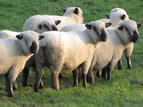
Quite often I'm the one roped in to assist the ewe as I have a smaller hand and arm! Christopher takes pride in the pedigree flock which started with just 9 sheep and has increased to 50 despite last year's dog attack.

The ewes were scanned earlier in pregnancy and one was expecting triplets but went on to have a fourth lamb. After a lengthy birth the fourth lamb came into the house to warm by the Aga, he is bottle fed as the ewe didn't manage to feed all four, including 3.30am which plays havoc with sleep and by day he follows us everywhere.

The bulls both passed their annual fertility tests and have had their feet checked and trimmed in readiness for the work ahead of them.

Some of the cows feet were also checked and the remainder will be done later in the year when the recent calves will be weaned from their dams.While the cattle were in the crush having their feet checked we also took the opportunity to trim their ears and replace any missing tags.

Digestate is an organic fertiliser applied to the fields prior to cultivation. The digestate is imported to our farm by lorry from anaerobic digestion systems in the south east.
Applying digestate to the soil provides more organic matter which helps the soil to retain moisture, improves root structure to maximise nutrient uptake and the crops respond better and compete and outgrow weeds. Where digestate has been applied the crops have been strong and healthy with increased yields.
After applying fertiliser to the soil it is cultivated with a minimum tillage cultivator which has two rows of discs followed by 2 rows of tines, another set of discs and a roller, so one pass of the field achieves many processes, uses less energy, is faster and more efficient than using many separate implements and passing across the field many more times.

Following behind the minimum tillage cultivator is the power harrow which creates a fine tilth or seed bed.
There are a few drills used on the farm for sowing seeds; we have our own drill used for crops such as wheat and barley and a contractor uses one of two precision drills, specific to beet or maize drilling.

Beet drill
The contractor has been working behind the power harrow drilling beet at 40,000 seeds per acre and 90% of those will be viable.

The beet seeds are drilled in rows 20" apart in preparation for lifting with a specialist beet harvester later in the year.
Beet has been drilled during March and April and it can be lifted or harvested from November as and when required, making it a good crop for preserving ground cover; it's a bit like a larder full of food in the countryside that's stored in the ground until needed.

Beet harvesting or lifting.
We have just completed harvesting last year's beet which was grown for our own cattle feed and for sale to an AD system and other farms in the south east.
We have two agronomists who 'field walk' the farm every week and report back regarding whether the crops they assess are growing well, any plant growth problems, pests or diseases they find or nutrient deficiency so that informed management decisions can be made for the coming week. Laurence used to do much of the field walking years ago when there was one agronomist and fewer fields. The extra sets of skilled eyes on the crops is an important part of the farming process.
Andy measured soil temperatures today in the fields due to be drilled with maize. The temperature preferably needs to be above 12 degrees Centigrade for maize grain to germinate properly with a quick, uninterrupted germination. Our agronomist measured between 10 and 12 degrees according to soil type and field location. Drilling will begin where the fields are already 12 degrees.

Colin discovered 'Light Leaf Spot' in some of the oilseed rape (OSR) and a yellowing of other leaves which he will have analysed on Monday but he suspects here may be a deficiency in either magnesium or Manganese.
Deficiencies can occur on light land which dries out quicker than medium loam soils.
Having undertaken all the cultivation, fertilising, sowing of oilseed rape and application of flea beetle control last autumn; still 60 out of the 150 acres drilled has failed due to a combination of bad take-up after drilling and pigeon damage and more recently competition from aggressive weeds outstripping the growth of the crop. Those 60 acres have been written off and we begin again with an alternative crop that can be drilled at this time of year as it's too late to re-drill with OSR.
The replacement crop must be suited to the soil and of real significance we must consider what might make a profit or at least the lowest loss come harvest time. Bearing in mind we have already incurred the costs of all the work entailed in the 60 acres written off, with no return, plus the cost of production is above the price received.
With our weather becoming increasingly wet, so also is the land. 200 acres of crops have been lost due to the land being too wet for the crops to establish, so we are currently mole draining or moling at Upfolds and will then mole three fields at Park.

A smooth unlined bore, 21" diameter is made through the clay subsoil to aid drainage and for some fields we have old drainage maps from decades past which provide guidance of where to run the moling.
Back