


 EDUCATIONAL VISITS Manor Farm is fully accredited by the Countryside Educational Visits Accreditation Scheme (CEVAS)
 THE FARM
Contact us for availability.

Archived News
21st July 2015
I begin my latest news back in time about 70 years
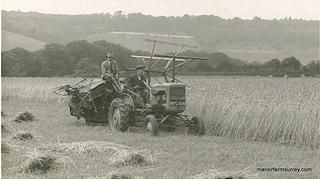
After the Second World War Edward (EDG) Matthews harvested the arable crops with a horse drawn reaper (later pulled by a tractor) and after drying in the fields for 2-3 weeks the grain was separated from the straw with a threshing machine located at West Lane.
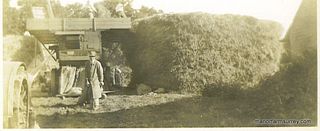
The grain would be loaded into sacks (as in the above photo)and stored in various barns and grain storage areas until a merchant collected it.
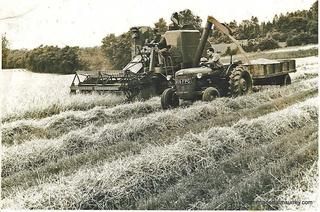
During the early 1950’s Edward purchased a combine harvester which meant that the grain was separated from the chaff on the move in the field. It was during this period that he had a bulk grain store constructed. This allowed the grain to be stored in bulk in ‘bins’ rather than in sacks; however it was still some years before the merchants could collect in bulk, so for a few years more it continued to be bagged up before leaving the grain store.
The brick built store had eight bins that could store 25tonnes each and later 2 x 50 tonne bins were added. This storage could be ventilated with cold or warm air to condition the grain.
A 20 tonne overhead bin was also part of this grain store which was constructed by a local Agricultural fabricator by the name of Gross. This enabled the haulier to position a truck below the overhead bin and ‘gates’ were manually unwound to allow the grain to be released from above into the truck below.
In 1970 a ventilated six-bin metal grain store was constructed with storage that improved upon the original and that was extended to a 12-bin store in 1975. This increased the farm storage by 600 tons to nearly 1500 tons
The original overhead bin that was used in the 1950’s brick grainstore is still in use today, in 1993 it was expanded to hold 30 tonnes.
We are now finally converting the slow manual opening of the gates to an electric switch!
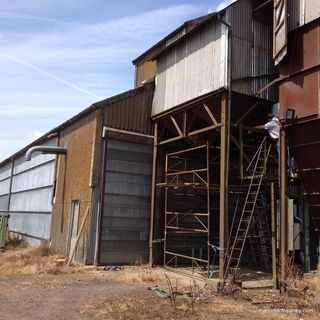
Scaffolding frame in place below the overhead bin as gate switches added.
As farming has adapted and evolved; so has the machinery, crop varieties and expectations of grain quality and grain storage.
Expectations for grain quality and storage have risen dramatically in the last 20 years, with higher standards for dryness, cleanliness and temperature which must be reached prior to collection. If a load of grain reaches the merchant and they deem it to be below any of the required standards it will be returned to the farmer.
With each generation the farmer has moved with the times; Edward Matthews began primarily with horse power and a thresher, built the first brick grain store and introduced the first combine harvester, then gradually phasing out horses; Fred brought in more mechanisation as it became available and built the metal framed grain store.
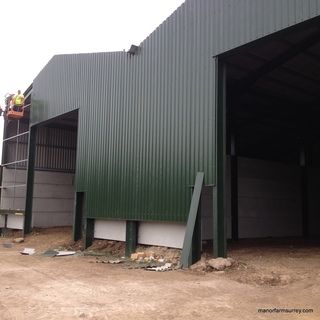
The cladding has been added to the metal frame.
Now, well into the 21st Century our new metal framed grainstore is almost complete and will provide high quality permanent storage in addition to the old metal store and the other temporary or seasonal grain storage we use.
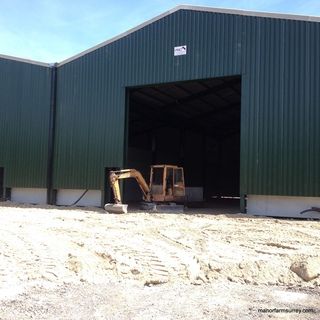
The ground has been levelled ready for concreting
Back