


 EDUCATIONAL VISITS Manor Farm is fully accredited by the Countryside Educational Visits Accreditation Scheme (CEVAS)
 THE FARM
Contact us for availability.

Archived News
31st May 2015
The peas have established better than we might have hoped, probably due to the various scarecrows and bird scarers in place across the fields. Some of them take human form and look fairly life-like from a distance; whereas others can simply be old CD’s spinning in the wind.
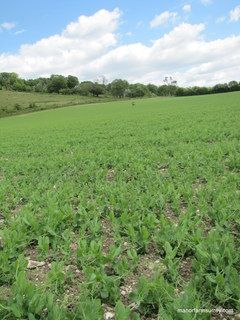
Peas with a scarecrow in the distance
Each crop has a limited time frame in which to establish and in the past we have had entire crops fail due to pigeon damage.
Seed bed preparation, crop establishment, aftercare, harvesting and of course the weather, all play their part in arable farming and our aim to produce good quality British produce. Any one element could affect the level of yield or success of a year’s work.
Attlees have collected the last of the oil seed rape that we grew last year which leaves about 40 tonne of triticale in one grainstore ‘bin’ and a small quantity of wheat. All the grainstores will be cleaned in the next month or so prior to this year’s harvest; they get dusted and vacuumed from the rafters to the floor.
We’ve been struggling for years to have enough grain storage as the efficiency and modernisation of farming techniques even in one generation has increased the yield per acre.
We had planning permission for a grain store at Coast Hill Farm and although the store was much needed, the permission lapsed at a time we were still coping with the death of laurence’s father.
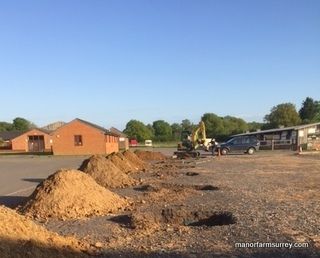
However the footings for the new grain store are now in place and the building framework should arrive on site this week and if all goes well the store which will provide 10,000 square foot of storage, will be ready for use this summer.
The Surrey County Agricultural Society saw 40,000 people through the gates at last week’s County Show which show cased a variety of top quality livestock from dairy and beef cattle to pigs, sheep, goats and poultry.
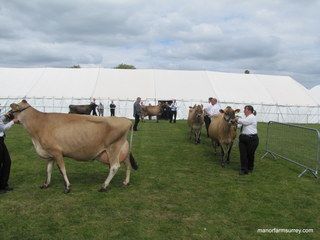
Dairy class being judged
Livestock stewards undertake an important role at County Shows up and down the country, checking which livestock arrive the afternoon before the show and managing their passports, ensuring that the exhibitors and the livestock have all they require overnight.
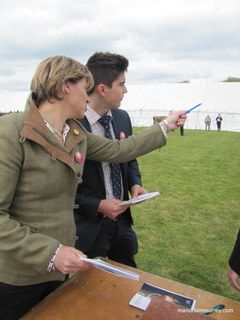
George Matthews and Louise Young (NFU) stewarding the Dairy cattle
On show day itself the exhibitors are up very early grooming and preparing their prize animals and stewards have a number of duties to make sure the correct class enter the ring on time and that judging runs smoothly, results are recorded correctly and rosettes and certificates are awarded.
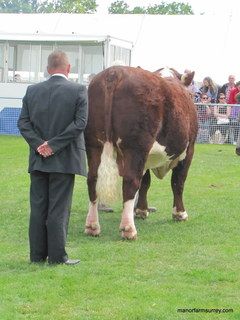
Judging a Hereford bull
After all the classes are judged the prize winners are led to the main ring for the Grand Parade.
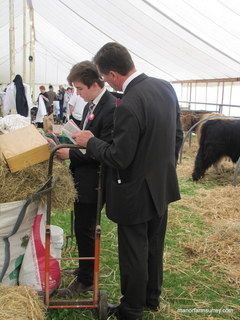
Christopher and Laurence
Our boys have taken in the footsteps of their father, grandfather and great grandfather as stewards.
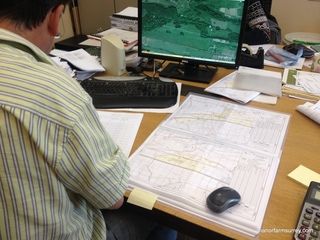
Laurence is going through 31 maps of the land we farm and has to check they are correct and must remove illegible features such as roads and trees if they have been left in, and return to the RPA. This takes 4 – 5 days, it is particularly complicated but must be extremely accurate as fines will be given for any errors.
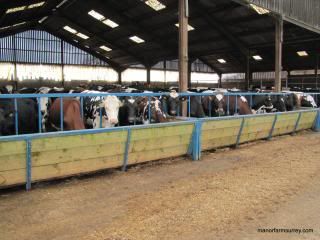
24 finished cattle have gone to ABP in Guildford as has one Belted Galloway cull cow. The barns have been mucked out and the muck trailered into a field where it will stay in a heap until muck spreading next year.
The Belted Galloways are in a number of groups according to their age or stage of reproduction.
We spend days at a time sorting the suckler herd, such as at weaning or when we need to separate one main group into two or three groups as we have recently.
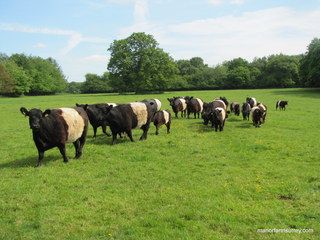
This group were walked up from Wotton House through the fields to Hatch meadow where they were sorted into groups.
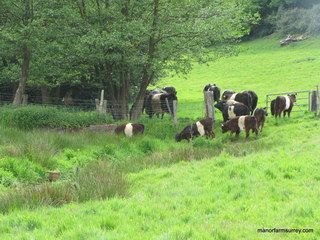
We walked one group back through the fields where calves paused for a drink fron the Tillingbourne
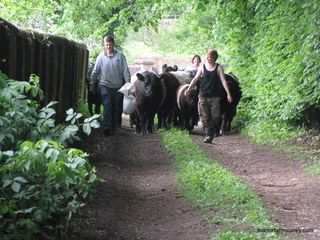
As the cattle are sorted we also have to replace any missing tags and treat with fly prevention and move either by foot or tractor and trailer.
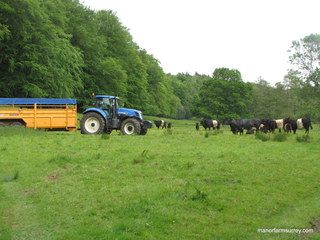
Some cows that will be culled in the autumn cannot be served by the bull so they needed to be split off and as they have calves at foot we moved them to a field at Netley without a footpath. Two groups are grazing the North Downs and further groups will join them after PDing and bulling.
Cows currently being served by Ethelred and still with calves at foot, are grazing Long Meadow behind Wotton House whilst Mister M is serving Ethelred’s daughters at Churchfield.
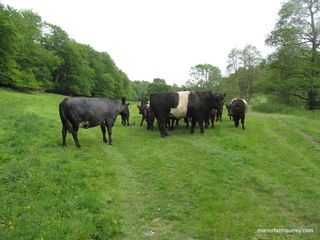
Ethelred is pleased to back with his Belted Galloways wives and Flo
our Belgian Blue x
As neospora caninum (dogs are the host) is becoming prevalent across the UK and causing miscarriages in cows at 6-9 months or stillbirths, we are having to review biosecurity measures and herd management.
Being a hardy native breed our Belted Galloways have lived and calved outside all year round and only occasionally had to come in with very young calves when the weather was particularly awful for a long period.
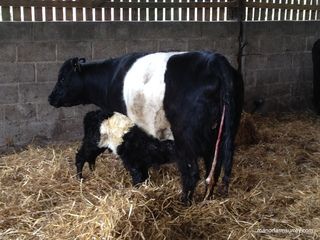
But after discussion with the vets and the test laboratory in Scotland we have decided to calve the suckler herd inside to reduce exposure as far as we can, until some sort of cure or prevention can be found.
Back