


 EDUCATIONAL VISITS Manor Farm is fully accredited by the Countryside Educational Visits Accreditation Scheme (CEVAS)
 THE FARM
Contact us for availability.

Archived News
28th March 2015
It has been a busy few months of field work and maintenance for the next cycle of crops, while grain from last season is gradually sold. 120 tonnes of maize grain has been sold to our local grain merchant, Attlees. The grain requires a grain passport and Don certificate which the haulier must have before departure.
Barley has been transported to Tilbury Docks and loaded onto a boat ready for export in April to the Far East.
We have also been selling fodder beet for cattle, sheep and pig which is an excellent source of energy.
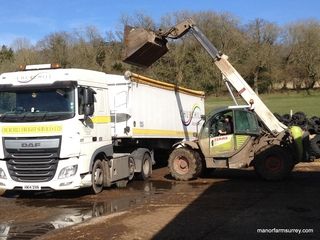
Here’s a lorry being loaded with fodder beet
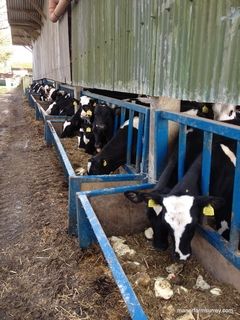
Some of our younger Friesians eating their fodder beet.
The last of the winter wheat was drilled at the end of February while the peas, maize and fodder beet are yet to be sown. Maize is a crop that needs quick, uninterrupted germination and growth in soil temperatures above 12 degrees Celsius to germinate properly, which in today’s cold wind feels a long way off.
The oil seed rape which was sown in August is not growing at all well due to a combination of the lack of protection against flea beetle, poor establishment and wet weather. As the seed was not ‘dressed’ or protected against flea beetle this year, we’ve had to apply insecticides through the autumn which would otherwise not have been necessary.
Last autumn we were contacted by a molecular biologist from the University of Bristol seeking farm locations to help with important research into the effects of pesticides on important pollinators in the UK.
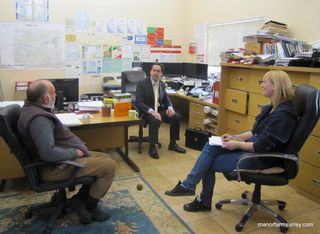
Dr Taylor visited us on Friday and met with our agronomist Andy Gay. Dr Taylor explained that current research on the effects of pesticides has often focussed on laboratory studies using pesticide doses far above those used in farming practises and are therefore not indicative of natural exposures.
The University of Bristol are therefore investigating options for new research into the effects of pesticides on important pollinators in the UK.
Their research suggests that pollinators, such as bees, are able to naturally breakdown (detoxify) pesticides far more easily than previously thought. They know that wild bee species are less sensitive than honey bees to chemicals, and that this is due to the presence of a number of detoxification enzymes.
Pollinating insects are vital to UK agriculture, especially crops such as oilseed rape, which has been successfully pollinated by bees for years and which provides an important habitat for bees.
Dr.Taylor says further research into the molecular process involved in metabolising and detoxifying pesticides is urgently required in order to maintain bee populations.
This is a fascinating and important research project that we are very pleased to be able to assist with.
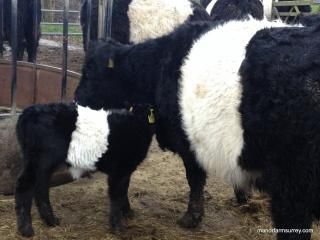
The Belted Galloways began calving in January and as usual this was outside calving.
However the ground became too wet and it was impossible to gain access to the field to tag or ring the calves so we made the decision to move the cows into a barn at Hackhurst once it was vacated by some of the Friesians.
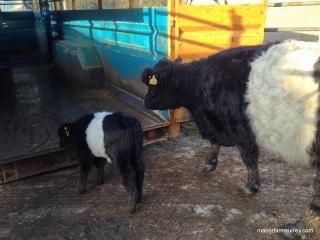
First trailer journey for this calf
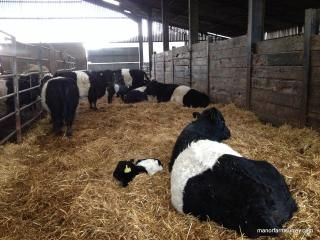
Into a barn for the remainder to calve
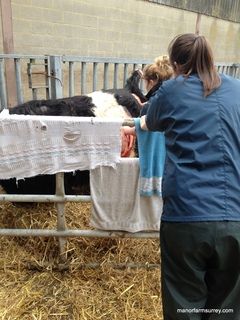
One heifer held onto her calf for a month after the rest. Unfortunately Holly was prolapsing for weeks beforehand and had the vet to stitch the prolapse back in place. The cow was monitored until calving began, then the stitch was released. Calving did not progress due to the scar tissue around the prolapse, resulting in a caesarean section.
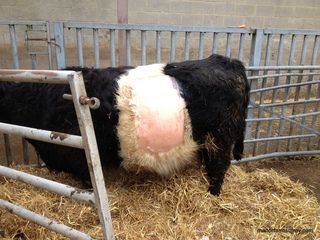
Holly is shaved for the operation
Internal parts were put back in place and then sutured
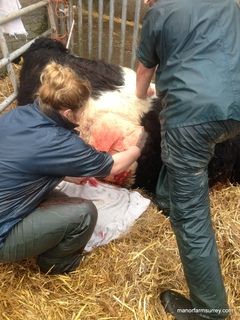
Holly went down for the final part of the operation
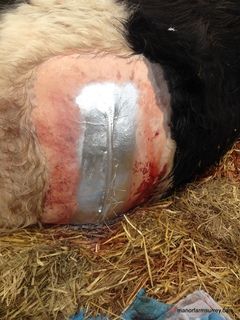
The vet used an Aluminium type spray to help prevent infection
Taking the Friesian cattle from ‘stores’ to finished or ‘fat’ cattle as they are known, is still costing more in production than the end price we receive from the abattoir or supermarkets, so we have sent almost 120 stores to Sedgemoor market over the last two Saturdays rather than continue finishing the cattle at below the cost of production.
The cattle are regularly weighed to check their performance which makes it easier when sorting those cattle ready to go to market.
In order for the cattle to arrive in time for market they are loaded onto the lorry at about 4am by the driver and Amanda. Laurence gets all the paperwork and cattle passports together the night before which for those numbers of cattle can take many hours. Once the cattle have departed Laurence then updates the electronic records and informs the British Cattle Movement Services (BCMS) that each individual animal has left the farm, which haulier was used and the destination.
Barns have been mucked out and the muck spread on the fields for fertilisation, also the muck heaped in the field over previous months has been spread.
Other fields have had digestate from an anaerobic digestion plant applied recently. The digestate is an organic fertiliser which replaces artificial fertilisers which we’d otherwise have to use.
The anaerobic digestate is a much more sustainable product than importing Egyptian fertiliser made from fossil fuels.
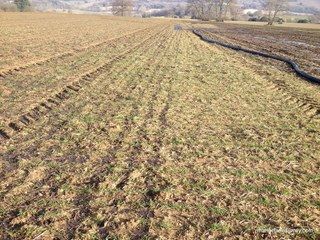
Rich organic digestate spread on the right. The left of field is next to be spread.
Clearly it would be even better to use digestate from our own AD plant if we had one on site as that would cut out the hundreds of lorries that deliver either the fossil fuel based fertilisers or the digestate that is currently being hauled in from another AD plant. One lorry load is currently being spread per acre so that is a large number of lorries on local roads that would not be there if we had an on farm AD plant.
Whilst producing nutritious food that suits our grade 3 soils, we also undertake habitat management and environmental work and organise free Educational school visits to help children gain a better understanding of a working farm and where their food comes from. It makes for a very interesting and diverse way of life.
Last week we were visited by St.Jude’s School who have been visiting us from London for six years! It was a pleasure to meet these groups of Key Stage 2 children and we hope that they had a great time and learned a lot of useful information to help with their Growing Project.
A further 200m of hedge laying has been undertaken by a group of local hedge-layers keeping this ancient rural skill alive. Hedges were commonly used a livestock barrier with the brash side facing the livestock and the fresh shoots emerging from the layered pleachers on the other side of the hedge.
The mixed species of hedgerow trees are left to grow in height for a few years prior to laying. Selecting a stem to lay from the stool or stump, cutting into that stem and reducing its thickness is all part of the skill, leaving sufficient bark and sap wood for the laid stem, known as a pleacher to survive.
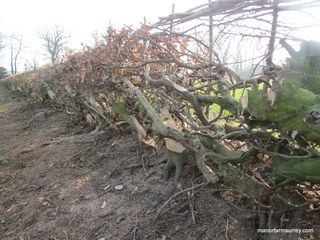
The pleachers are laid more towards a horizontal position however must still lay uphill in order for the sap to rise and new shoots to form at the base.
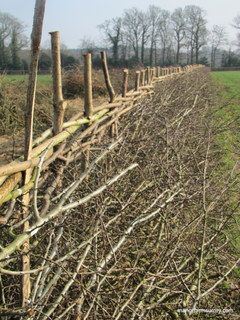
Hazel stakes are placed along the hedgerow with Hazel binders twisted through the top to maintain strength whilst the hedge begins its re growth. The hazel stakes and binders are both products of coppicing which is another ancient management skill continued today.
A hedge may be laid every 15 years which promotes new growth and thickness to the base of the hedge and improves its strength. This rotational management increases the lifespan of hedgerows which act as wildlife corridors around our farm for mammals, insects and birds as well as providing a different habitat for plant species along the hedgerow and field margins.
Back