


 EDUCATIONAL VISITS Manor Farm is fully accredited by the Countryside Educational Visits Accreditation Scheme (CEVAS)
 THE FARM
Contact us for availability.

Archived News
18th January 2015
Ed has been ploughing the fields along Whitedown prior to cultivation for peas and now that the fodder beet has been lifted at Paddington he will plough those fields for the next rotations of Barley and wheat.
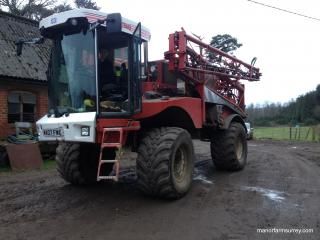
Our versatile computer expert has been out of the office and in the cab of the Bateman sprayer, investigating problems with the GPS system.
When the sprayer was sold to us about five years ago, the chap selling conveniently failed to inform us that the supplier of the GPS kit was changing over to a different satellite signal and they no longer wanted to deal with the original kit they had supplied for the sprayer.
We have just about coped over that period, despite numerous problems and the supplier not being too willing to resolve these, because they would rather we bought a whole new system costing about £16,000
A GPS system helps to provide very precise application of fertiliser, herbicides or spray, preventing any missed areas or overlaps on the crops. This piece of precision kit is estimated to save around 5% wastage and ensures only what is necessary is applied.
Having visited the pedigree herd of Belted Galloways at Barwise Hall in September, I bought our new bull ‘Barwise Mister M’. Mister M was halter trained which has already come in handy because he seems to prefer to be led compared to Ethelred who tends to walk on in front.
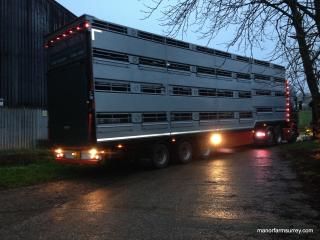
It’s a long way to haul a single animal from Cumbria, so hauliers are often asked for a part load on a lorry to share costs and make use of an empty lorry on its outward or return journey. Having made inquiries with a number of hauliers I then had to wait for the first of these to have a spare bay which could bring Mister M south.
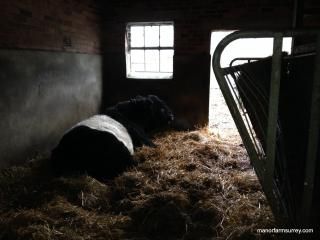
It took longer than we’d hoped, but eight weeks later a call came at lunchtime offering a lorry to bring Mister M down as far as the haulier’s yard where he would stay in lairage overnight and the next morning we’d discuss the possibilities for the next leg of the journey.
The bull was loaded on a trailer and was meeting the lorry in Penrith within an hour of the call. Finally he was on his way to join the Wotton Herd of Pedigree Belted Galloways.
The following afternoon a lorry due to collect a load of sheep in Hampshire, made a detour to us with Mister M. He looked swamped by the size of the lorry, but later that night it was filled with sheep.
We had a busy few days before Christmas (can’t believe how long ago that seems!) sorting out the Belted Galloways and moving them onto fresh ground.
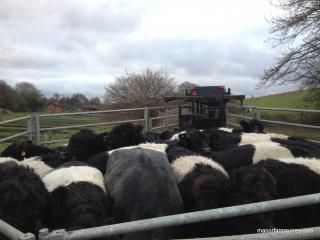
The cows and Ethelred were fetched up in the Cressbeds and as each one passed through the crush before loading into the trailer, we trimmed their ears and tails to tidy them up for winter.
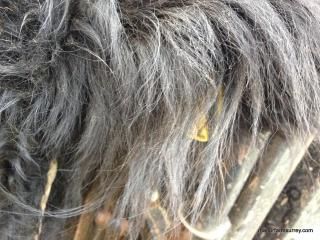
The hair grows fast around their ears
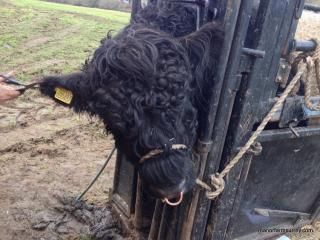
Here is Carsluith Ethelread getting a haircut!
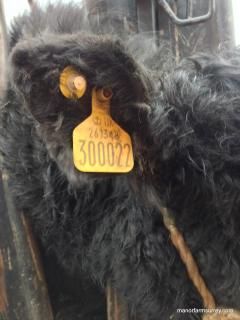
It helps to trim their hairy ears so that we can read the tags more easily and the tails because it prevents them getting caked in mud as they out-winter.
The grass has little or no value at this time of year so the outside cattle are fed home grown haylage as are the calving herd.
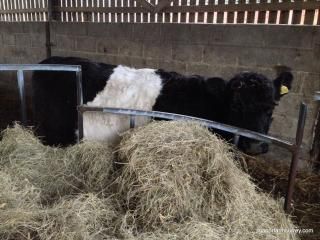
Haylage is grass that has been cut during the summer and baled and wrapped in plastic whilst it still has a high moisture content. It is different from hay which is left out to dry before baling.
The plastic wrapping keeps the oxygen out and creates anaerobic conditions, which allow the hay to pickle or ferment. Haylage has a higher level of digestible protein than hay and is often feed to horses if they are sensitive to any mould or dust in hay.
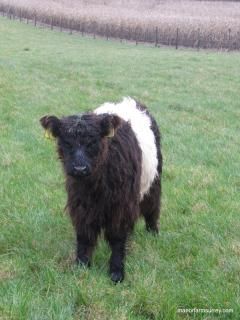
Calves born in 2014; they will feed on mother's milk for 9 months
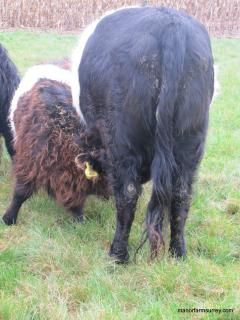
It’s almost three months since the last calving of 2014 and it all began again on 7th January with the birth of a heifer calf at Churchfield followed closely by another two heifers.
16 Belted Galloways and one Belgian Blue x are due to calve.
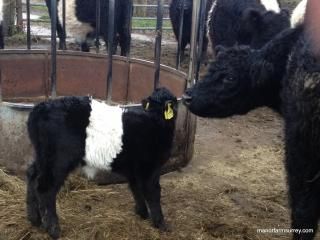
The weather has been fairly dismal and the ground quite muddy for such short calf legs! so we decided to move 15 cows and the three calves to Hackhurst barn on Friday.
We took just five cows at a time on the short journey and very steadily; there's a section at the front for the calves to travel with their mothers and away from the larger pregnant cows.
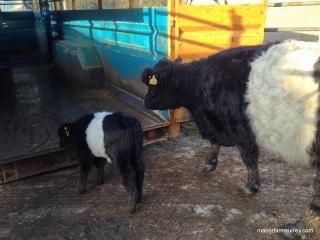
First journey on a trailer for this little one!
Jill has what the vet suspects is a trapped nerve and so we have kept her apart from the main crowd for a quieter calving, but with another cow for company.
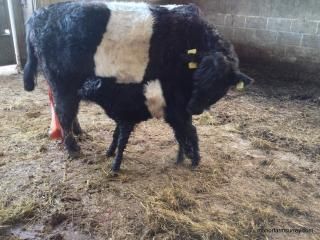
Yesterday a bull calf was born in the morning and a heifer later in the day.
Back