


 EDUCATIONAL VISITS Manor Farm is fully accredited by the Countryside Educational Visits Accreditation Scheme (CEVAS)
 THE FARM
Contact us for availability.

Archived News
8th July 2014
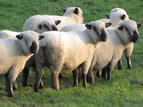
Our next Belted Galloway Beef is available 14th July, please ordered in advance at: info@manorfarmsurrey.com The ‘Beltie’ beef is dry-aged for four weeks to concentrate the natural flavour and tenderise the beef after year-round grazing on natural pastures and the herb rich grazing of the North Downs. 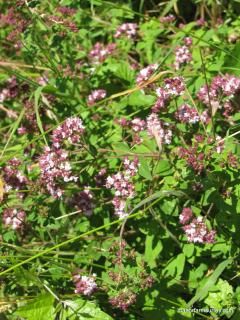
Harvest preparations have been in full swing; the combine harvester serviced and the grain stores literally dusted and vacuumed in readiness for this year’s grain storage.
Grain storage is always tight as we have to get everything in within a relatively short space of time and much is dependent on the weather. Logistics become more complex if the grain needs to be dried and there’s no available space to put it.
Our grain storage has been adapted and improved over the years to enable a less manual system of emptying (cumulatively days of shovelling by hand) but there isn’t sufficient space to manage the tonnage especially when more crop varieties are grown in a given year or due to wet weather.
Planning permission for a new grain store lapsed at a difficult time after Fred’s death and although this permission has been re-sought and granted, it is too late for this year’s harvest so we will have to muddle through and pray that we don’t have a wet summer.
Each crop such as wheat, barley and oats will be stored separately as will the individual varieties such as milling wheat and feed wheat but the grain cannot be stored until the moisture content is below 15% and reaching this within the shortest possible time prevents quality degradation.
The combine harvester monitors the moisture content of the grain as it’s harvested and a hand held meter can be used once the grain is in a trailer or storage area. When moisture content is too high, the grain is put through the grain drier which entails more shifting about of grain before it can finally be stored.
The grain needs to be cooled rapidly once in storage to maintain good condition and prevent insect damage. Ventilation systems vary between the grain stores but are often within the floor and blow cool air beneath the grain.
We have a long history with Plumpton Agricultural College which includes work placements for students, full time work for graduates as well as hosting Educational visits for Agricultural students.
This summer we have Joe working for us who has completed his studies at Plumpton and Rees who has yet to complete his course.
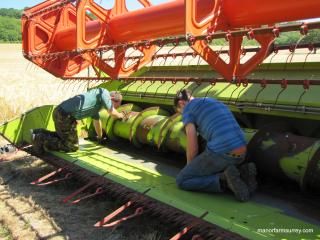
Ed and Rees preparing the header for grain harvest
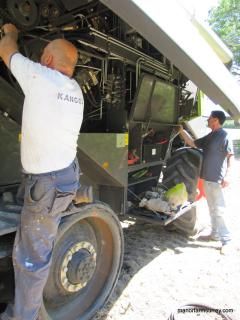
David and Laurence making final adjustments to the combine
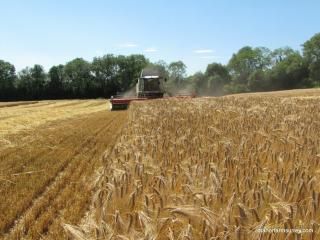
On Thursday Laurence began harvesting 60 acres of barley north of the railway line, which for the first time in about 15 years or so, is being crimped and stored for cattle feed.
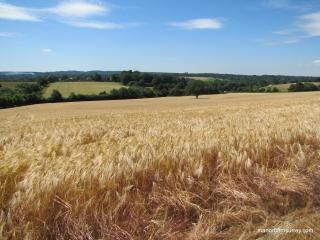
Slightly green barley as required for crimping
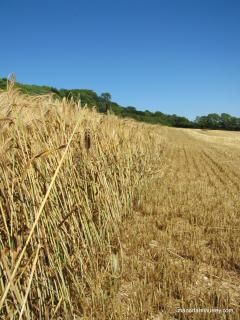
When crimping, the grain is harvested before full maturity with a moisture content above 25% but on Thursday, the hottest day of year so far, the moisture dropped from 35% down to 25% within the day.
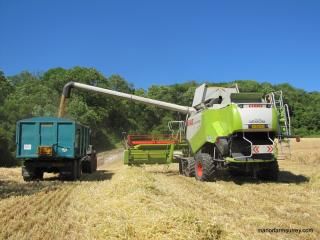
The barley grain was carted along the field to Gomshall where it was fed into the crimping machine which gently cracked the husks.
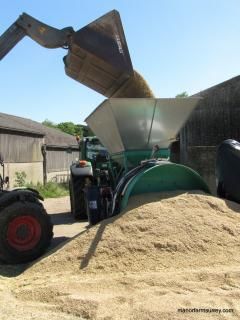
Once crimped, the grain is ensiled to produce a high quality, on-farm and thereby fully traceable feed for our livestock.
Ensiling is based on lactic acid fermentation created by lowering the pH to 4 within anaerobic conditions.
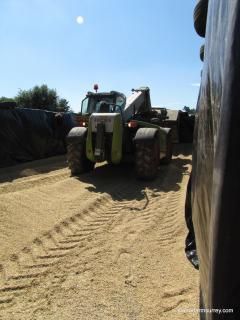
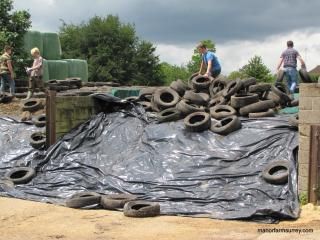
The crimped grain is placed in a clamp and compressed before sheeting over to create anaerobic conditions (the moist grain would rot if left uncovered in aerobic conditions).
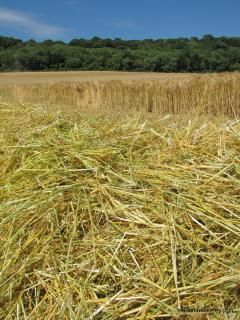
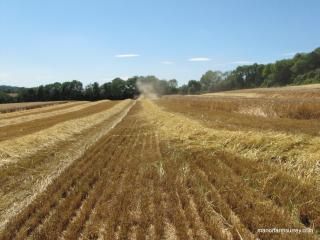
The damp barley straw has a beautiful sweet scent; it could have been wrapped as stawlage but as we have plenty of haylage at present we’ll let the straw dry and bale for winter bedding.
We undertake a variety of wildlife management within the HLS scheme but also choose to provide extra corners and quiet areas where we can.
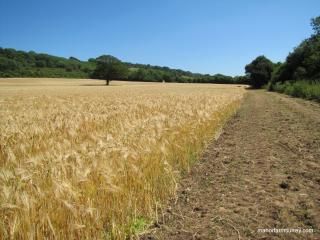
In this barley field the headlands have been topped and recently re-drilled with cereals on three sides that will be left standing throughout winter for birds to feed from.
Final decisions on next years crops haven't been made yet, but this field may be left as over wintering stubble with the bird feed standing around it, and then sown with peas next spring.
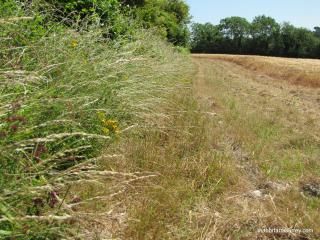
The top headland has been cultivated but not drilled, which creates a contrasting habitat that is bordered by chalk flowers and grasses and grades up through scrub to mature trees.
Other jobs at the moment; Rees has been washing out trailers ready for the main harvest, Ed has been feeding the inside cattle, mucking out sheds and bedding up, Edward and Joe fencing and Christopher more topping!
It’s that time of year to cut our roadside hedges for safety and vision and we ask Raymond to trim a few more for the community as the council don’t seem to do so.
The Highways Agency has been investigating the ditches and drainage along the A25 and to see whether it might be possible to create a water catchment area in a roadside field at Gomshall.
In the meantime we have undertaken ditch and drainage work to do what we can to help, in what is a much bigger picture of water running off the hills, down many byways and lanes onto the A25 but where it no longer gets carried away by road drains as it once used to.
The warm wet weather is good news for the young maize and fodder beet plants. The expected heat-wave next week should allow the remaining 70 acres of barley at Hackhurst to ripen off to 15% moisture or below; that will go to dry storage.
It’s likely that the oilseed rape at Manor will be harvested next, followed by 200 acres of barley at Dunsfold, OSR at Shalford and Upfolds and then on to the wheat.
Harvest time can be indescribably stressful for many farmers as pressure mounts to bring in the culmination of the year’s work.
If a UK farmer or farm worker is finding things difficult in their business, family, health or with farming issues, then Farm Community Network may be of some help. Their website: http://www.fcn.org.uk/ is full of information and has a contact number which will be
Answered in person 7am-11pm every day of the year on 0845 367 9990
Back