


 EDUCATIONAL VISITS Manor Farm is fully accredited by the Countryside Educational Visits Accreditation Scheme (CEVAS)
 THE FARM
Contact us for availability.

Archived News
8th March 2014
The months of rain and wind have battered more than just buildings and barns but also the spirit of everyone soldiering on outdoors; work is so much harder in relentlessly bad weather and so the glimpses of winter sunshine over the last five days has made a vast difference to livestock and staff alike.
TB testing was undertaken this week on all Belted Galloway cows and heifers on the farm that have previously calved, plus the bull. We needed to be well organised to get round all seven locations and have a cattle crush moved and ready in position.
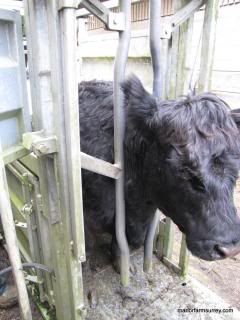
The cattle are held in the crush while two areas of hair are trimmed on the neck, one above the other; the skin thickness is measured at each of these patches and the information recorded.
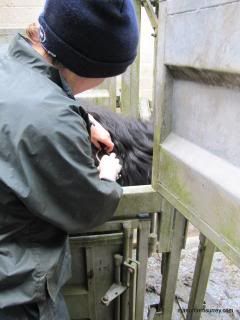
Finally, 0.1ml of avian tuberculin is injected into the top patch and 0.1ml of bovine tuberculin into the bottom patch.
The second part of the TB test is to return to the cattle 72 hours later and proceed through the groups in the same order.
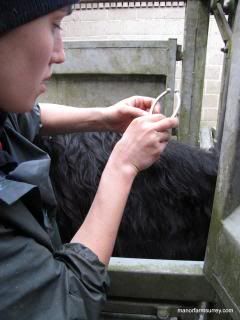
The vet checks for any thickening of the skin at the two injection sites; measuring any obvious lumps with callipers.
There are strict guidelines to ensure the same vet undertakes both parts of the TB test and that they use the same pair of callipers. The vet is checking for any bovine or avian reaction and the comparison between any such findings.
I am pleased to say that we didn’t have any reactors and won’t need to be tested again for four years, as long as the TB testing intervals are not altered in the meantime.
The west of England across to and including Hampshire, Berkshire and Buckinghamshire and northwards to Nottinghamshire, Derbyshire and Cheshire are all tested every 12 months as is East Sussex.
Any cattle found to react during TB testing are isolated, slaughtered and post mortemed but nothing is conclusive until tissue samples undergo laboratory diagnosis and at that stage it’s often discovered the animal did not have TB.
Nearly all warm blooded mammals are susceptible to TB including farmed and wild deer badgers, humans, pets and cattle.
Just over 38,000 cattle were slaughtered due to TB in 2012.
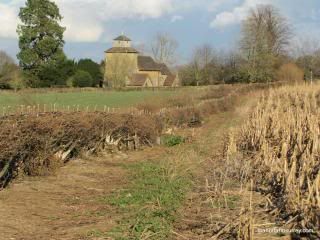
The hedge laying between Church Field and Hatch field has been completed. Laying the hedge will extend its life in a similar way to coppicing a Hazel stool or pollarding a Willow.
The hedge will sprout new shoots from the laid pleachers and thicken the base of the hedge lower down.
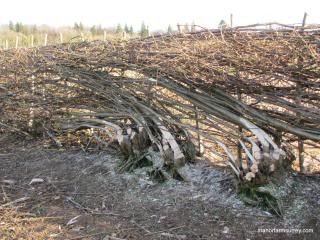
Hazel stakes are positioned along the hedgerow with flexible lengths of Hazel binders woven along the top.
Back