


 EDUCATIONAL VISITS Manor Farm is fully accredited by the Countryside Educational Visits Accreditation Scheme (CEVAS)
 THE FARM
Contact us for availability.

Archived News
23rd February 2014
It’s a busy few weeks for the vet, with the bull fertility test last week and our four yearly TB testing in a week’s time which will be over two days; 72 hours apart.
The weather a week ago was cold and wet and not conducive to undertaking a bull fertility test so the vet postponed until Friday just gone and we were lucky enough to have a fine day and a glimmer of sunshine.
Carsluith Ethelred was very accommodating walking up from the bull pen and into the crush where he was tested, measured and condition scored.
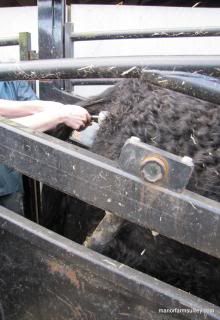
A gentle stimulation causes the bull to produce a semen sample which is collected by the vet.
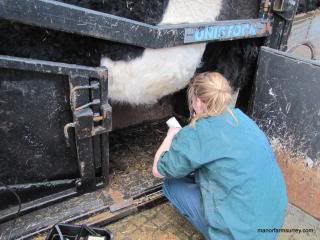
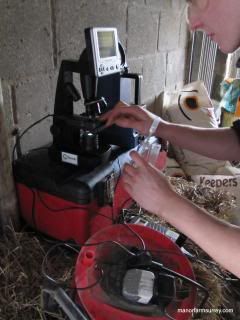
Immediately after collection the semen is inspected for quantity and quality under a microscope before it dies off in the cold.
I am pleased to say that Ethelred passed his test and is ready to return his cows in March; leading to calving early in 2015.
About a year ago we had a cow named Mary who aborted her second consecutive calf and blood tests revealed she had been exposed to Neospora and BVD both of which can lead to abortion. This led to us vaccinating the Beltie herd against BVD, however there’s no treatment for Neosporosis; this is reliant on education and prevention.
Neosporosis was featured on Countryfile last weekend due to Adam’s herd being infected by this parasitic disease and having to cull eleven animals.
Neosporosis is a disease caused by the protozoan parasite Neospora canis, a parasite that invades and inhabits the body of its host animal; dogs and foxes which can pass on the infection via fertilised parasite ovum in their faeces. Cattle are intermediate hosts when they ingest the faeces amongst the grass they are grazing.
This disease needs the dog to complete the life cycle of the parasite but once a cow is infected the disease can circulate within the herd passing vertically from mother to calf; it cannot be spread across the herd from cow to cow.
Blood testing is a useful method of diagnosis for Neospora but is much more sensitive around calving or abortion. For this reason, regular sampling of healthy cattle for Neospora is not commonly done unless a farm is experiencing a drastic Neospora problem.
In relation to our pedigree suckler herd this disease could become a serious problem because the cattle undertake conservation grazing on the North Downs which is accessed by hundreds of visitors and their dogs every week. Similarly on the lowland pastures crossed by public footpaths many of these fields are plagued with dog faeces; unless everyone cleans up after their dogs in fields, this untreatable disease is set to take more lives.
One of the key elements of naturally rearing native cattle is that they live outside all year round.
However in order to manage the herd sensibly through foul weather such as the last 3 months and during last year’s snow, the young-stock are in a field with access to shelter in a farmyard and the in-calf cows are also close to a farmyard for easy access to the cattle handling system.
Despite these particular fields being selected for pregnant cattle and calves due to there being no public footpaths through them; some walkers decide to push the wire down and walk inside a field, taking their dogs with them. Dogs chasing cattle or as one owner said; ‘he’s only playing with them’ is enough to stress the cows and cause an abortion.
Dogs are a permitted accompaniment on a public right of way if they are kept under close control or on a lead; but allowing them to wander where they like off a path, through hedges and into adjacent fields is not keeping them under close control and allows enough time for them to foul, eat any afterbirth in a calving field or chase around out of sight.
It’s becoming very difficult to maintain a healthy and growing pedigree suckler herd with increasing external risks in such a highly visited AONB.
I am waiting to hear the post mortem results for the Belted Galloway calf aborted last Monday. Polly, the dam was about 7 months into pregnancy and it’s quite distressing to see her searching the calving ground for her calf.
Back