


 EDUCATIONAL VISITS Manor Farm is fully accredited by the Countryside Educational Visits Accreditation Scheme (CEVAS)
 THE FARM
Contact us for availability.

Archived News
1st February 2014
The Surrey Hedgelaying Group were out in force today; laying a predominantly Hazel hedge with a few Elms that have not succumbed to Elm disease.
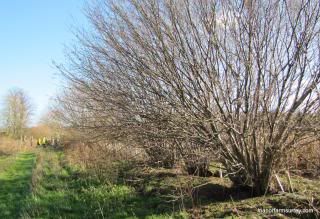
The hedge is left to grow up in the years preceding laying to provide enough length to the pleachers.
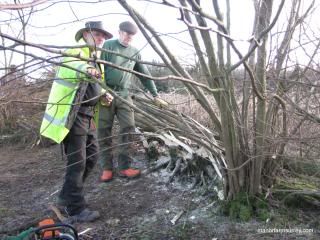
The hazel stool has many tightly grown stems some of which are a little intertwined and careful selection is needed before cutting begins.
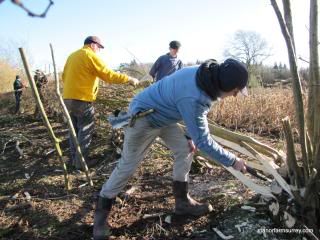
With their many years of experience and accumulated skill, Con (in yellow above) and Fred (below, left) provide guidance and instruction when required.
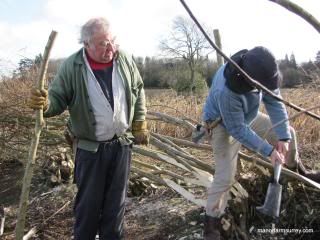
The stem to be laid is cut through by about two thirds leaving bark and sapwood and enough stem to keep it alive and prevent it snapping as the pleacher is laid down along the hedge.
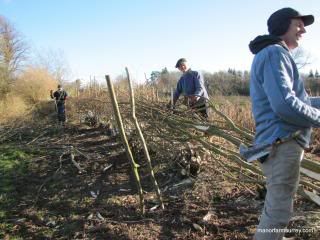
It may seem fairly straight forward to an observer, but it takes many years to become an accomplished hedge layer. Billhooks and axes are the traditional tools used but more often now you’ll see a chainsaw in use.
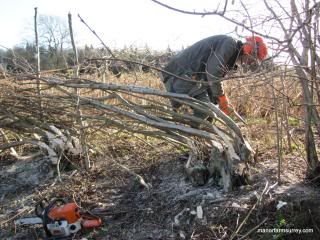
The laid pleachers are interwoven between hazel stakes, then binders are woven at the top of the stakes. The stakes are being knocked in place and binders lay in wait on the fore-ground.
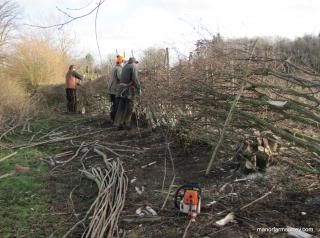
Hedgelaying is a rural skill that was once commonplace in the countryside; and with a larger work force even two to three generations ago on estates and farms, some of the labour would shift to coppicing and hedgelaying during winter months.
Now the skills are passed on at agricultural colleges and through rural courses but particularly by the annual commitment shown by local hedgelaging groups. Many thanks to Fred, Con and the great team of hedgelayers working at Manor Farm.
Back