


 EDUCATIONAL VISITS Manor Farm is fully accredited by the Countryside Educational Visits Accreditation Scheme (CEVAS)
 THE FARM
Contact us for availability.
Archived News
13th June 2013
We’re nearly half way through another year but not half way through calving!
Our pedigree ‘Belties’ are in three calving groups this year. The heifers at Raikes Farm have given birth to their first calves; one bull calf and four heifer calves.
It appears that Vi, one of the expectant heifers probably slipped her calf; she was due around the third week of March and although the dates given at the pregnancy diagnosis can be out by about a month, we would have expected her calf by the end of April. She will be given a second chance and be put back to the bull.
Calving began at Churchfield Farm on Sunday morning followed swiftly by another on Monday; adding two more heifer calves to the herd.
It was wet and cold yesterday evening as I checked the cows; a couple look closer to calving than the others and I hope they'll time it for Friday or Saturday when the forecast improves!

'Bumble' comes over to investigate the Landrover
To register a Belted Galloway calf as pedigree, both parents must be registered and the calf must have a complete white belt encircling its middle with the rest of the coat being black.
The seven calves born in recent weeks are sired by Carsluith Ethelred and the markings are perfect. This is great news as the heifer calves will be future herd replacements.
One cow miscarried her last two calves so the vet took some bloods which indicated the cow had been exposed to Bovine Viral Diarrhoea (BVD) and a disease called Neospora (a disease cycle spread by foxes or dogs).
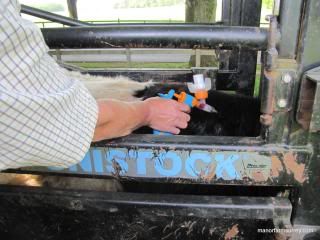
After discussions with the vet we began a programme of BVD vaccination in the Belted Galloways last year which requires an annual booster which we administered last week. We also gave the young stock their initial vaccine which involves two doses of vaccine, three weeks apart.
BVD is a viral infection that can remain undetected in a herd for some time because miscarriage and infertility can have other causes. The effects of BVD in cattle includes; increased levels of infertility; extended periods between calving and conception; an increase in services to get a cow in calf; abortions and neonatal deaths; deformed calves; viral diarrhoea; immunosuppression which can lead to pneumonia.
With these effects on herd health and loss of production, BVD is unsurprisingly thought by many to be the most important viral disease of cattle.
If a cow is exposed to the virus in early pregnancy the calf could be persistently infected (PI) with the virus which can spread to other cattle in anything from saliva and tears to semen and via an embryo.
BVD can be controlled by vaccination and by the removal from the farm of any PI animal.
It is now compulsory to test cattle for BVD in Scotland and is likely to become compulsory throughout the UK as it is causing significant economic losses in the national herd.
With the annual BVD vaccinations last week we also began a voluntary programme of testing the suckler herd so that we have a greater knowledge of herd health which may also cast light on the calving history.
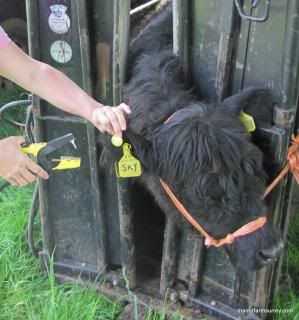
A special ear tag has been designed to take a tiny tissue sample which is sent to a lab for testing, whilst leaving a unique BVD ear tag in the animal which will correspond with the test results. The tag will be useful when buying or selling livestock to ensure that farmers don’t unwittingly ‘buy in’ disease.
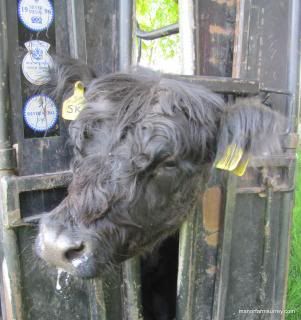
'Sky' enters the crush and has her ears trimmed
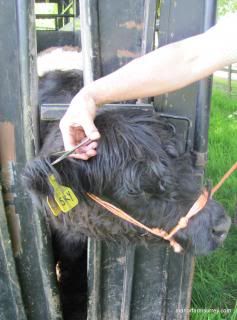
Belted Galloways have very shaggy ears so we trim them ocassionally so that we can read the ear tags more easily!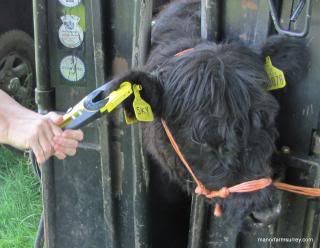
The BVD test tag is attached to Sky's ear and a sample of ear tissue is retained on the ear-tagger in a tiny vile. The vile is sent to the lab and we await the results
Back