


 EDUCATIONAL VISITS Manor Farm is fully accredited by the Countryside Educational Visits Accreditation Scheme (CEVAS)
 THE FARM
Contact us for availability.

Archived News
23rd April 2013
The last fortnight has seen a transition from winter to spring. Noticeably in the air with flocks of Redwing leaving our fields and hedgerows and returning to their summer breeding grounds in northern Europe and Asia, whilst our first summer visitors have arrived to breed in the UK: Chiff-chaffs have flown from southern Europe and North Africa and Blackcaps from Germany and Africa.
On the ground there’s a flush of growth and many flowering plants which not only herald the arrival of spring but also provide the early feed for butterflies and bees.
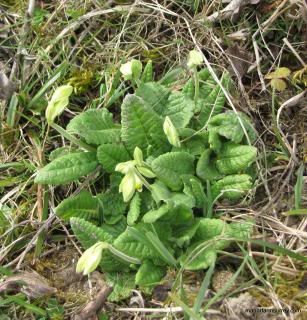
The Brimstone butterfly is one of a few species that overwinters as an adult and when emerging in spring they will nectar on dandelion, primrose, cowslip, bugle and bluebell.
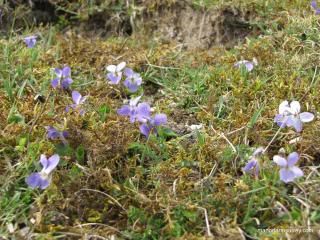
Hairy Violets on chalk downland range from white to purple in colour, here they are growing amongst salad burnet and moss.
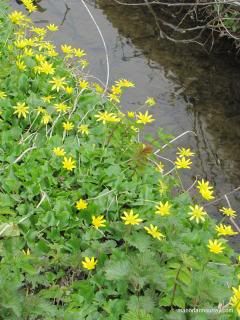
Celandine amongst the leaves of Meadowsweet on the banks of a stream. Meadowsweet favours wet habitats such as damp meadows and riverbanks; it will grow between 3-7 feet and flower June to early September, with clusters of fluffy creamy-white flowers.
The woodland floor is covered by one of the most unassuming and delicate plants, Dogs Mercury. There are separate male and female plants and they are highly poisonous if eaten by humans, but the seeds may be eaten by small mammals and birds.
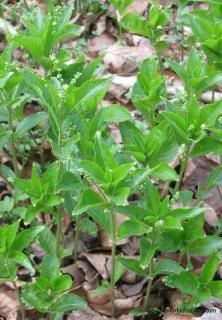
Dogs Mercury - Mecurialis perennis
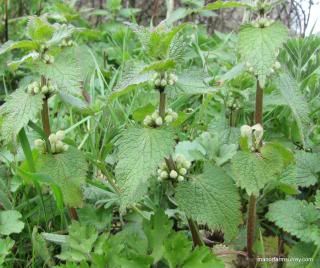
White Dead Nettle - Lamium album
White dead-nettle acquires its name because the leaves look similar to those of a stinging nettle, however the leaves of a dead-nettle do not have the stinging hairs and they are eaten by slugs and snails! The leaves of the dead-nettle are at right angles to each other and grow from a square stem making a sturdy plant that flowers from march to December.
The nectar at the base of the tube-like flowers is only reached by long tongued insects such as bumble bees and mason bees.
I’ve noticed over recent years an increase in trees with an orange covering, generally on one side of the tree and primarily on higher, more weather exposed ground.
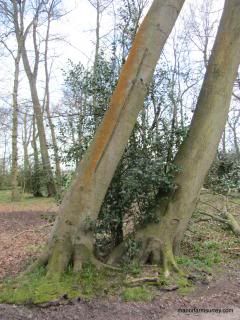
Trentepholia is an alga seen here on Beech trees.
Trentepholia is classified as Green Algae and it has green chlorophyll, but this is protected by the orange pigment from intense sunlight.
Current speculation suggests a decrease in pollution or local short –term climate change may have caused the increase in trentepholia but a systematic research study is yet to be undertaken.
Back