


 EDUCATIONAL VISITS Manor Farm is fully accredited by the Countryside Educational Visits Accreditation Scheme (CEVAS)
 THE FARM
Contact us for availability.

Archived News
16th December 2012
The weather has continued to play its part in delaying and affecting crop production and harvesting throughout the UK.
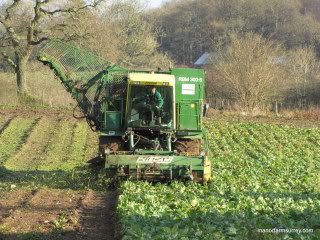
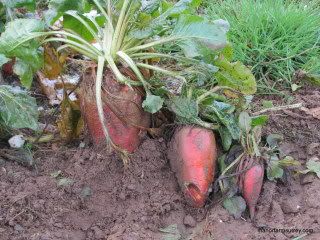
The fodder beet has just been lifted by a local contractor with a specialist
machine and the crop stored at Hackhurst, Paddington and Churchfield for winter feed.
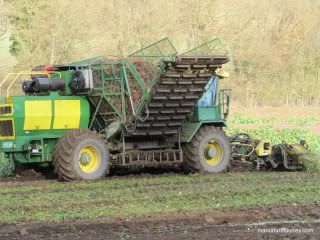
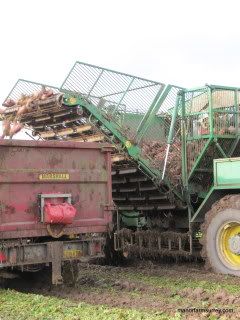
The size of beets varied considerably this year, even within one field due to the cold wet summer.
It’s always very challenging to find crops which grow well enough on the poor grade 3 soils here in Surrey which we farm, also protecting them from pests (rabbits, slugs and pigeons love to systematically eat what we sow).
Of the 360 acres of winter oil seed rape we had drilled, all but 30 acres at Combe have been destroyed and as the birds continue to have a field day; it looks likely that the whole crop will be written off.
The seed was drilled into a cold, wet seedbed so it had a slow start; on the heavier ground the crop was eaten by slugs and on the lighter ground where the crop was already backward, 150 acres were completely decimated by pigeons.
There’s no point re-drilling with oil seed rape as the weather remains wet and the mass of slugs and pigeons just waiting to fatten themselves still further.
So, with the cultivator in front of the drill, 150 acres of barley have now been sown at Shalford, replacing the rape crop. We shall see how the barley progresses and what the markets are like next year before deciding when and to whom it will be sold.
About half the maize crop was harvested in October but the remainder was held up by the late maturity in part of the crop followed by the extreme rains which hit England hard. The maize harvest was finally all in from Abinger, Silent Pool, Combe and Hackhurst by the end of November. Oats were then sown at Churchfield, Marshmans, Silent Pool and Crossways.
Fortunately the fields drilled with wheat in September, after the worst harvest in living memory, have come through quite well so we remain positive about these fields and hope for more settled weather to come.
All the Friesian x cattle have been moved to their winter quarters where they can be fed each day and bedded up three times a week.
One of the young Friesian calves broke its leg last week when it was spooked and jumped over a pen, (possibly by the dustcart which gave an unexpected banging noise). The young lady vets were pleased to gain some practice of applying a cast; which is pink! The cast will be removed in three weeks and another applied to allow for the animal’s growth.
Belted Galloways on the other hand are a hardy breed which have thrived on poor grazing in the highlands of Scotland for centuries. With a double layered coat, this breed will remain outside all year round; with an outer coat to shed the rain and a fleece like undercoat for warmth however some groups will have access to barns when necessary.
In 2009 when Nightfall was born on 1st February; she had a head start before the snow began to fall, whilst Snowflake was born onto the cold white ground on 9th February. The cows and calves were given a barn whilst they got used to feeding and then returned to the herd.
Similarly when calving began earlier than expected last year in one of the least practical fields (with river and marshes), a calf was hidden so well in the bracken by his mother, that it was a week before ‘Magic’ the calf appeared in the open! Calving of that group was completed in the nearby barn because the field couldn’t be accessed by the cow grab which allows us to ear tag, dip navels and ring the bull calves.
This view will be a thing of the past in our fields soon as the work continues to bury all the overhead power cables across our fields.
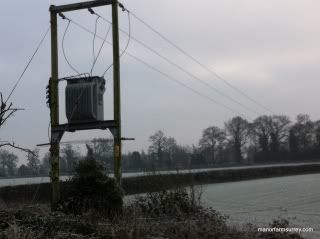
This is a project we have been working on for a couple of years now
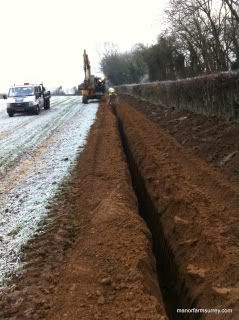
to dig across the fields, bury cables about five foot below ground and have sub-stations built in various fields.
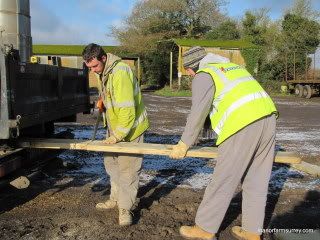
Here are the contractors in freezing weather last week cutting the shuttering boards to lay the base for the electric station by West Lane
It’s an early start tomorrow as a Saddleback pig is off to the abattoir.
Back