


 EDUCATIONAL VISITS Manor Farm is fully accredited by the Countryside Educational Visits Accreditation Scheme (CEVAS)
 THE FARM
Contact us for availability.

Archived News
22nd October 2012
It’s been a hectic start to the week. The dogs fetched up the Belted Galloways from the field opposite Abinger Hall and moved them along the track and behind the Cressbeds. There was still plenty of grass in the first field but as the council were planning on erecting a large fence between them and the cattle whilst they do drainage work on the A25, we thought it would save them time and money if we just moved the livestock.
The ground is very wet everywhere at the moment so I’m not sure we’ll be able to move them back into that field for a while.
A little calf called Pip has always had an odd look about her since she was born in October 2011. A couple of vets have taken a look at her but didn’t come up with anything concrete. As the months progressed the other calves grew in size and strength but pip remained small with a shortened neck and a stiff looking gait about her. Pip couldn’t keep up with the herd so when the Belted Galloway calves were weaned she moved into a group of younger Friesian calves so that she could hold her own.
Pip seemed happy enough in the fields and feeding well, but her walking and standing became increasingly difficult and when the head vet was next on the farm he saw Pip for the first time and diagnosed Spastic Peresis which is rarely seen in cattle. The disease is a progressive hyper-extension of one or both hind limbs. Muscles gradually contract and the legs stiffen causing a pendulum effect. If both hind legs are affected the calf attempts to put more weight on her front legs by holding them underneath her body whilst arching her back.
There’s no successful medical treatment for Spastic Peresis and with the disease progressing more rapidly, the decision had to be made for Pip to be put down and so the disposal services came for her this morning.
It was a dank foggy day and really sad to see Pip emerging from the fog for the last time at the back of the herd. David was kind and sympathetic as he went about his work and Pip was shot and then taken away. Livestock farming may be about life and death but you’d have to be a hard person not to feel anything when you see a calf born, watch and worry about her for 361 days and then see her die.
Groups of Friesian calves are arriving at about ten days old and are reared at Manor Farm and Raikes Farm. As they are weaned off milk they move to larger barns for the winter and next spring they will move out to grass at about six months of age.
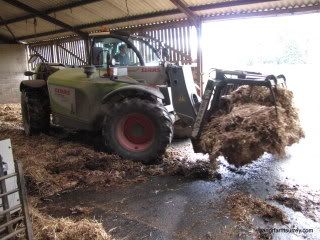
As each group of calves moves from the first barn; these are mucked out with the tele-handler and then thoroughly disinfected and limed before being bedded up with fresh straw in readiness for the next calves. We are rearing calves for a neighbouring farmer and some for ourselves.
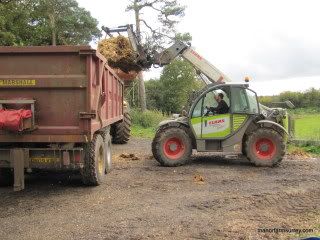
The late completion of harvest has delayed autumn cultivations and in some counties crops remain in fields due to bad weather and straw cannot be shifted; reports from the North East, South West and East Anglia are particularly bad.
We drilled 340 acres of oil seed rape by mid September but this was delayed by a number of factors: late harvest which then delayed straw removal and plenty of rain over recent months resulting in very wet soils. The OSR at Coombe is the most forward crop being sown first, followed by Upfolds and lastly after delayed sewage sludge application is the Shalford crop.
At the beginning of October we drilled four varieties of wheat; Havana a feed wheat at Dunsfold, Solstice which is a class one wheat at Normandy and Whitedown and Gallant at West Lane. We are also growing about forty acres of hybrid wheat this year.
Hemp is being harvested for seed which will be made into Goodoil. The hemp straw will be mown and retted and then dried and baled at Raikes; the resultant fibre will be used for insulation or horse bedding.
About half the maize has been harvested and to silage clamps where the crop is sheeted over and left to pickle. It will remain in the clamps until required to feed livestock over winter.
About ninety acres of oats will be sown after the maize for a seed contract. Winter barley needs to be sown at Park and Coomb Farm but the ground is saturated and needs 2-3 weeks of dry weather before it can be drilled and at the moment this seems quite unlikely.
Tomorrow we’ll be weighing and sorting Pip’s siblings, dividing a group of eighteen which have been conservation grazing on the North Downs.
Back