


 EDUCATIONAL VISITS Manor Farm is fully accredited by the Countryside Educational Visits Accreditation Scheme (CEVAS)
 THE FARM
Contact us for availability.
Archived News
16th July 2012
Preparations for harvest have been underway for a few weeks, with trailers being serviced and the grain stores being dusted down and vacuumed! Since January half of the storage bins in the grain store at West Lane have gradually been adapted to make them self emptying onto a conveyor. Trevor is completing the wiring of the conveyor and this should be ready just in time for harvest!
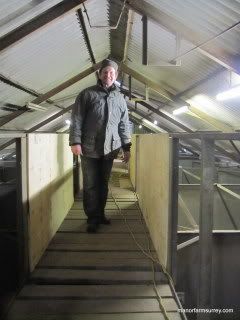
Here's Ian working in very cold conditions converting the grain storage bins.
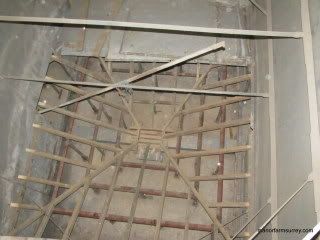
The frame-work for the angled floor
Laurence designed the conversion of the six bins so they now have an angled floor which acts more like a funnel and saves two men, two hoursof shovelling per bin.
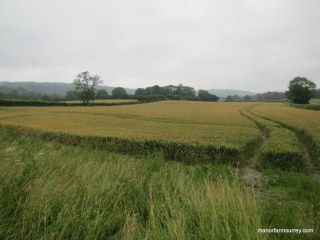
Field of wheat with a wildlife headland in the foreground
Winter crops have been growing quite well but they are beginning to suffer from the constant rain which is water logging some crops and the heavy rain and hail has flattened some areas of barley.
The barley and oats are both being grown as seed crops so it’s imperative that any isolated weeds are removed from the fields by hand. We have sold the barley to Bartholomews and the oat seed to Lillico Attlee and they inspect the crops to ensure they are up to standard.
The process of rogueing entails all the staff we can muster, spread out in a line, covering 110 foot at a time. The line of people walks back and forth across the field pulling any rogue plants and putting them in a bag. So far 20 acres of oats and 40 acres of barley have been rogued, with 20 more acres of oats to be completed at Coast Hill.
Lapwings have been nesting for a number of years on the farm although this year they have had the added protection of National Trust warden Paul Redsell who kept an eye on them. Lapwings need a variety of habitats close together for breeding and rearing young.
Spring sown crops provide a good location for the nest site with good views all around of predators, however they have been predated by rooks and crows in the past and although they only rear one brood a year, they may actually lay up to four clutches of replacement eggs a year if the eggs are lost.
Soon after hatching the chicks are led to nearby grassland with small patches of water where they stay for 5-6 weeks feeding on small invertebrates; it is during this relatively short but hazardous journey that the chicks are often taken by rooks and crows.
We really do need some sunshine to dry and ripen the crops and get them fit for harvest which usually starts15th-20th July. Laurence is hoping to start combining the barley on Wednesday or Thursday this week with the remaining crops being harvested in August.
The weather and hundreds of rooks have been hard on the hemp this year and much of it has been re-drilled but the birds have continued to hammer these fields; hence the use of the bird scarers while the plants try to become established.
With atrocious weather, a group of fifty young Friesians were moved back into barns for a week as they were getting set back by the relentless rain. Things have improved a little and now they are grazing at Damphurst and hoping for sunshine on their backs.
The Belted Galloway calves born between October and early January have recently been weaned. The cows were housed in a barn at Hackhurst and the calves in a barn at West Lane. If they had been left in two separate fields, even miles apart, they would try to find a way of being reunited, escaping from the fields to find each other.
One heifer calf, Pip was born on 26th October and she is a dear little calf that has had a strange look about her from just a few weeks old. She appears to have a stiff neck and it almost looks too short, the vet has taken a look at Pip and thinks that either she was damaged during calving or there’s some fusing of bones in the neck or spine. All the calves were weighed before moving out from the barn to fields at the foot of the downs; the heifers are generally lighter than steers but the two heifer calves born either side of pip each weigh over 116kg more than she does.
Whilst Pip was with her mother she was safe within the herd; we just knew that she would be bringing up the rear of the group with her mum each day. Pip will never ‘do’ like the other Beltie calves and she will need a great deal more care and attention but won't ever be roboust enough for breeding. Last week Pip moved into a group of younger Friesians where she will be safer and won’t be struggling to keep up with the Beltie calves as they move onto the North Downs.
Three of the older cows will now leave the farm whilst the others will be put back to the bull once he has run with the two year old heifers (their first time) for six weeks.
The theme of weaning continues with ten stonking piglets being weaned from Polly the sow who has done such a fabulous job raising her outdoor litter; she has been pulled down by the piglets and is now having a well earned rest. Polly won’t be put onto higher rations until her milk dries up in order to help prevent mastitis.
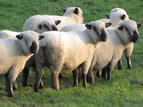
Christopher’s sheep are being weaned and the flock has been treated to prevent fly strike which thrives in these wet, muggy conditions.
We have been devastated by the unexpected deaths of a lovely Beltie heifer and calf during calving early in June and the fox taking three of our Silver Appleyard ducks and the drake, leaving just one female with bite wounds around her neck.
It’s always difficult to lose any animal on the farm and results in so many ‘what if’s’. But I believe that we strive to do our best and learn from each situation.
When the boys found the injured duck and the last clutch of duck eggs; the duck was treated but wouldn’t leave the security of the barn for a couple of weeks and the eggs were put in the incubator in the hope that some would hatch. Four weeks later one little duckling emerged bringing some joy out of sadness.
Back