


 EDUCATIONAL VISITS Manor Farm is fully accredited by the Countryside Educational Visits Accreditation Scheme (CEVAS)
 THE FARM
Contact us for availability.

Archived News
24th April 2011
In this weather the pig wallows need to be topped up regularly to provide the pigs with a cool and relaxing place to lie. The mud acts as a sun screen for pigs; this is particularly important for the four young Saddlebacks’ with their pinkish band around the shoulders being prone to sunburn.
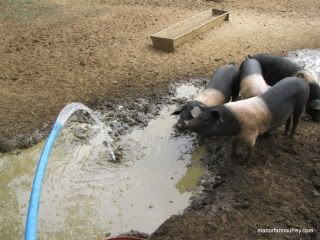
These Saddleback gilts have moved into a new field and are enjoying the wallow in this hot weather.
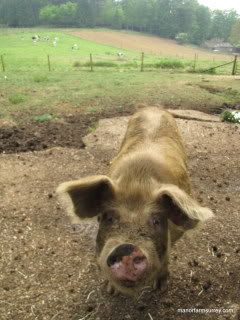
Spot’s an old hand at wallowing and you wouldn’t know he was a ‘pink’ Gloucester Old Spot when he’s caked in mud!
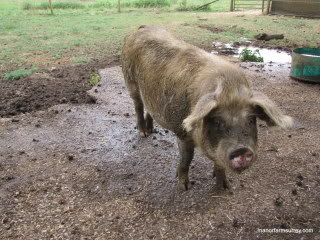
This weekend has seen the return of Lizzie, a sow who had her first litter of piglets by Percy and has now come to stay with Spot, Percy’s son for service. I hope that Lizzie does get in pig, but I have my doubts as she’s rather on the plump side; not the best situation before being served.
The weather is once again the main topic of conversation on the farm with agronomists, grain merchants and other farmers. The past weeks of dry weather and more recent blazing sunshine are causing great concern. The crops are desperate for rain and if it doesn’t come soon, the outcome will be significantly lower yields come harvest time.
We are growing two varieties of Class 1 milling wheat (for bread) on 650 acres, two varieties of oilseed rape on 340 acres, barley and three varieties of triticale; all for seed.
The oilseed rape is insect pollinated (the pollen is not blown on the wind), it has bright yellow flowers and a fragrance to attract insects. In comparison, wind pollinated plants are often less colourful, unscented, and with small or no petals as they don’t need to attract animal pollinators.

30 acres of winter linseed is in the ground which we are trying out this year; this will be harvested in July which hopefully will be easier than the spring varieties which aren’t harvested until September in damper weather.
Paddington has been drilled with fodder beat which we’ll use to feed the Friesian x cattle next winter. Maize has been sown by Raymond with his specialist maize drill and this will be cut into maize silage later in the year.
Back