


 EDUCATIONAL VISITS Manor Farm is fully accredited by the Countryside Educational Visits Accreditation Scheme (CEVAS)
 THE FARM
Contact us for availability.

Archived News
21st October 2010
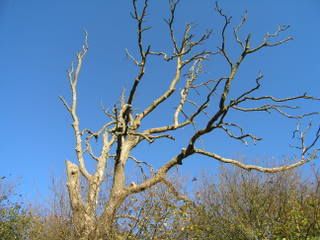
Today we’ve woken to our first autumn frost and the rising sun has brought with it an azure blue sky; it’s a perfect day for working outdoors. A layer of ice on the water troughs and duck pool, but not too severe.
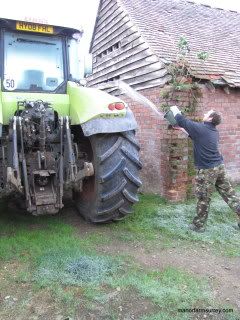
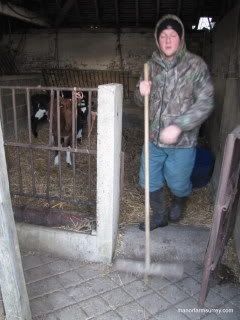
Ed defrosting a tractor and Sam littering up the calves
A herd of shorthorn cattle have arrived from over the hill and are staying for just over a week.
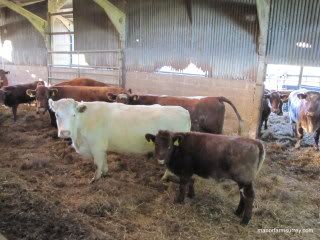
We are providing B&B (barns and breakfast) for the cattle and an area in which they can be sorted and run through our cattle handling system.
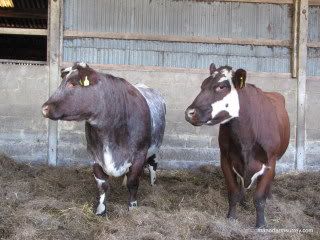
It took a couple of hours to get the paperwork sorted on arrival and log each animal as a movement onto the farm with BCMS on the computer and sending off the passport forms by post. The vet has been to scan the cows and heifers for pregnancy and ear tags have been replaced. The herd is being sold at auction and when they leave here the information will need to be updated once again by computer and a passport form will be sent off from their point of destination.
Looking for farm efficiency is ongoing, particularly with ever rising fertilizer and feed costs. As a result we have ordered a straw chopper which will shoot the straw into the barns and save the manual littering up in the large barns; at our busiest times this takes three men a total of 60 man hours a week compared to the estimated 1 man driving the chopper for 20 hours tops.
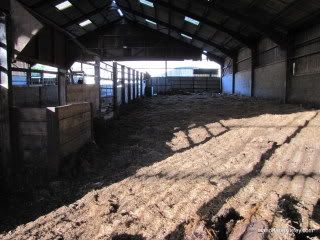
Barn currently 'littered up' by hand
We’ve also invested in new feed troughs which are located outside the housing area. At the moment feed rings are inside the barns taking up space; they’re more awkward to fill with grub and food can spill out and be trampled by cattle. The improvements will create better use of space for winter housing and more efficiency and ease of work.
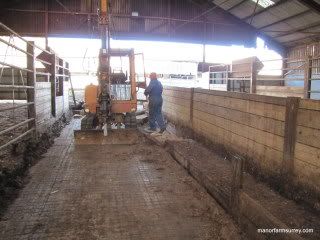
David is preparing one barn to allow access by the tractor and feeder wagon.
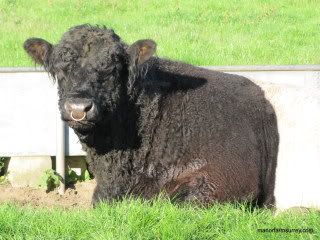
Granite is a handsome and most genial Belted Galloway bull purchased in May; he ran with the cows and heifers for three months and was seen regularly bulling the girls. The bull was moved out of the herd and pregnancy scanning was undertaken seven weeks later.
The mobile crush was set up in the field and the cows were scanned in turn. It was with a sinking heart that I heard ‘not in calf’ time and again from the vet. A feeling of despondency and disbelief engulfed me; the cows which have been calving perfectly well up to now, weren’t even in calf.
Hugh, the vet came last week to check Granite over and the news wasn’t good; he explained what could be felt beneath the skin of the scrotom. Hugh found atrophy of the right orchid and the epididymal tail (sperm store) is detached or becoming detached from the left orchid; he’d never come across anything quite like it before. Without a post mortem it’s not possible to know what caused this irreversible change, but maybe something like an abscess. It’s not a recent problem but one that occurred some time ago, which accounts for the lack of pregnancies in our herd despite Granites keen libido and running with the cows for three months.
It’s a dreadful shame, Granite is a pleasure to have around, however he’s not capable of work and that has set us back at least six months in the calving programme. Now I’ve got to find another bull and Granite will be dispatched..
I’ve lost track of the past few weeks and can’t believe it’s the October half term. Laurence of course hasn’t had a summer holiday due to harvest followed by autumn cultivations, so he could do with some R&R with the family. With this in mind he planned to get things tied up on the farm on Monday and was set to spend a few days with our boys.
However at 9.20 on Monday morning Laurence received a call from the Rural Payments Agency informing him that they were going to commence an immediate farm inspection (the third since March) and when the inspector arrived at 1pm, she informed Laurence that a further inspection would occur in the near future for Higher Level Stewardship; that will be our fourth inspection in eight months.
So instead of preparing to get away, Laurence was meeting the inspector and going through maps and paperwork. The RPA could choose to check one or more of the following elements; however in our case they are doing everything!
The inspection is likely to take a few weeks as they want to inspect every field or land parcel (there are over 280), check all pesticide records and storage (SMR9), feed inputs and outputs (SMR11), all Sites of Special Scientific Interest (GAEC6) and scheduled monuments (GAEC7), all rights of way; of which there are miles (GAEC8) and all hedges and watercourses; many more miles (GAEC14+15), the children’s pigs (SMR6), check the Soil Protection Review back to 2006 and enquire about any land not in agricultural production.
I do wonder how the RPA chooses our farm ‘at random’ four times in the space of eight months, how is a man to run his business well when it keeps being interrupted for weeks on end and on such a regular basis?
Although we understand that inspections have to be made, it seems quite unfair that some farms have never been inspected, whilst we are just at the beginning of our third in-depth inspection since March with a further inspection pending. Other farmers are now asking Laurence what it’s like to undergo an inspection, so that they might feel ready should the day ever arise on their farm.
The process of each inspection takes Laurence away from his work as he pulls out the paperwork relating to each of the above clauses when requested by the inspector; and although that doesn’t sound onerous, there is a huge worry as we wait for the outcome which we hope is good, but which may result in a heavy fine. There is an appeal system but of course that takes even more time and may even delay other entitlements.
During the cattle inspections which took over three weeks to complete earlier this year, our normal work ceased for the first week as three of us had to round up every beast and run it through the crush; to check each animal existed and that it had two tags and a passport with all the correct information. The inspectors work in our office to check passports and cross reference movement records so we have no day to day business privacy.
I cannot begin to adequately describe the pressure placed on farmers during an inspection, but suffice to say it is immense. I think even the strongest of people would feel quite depressed, if not victimised after three inspections in short succession, so how on earth are they to remain emotionally intact after a fourth?
We are indeed doing our best to farm well, but in weeks such as this I begin to wonder why we get up to farm each day; oh yes, it’s to produce good quality British food and to see an azure blue sky on a frosty morning, I guess it’s worth going on.
Back