


 EDUCATIONAL VISITS Manor Farm is fully accredited by the Countryside Educational Visits Accreditation Scheme (CEVAS)
 THE FARM
Contact us for availability.

Archived News
7th October 2010
September has been extremely busy on the farm with the main harvest drawing to a close and going straight into seed bed preparation and drilling the new crops.
The soil is analysed on a regular basis to ensure that crops are supplied with a balance of the major nutrients; nitrogen, phosphorus, potassium, magnesium, calcium and sulphur.
PH testing measures the acidity or alkalinity of the soil and recent tests indicated that our sandy soils had become too acidic due to heavy rainfall leaching the dirt; this can cause quite a large drop in yield. We’ve been spreading lime across these fields to bring the pH back to optimum level whilst at the same time not over-liming as it would take quite a while to return the pH to normal and at £14.20/tonne the costs soon mount. We have applied 225 tonne at Dunsfold, 55 tonne - Normandy, 260 tonne - Manor Farm and 225 tonne at Shalford.
Crops drilled so far: 350 acres winter rape at Shalford and Park Farm, winter linseed at Raikes Lane and Crossways, 650 acres wheat, growing different varieties to spread risk; Solstice at Dunsfold and Normandy, Gallant at Manor Farm, Albury and Whitedown. The Gallant is Class 1 milling wheat.
We haven’t grown barley for eight years as any profit has been marginal on the soil we have available. The malting varieties haven’t been a huge success, so we’ll grow 70 acres of seed crop barley this year on ground that’s not best suited for wheat.
2010 has seen 17 calves safely born on the farm; 8 bulls and 9 heifers, the last of which was born on Monday and is named Jenny. We must ear tag each calf as soon as possible and register them all with the British Cattle Movement Service (BCMS).
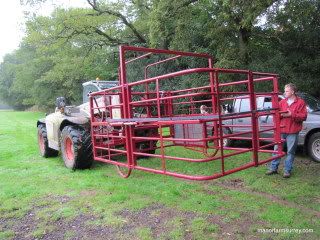
Our cattle catcher has been a real bonus during calving; positioned on the front of the Tele-handler the cage-like contraption is operated from the cab which eliminates the need for anyone to be on foot when catching an animal.
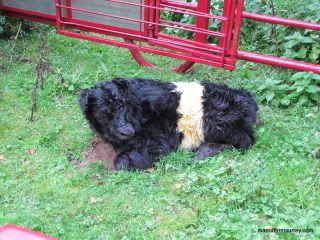
There’s a simple ‘crush’ to hold adult cattle and an inner cage designed to hold a calf steady during tagging whilst providing a safe area for us to work, protected from the mother.
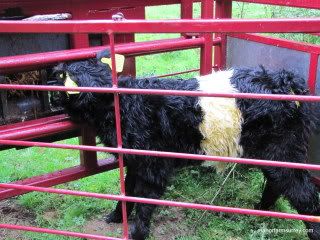
Just two days before this calf was born, I was checking on the cattle and the perimeter fence only to find two more Chinese lanterns.
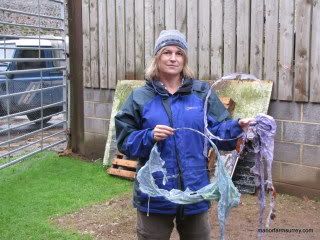
Both were the full wire version; a wire frame with two fine wire cross-pieces. These are terribly hazardous to wildlife and livestock and I hate to imagine the pain and suffering that may have been inflicted on our calves had they found the colourful paper and wire before I did. I was grateful for the rain that afternoon as the calves were curled up alongside their mothers rather than being playful and inquisitive as on a fine day.
The NFU is continuing to press for a ban on these lanterns which in basic terms cause mass littering of the countryside, but even more hazardous are crop fires and even a house fire in Germany where a small boy was killed. Some lanterns are marketed as 100% biodegradable all because the wire eventually oxidises, however in the meantime a post mortem has confirmed the death of a cow due to a lantern and wire has contaminated livestock feed in cut hay, silage and straw.
After a mass landing of lanterns in August across woodland, crops and cattle fields, we were later assured by the manager at Haley Conference Centre that future events would not be allowed to release lanterns at Wotton House. Let’s hope that others soon realise that Chinese lanterns, although very pretty as they float up into the night sky, are already causing high risk and life threatening situations.
Back