


 EDUCATIONAL VISITS Manor Farm is fully accredited by the Countryside Educational Visits Accreditation Scheme (CEVAS)
 THE FARM
Contact us for availability.

Archived News
30th July 2010
I have just returned from Wales where the temperature was at times, ten degrees lower than here and the grass was green and lush. In comparison our corner of England is suffering severe drought and the cattle have found very little grass for over a month. At this time of year with most cattle out ‘on grass’ the workload should be reduced, however without any rain to encourage new growth, we are having to feed the cattle with pea and bean nuts on a daily basis.
This began with Sam bagging up 40 – 50 bags of grub by hand and distributing the food to each field; a task that took him all day every day for a fortnight with just occasional help from Christopher.
Amanda is back off holiday and our boys are working on the farm now that they’ve broken up from school; I’m sure Sam is pleased with some extra help!
The situation has worsened and currently, one tonne of food needs to be moved to 22 locations every other day with a modified system. The back of the pick-up is filled with nuts using the tele-handler and as Amanda drives the truck into the fields, Sam and George shovel food out the back, making the job much more efficient.
Edward spent a week cleaning out the grain store at Raikes; brushing, scraping, sweeping and vacuuming the old dirt, grain and dust accumulated since the last grain was stored. One of the others helping for a couple of days was Tom Stotesbury whose own father, Peter worked for Fred when he was a lad and who went to school with Laurence.
It’s interesting to see how history repeats itself with generations of farmer’s sons starting to work on the farm over the summer, and sons of friends and neighbours doing the same.
Laurence began harvesting the winter rape last week but things haven’t gone smoothly, with four major break-downs already. The combine harvester wasn’t performing well the first day and Laurence discovered that the sieves hadn’t been cleaned out properly prior to harvest and that caused a four hour stoppage.
The following day a chain link broke less than five minutes after Laurence had got going, but it took over an hour to unblock the combine before the break was found.
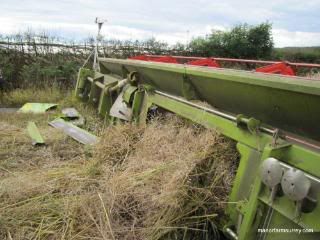
The 'header' or cutter bar is removed
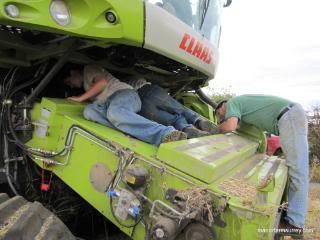
George, David and Laurence spend hours unblocking the combine.
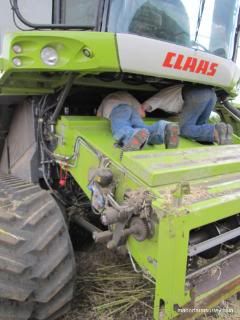
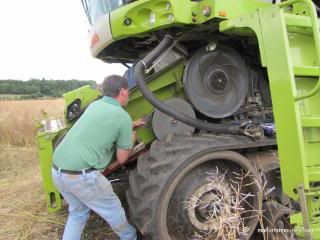
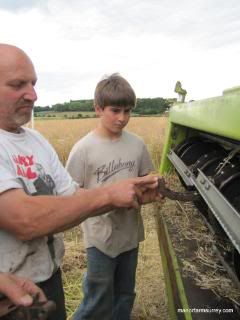
After the broken link was found the welding kit was brought out to the field to carry out repairs with a down time of four hours.
The other two stoppages have been due to the combine getting blocked up with rape, resulting in further arduous hours pulling the blockage free by hand.
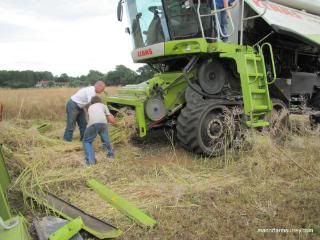
The first caused down time of three hours, but on Thursday Laurence had what he thinks might be his longest ever ‘blockage’ of six hours; a frustrating and stressful time.
As the oil seed rape ripens the pods become very sensitive and explode when disturbed, losing the seed to the ground.
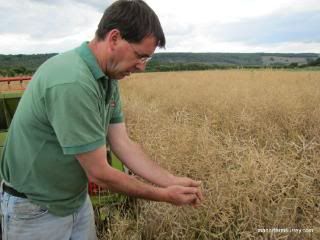
Checking the crop is fit to cut
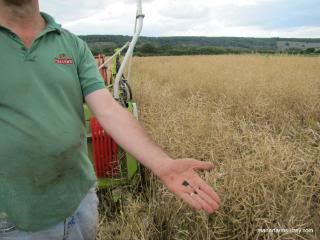
Once the crop is ready it must be harvested swiftly, even if the stems are still greener than the top of the crop, but it’s this that causes many of the blockages, particularly this year as Laurence is cutting the crop low to the ground in order to make rape straw.
The 300 acres of winter rape drilled in August ’09 should yield more than the spring rape which was drilled in April and will be harvested at the end of August. So far 150 acres of winter rape has been harvested, with a more even crop at Park Farm compared to the fields at Manor Farm. The remaining winter rape isn’t yet fit so last night the harvest moved over to wheat.
Gallant is a Class 1 milling wheat which is a relatively short variety, but probably shorter than it ought to be due to the lack of rain earlier in the growing season. As the straw is very short we’ll not have the number of straw bales we need coming off the fields. The wheat is coming off at about 3.4 tonne an acre which is not too bad for the soil we have here.
As the wheat is harvested this year, the outer 6m margin will be left un-harvested to provide food for wild birds over the winter months.
Back