


 EDUCATIONAL VISITS Manor Farm is fully accredited by the Countryside Educational Visits Accreditation Scheme (CEVAS)
 THE FARM
Contact us for availability.

Archived News
2nd July 2009
Our main beef herd arrive on the farm at about ten days old and stay for about two years; these are a mixture of females and castrated males which are not producing calves. The only breeding stock we have are the Belted Galloways, which are black at the front and rear end of the animal with a white band around its middle.
Over the next two months the Belted Galloways will be calving in a field at Raikes Farm, it is a fenced field beside which is a track and public footpath. A cow will naturally be protective towards her calf and so we advise visitors to the countryside not to linger on footpaths or by fences with cows and their calves nearby and certainly not to try entering the field to get a closer look.
Duchess, a pedigree Belted Galloway we purchased last year, gave birth this morning. I was hoping for a heifer calf which could also have been registered as pedigree and kept as future breeding stock. However the calf is male and therefore will be castrated and raised for beef and sold through my beef box scheme in about two and a half years.
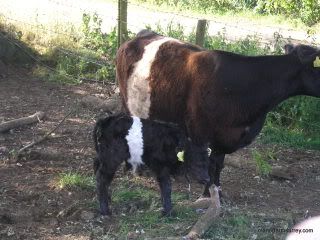
The calf needed to be tagged, so Luke drove out into the field and placed a feed ring over the calf which kept Duchess away long enough to allow Amanda to insert the tags. The ring was then lifted away, a good method for safely reaching a new born calf .
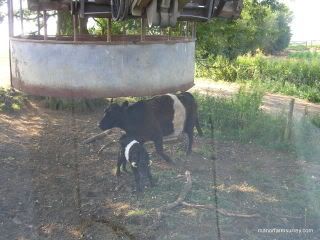
Photo taken from the cab as the ring is lifted away.
I have hired Waterbeck Willow, a bull from a Wiltshire farm who arrived today for about two months. Before the bull could be transported from the West Country he had to be TB tested and cleared. Willow will graze in the Rifle Ranges with cows and maiden heifers which cannot be served by Kempslade Harvey as he is their father.
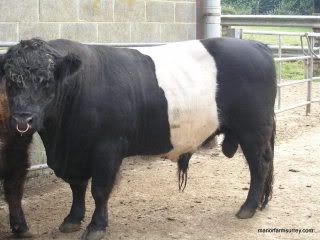
Waterbeck Willow
As Willow was arriving, everyone else was on the Downs fetching in the Galloways and bringing them back to the farm to be sorted into two groups; those cows going to the rifle Ranges with Willow tomorrow and the remainder returning to downland this afternoon.
I have spent some months gradually working on three interpretive ‘pop-up’ panels for the farm which have been supported by the Surrey Hills Sustainable Development Fund. The three titles are Arable, Our Cattle and Our Heritage.
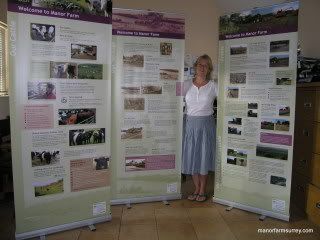
Like all these things, I start off with so much information and of course all my photos taken on the farm, then it has to be whittled down by the graphic designers in order to fit into the available space. Anyway, I am pleased with the final product which arrived on Monday and will be on display to school children tomorrow whilst they stop for lunch!
Cattle weighing, sorting and fly control has been a major task recently. Gathering the beef cattle into a temporary coral in the field and running them through the cattle crush with a weighing pad in the front section is never an easy task and it’s certainly a harder task for all those involved in this heat. The ear tags have to be read and recorded on paper at present but we are looking into an electronic system which would read the ear tag and store the information direct onto a computer, the information being immediately accessible back in the office.
David has been out spraying maize fields with herbicide at dawn and dusk over recent weeks, it cannot be sprayed during the day or the crop will be scorched in the sun.
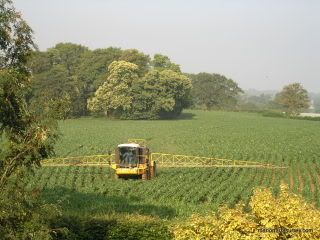
Spraying completed by 7.30 this morning - the day is already getting warm
Most of the linseed is in flower now, with the later sown fields only just beginning to bloom. The flowers are produced near the top of the stems, each being separately stalked: while the flowering period may last for some weeks, individual flowers are short-lived.
A beautiful sea of colour can be seen during daytime and then the flowers close again at night. Linseed flowers are commonly bright blue, but may be pale blue or white.
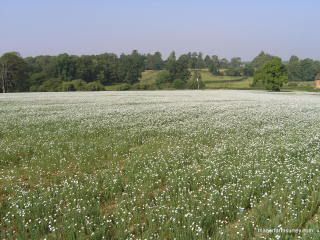
Now for a short technical burst: Nastic movements are non-directional responses to stimuli such as temperature, humidity or light irradiance.
Nyctinasty is the circadian rhythmic (24 hour) nastic movement of higher plants, in response to the onset of darkness. Examples are the closing of the petals of a flower at dusk and the sleep movements of the leaves of many legumes. The term 'higher plants' is used to describe flowering plants, whose reproductive structures are found in flowers and their seeds enclosed in fruits.
Linseed and oil seed rape are both insect pollinated and are popular with honey bees although the latter produces honey that crystallizes more quickly. It has been good to hear from our bee keeping friend Gavin about the comings and goings of his bees to our linseed in a nearby field and we look forward to hearing whether this produces a tasty Surrey honey.
Laurence has spent three days judging crops grown by farmers in Herefordshire and Hampshire and has today whizzed off to an NFU meeting in Brussels, ‘Pulses, Oilseeds and Cereals’ and intends to be home in time for a school visit tomorrow at 10am!! Never a dull moment!
What with a hired bull arriving, two fuel deliveries, making signs for a footpath, the hen house to clean and preparations for the school visit tomorrow, oh and a phone call to my private line because someone hadn’t got an answer in Laurence’s office (if he doesn’t answer, it’s because he isn’t there!), it has been one hot and bothered day. In between, I have been trying to jot down a few thoughts for this page and whilst doing so, received an email suggesting the site should be more up to date! I can only do so much folks!
Back