


 EDUCATIONAL VISITS Manor Farm is fully accredited by the Countryside Educational Visits Accreditation Scheme (CEVAS)
 THE FARM
Contact us for availability.

Archived News
13th March 2009
In preparation for this year’s educational school visits I have been updating my display boards, renewing photos and adding captions. Sam and William have cleared up the yard and we have prepared the old hay barn as the focal point for educational visits.
Yesterday we hosted 28 ten and eleven year olds from Kender Primary School, London. The school were on a two day visit to the Surrey Hills supported by the Sustainable Development Fund.
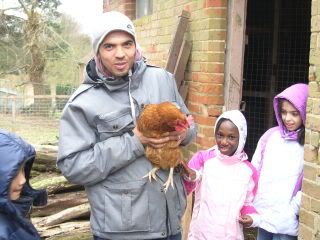
The majority of the children hadn’t visited a working farm before so there were plenty of new experiences to be had such as holding a hen or stroking their silky feathers and collecting eggs, still warm from laying.
The piglets were a big hit, as was meeting Percy the boar and stroking him until he lay down and rolled over!
As well as learning about livestock farming, we introduced the children to the food we grow. We had buckets of seed; wheat, oats, oil seed rape and maize which the children could touch, whilst Laurence briefly explained the many different field operations involved in growing. Then up to the field to look at The combine harvester.
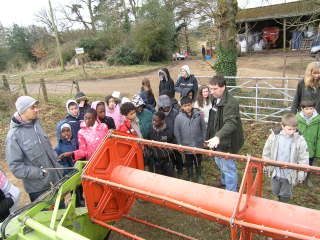
Then great excitement as the children stood back and watched Laurence start up the combine, raise and lower the cutter bar and swing out the unloading pipe.
It was a pleasure to meet Year 6; I hope they enjoyed their visit and have taken some good memories back to London.
It was just two weeks ago that I wrote about the ploughing, power harrowing, drilling and rolling of fields between West Lane and Crossways. To complete the field work in the 18 acres opposite the farmhouse, took in the region of 10-13 hours.
The cold weather has slightly delayed the wheat from chitting, but the emerging green shoots have been swiftly followed by a dark cloud of rooks descending on the field. About fifty of them are systematically working their way along the drill lines eating the tiny germ from within each seed. We have placed an automatic bird scarer and plastic bags on posts out in the field as it’s imperative to give the plants chance to establish.
Back