


 EDUCATIONAL VISITS Manor Farm is fully accredited by the Countryside Educational Visits Accreditation Scheme (CEVAS)
 THE FARM
Contact us for availability.

Archived News
17th October 2008
Con O’Kelly has started coppicing a Hazel shaw bordering the fields between West Lane and Crossways.
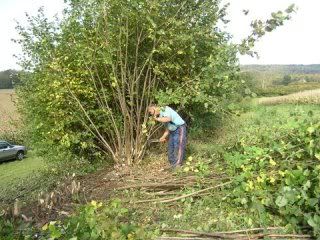
There are three areas of coppice we aim to get back into cycle over the next 14 years. Con has a plan of work which will see three areas divided into seven sections or coups.
The coups will be cut every 5-7 years according to the readiness of the stumps or stools to provide timber products. This is known as the coppice cycle.
The largest area of Hazel has not been coppiced for about 50 years and although it creates a habitat for wildlife, it is technically regarded as neglected coppice because the coppice has grown beyond it’s harvestable size.
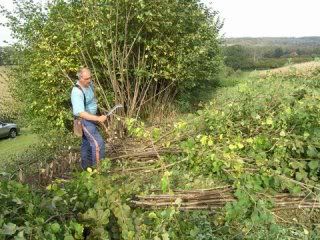
Active coppice management will breathe new life into these areas. As each coup is cut in rotation and is at a different stage of growth so a wider variety of habitats will be created, encouraging greater diversity of species.
As the coups re-grow, wildlife species which rely on the light and warmth of the early coppice cycle can move to nearby coups which have just been cut.
An area of older trees and dead standing trees will be kept as these also provide a valuable habitat.
Historically the produce from a Hazel coppice was used for thatching spurs, wattle and daub, hurdle making and firewood.
The initial area to be worked has about 100 hazel stools and Con expects to cut in the region of 50 over this winter.
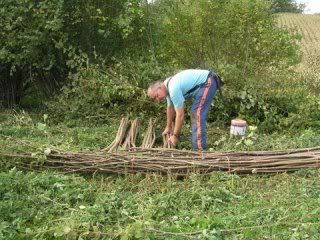
Any suitable pieces of straight timber will be kept as stakes ready for use in hedge laying. The thinner, long flexible stems will be used as binders to weave between the stakes at the top of the hedge.
Back